 Share:


From observing Earth from the Moon to sharing satellite data, space science showcases the value of international cooperation in advancing research and addressing global challenges.
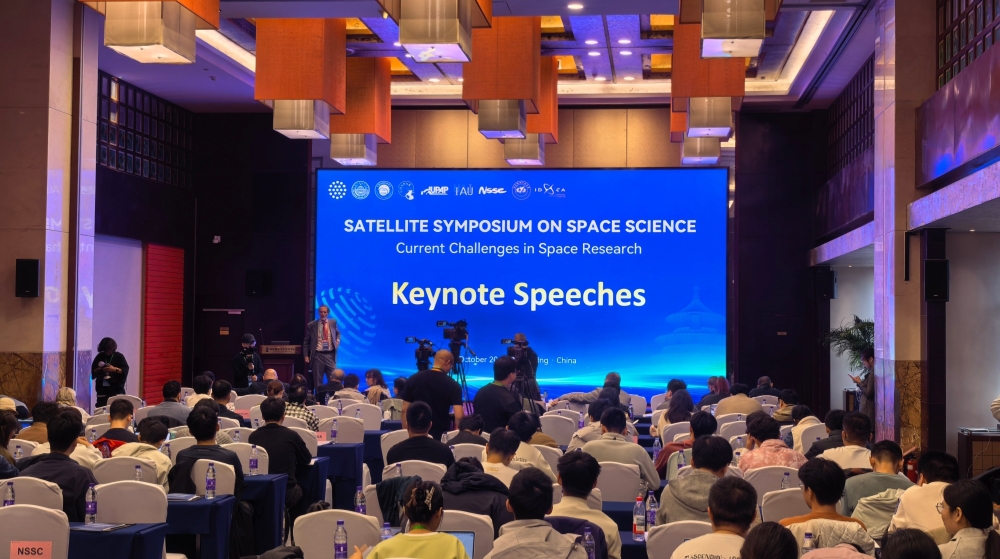
Guo Huadong, an academician of the Chinese Academy of Sciences (CAS) and a professor at the CAS Aerospace Information Research Institute, outlined the technical advantages and application potential of Moon-based Earth observation at the Satellite Symposium on Space Science in Beijing on Oct. 20.
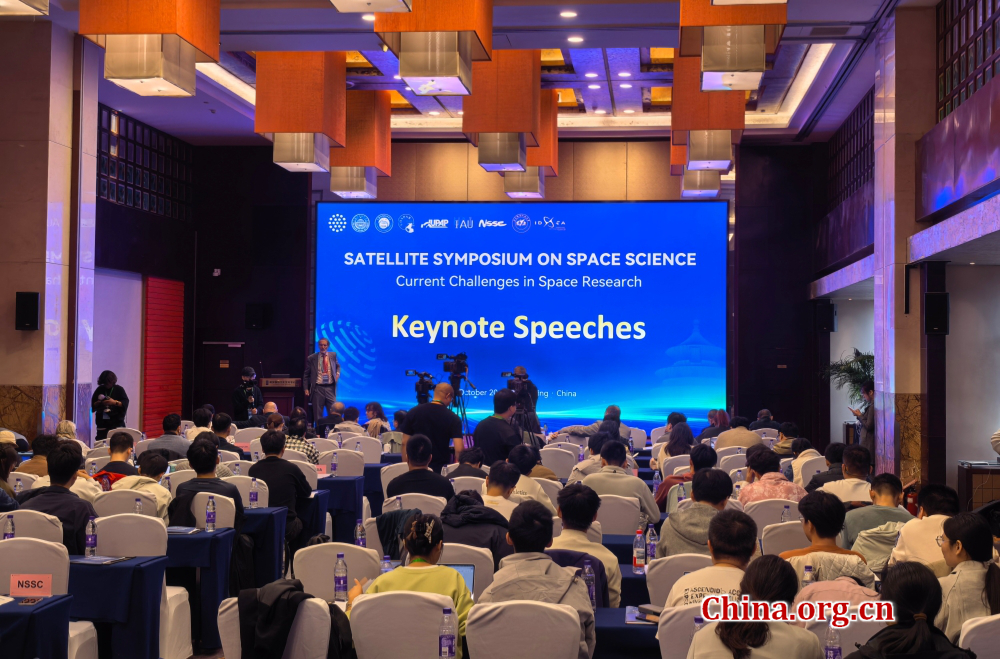
The Satellite Symposium on Space Science, part of the 2026 International Science Council (ISC) Midterm Members' Meeting and Beijing Science Dialogue, is held in Beijing, Oct. 20, 2026. [Photo by Mi Xingang/China.org.cn]
The symposium was one of the satellite symposia held as part of the 2026 International Science Council (ISC) Midterm Members' Meeting and Beijing Science Dialogue currently underway in Beijing. More than 160 experts, scholars and young researchers, representing over 20 international and domestic scientific organizations and research institutions, participated online and in person. Participants came from countries including the United Kingdom, France, Italy, India, Argentina, New Zealand, Kuwait and China.
Jointly organized by the Chinese Society of Space Research (CSSR), the Committee on Space Research (COSPAR), the International Union of Pure and Applied Physics (IUPAP) and the International Astronomical Union (IAU), the symposium focused on "Current Challenges in Space Research."
For Guo, Moon-based Earth observation offers a new way to study the planet. Unlike satellites that collect data along individual orbital tracks, a fixed platform on the Moon could provide a much broader view of the Earth, helping researchers observe large-scale environmental and geological processes. The Moon's long-term stability could also offer advantages for sustained observations.
Realizing this potential would require instruments capable of operating in the lunar environment, as well as solutions to challenges involving energy supply, data transmission and storage, Guo said in an interview after the symposium.
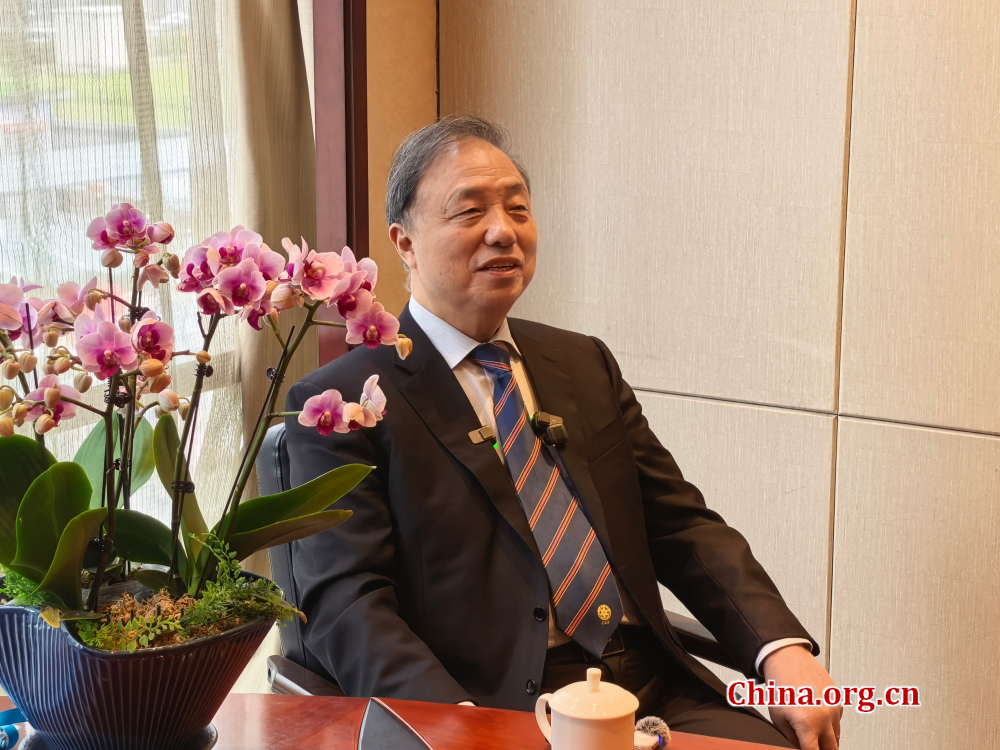
Guo Huadong, an academician of the Chinese Academy of Sciences (CAS) and a professor at the CAS Aerospace Information Research Institute, speaks in an interview at the Satellite Symposium on Space Science in Beijing, Oct. 20, 2026. [Photo by Mi Xingang/China.org.cn]
Guo noted that outer space is a shared resource and stressed the importance of cooperation among countries in its exploration and peaceful use. "International cooperation allows countries to pool their resources and capabilities," he added. For a project as complex as Moon-based Earth observation, cooperation could help bring together the technologies and research capacity needed to advance the work.
The value of collaboration extends beyond any single mission. Guo also highlighted the importance of sharing scientific data, particularly when it can help researchers address global challenges such as climate change and sustainable development.
He pointed to the international use of Chinese satellite data related to sustainable development as an example of how shared scientific resources can benefit researchers and users across different countries.
Data sharing, however, requires clear classification and management. Guo emphasized that scientific datasets, commercial products and information subject to security restrictions should be treated differently. Clearer policies, better management and safeguards for data owners' rights can help facilitate data sharing, he added.
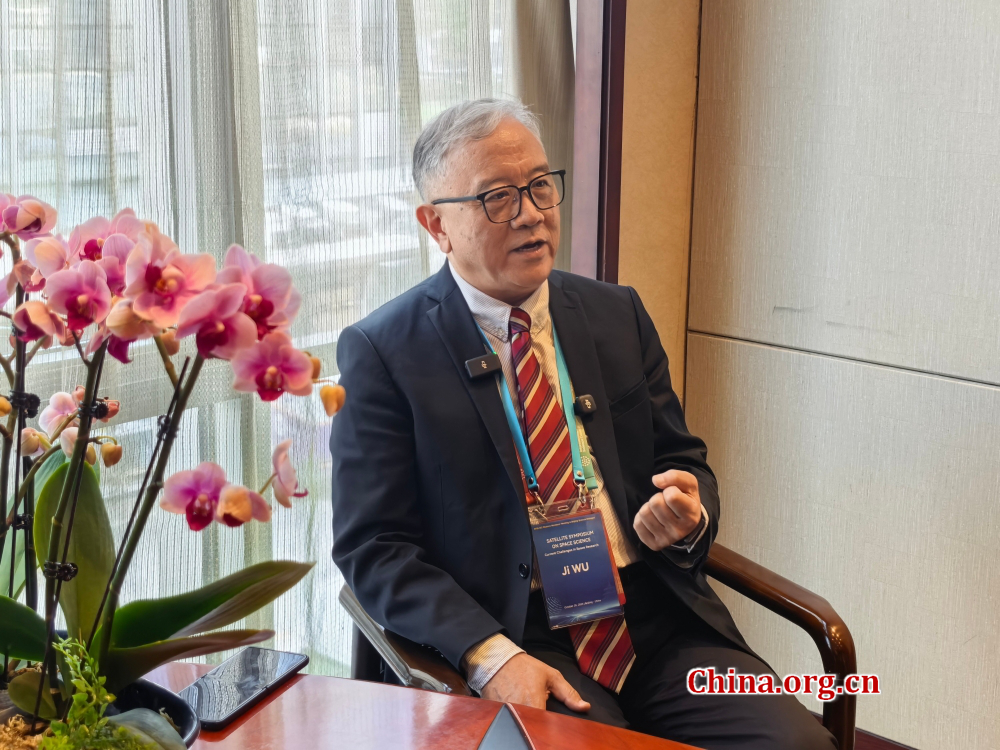
Wu Ji, honorary president of the Chinese Society of Space Research (CSSR), speaks in an interview at the Satellite Symposium on Space Science in Beijing, Oct. 20, 2026. [Photo by Mi Xingang/China.org.cn]
Wu Ji, honorary president of the CSSR, echoed these sentiments during an interview after the symposium. Because space research seeks to expand humanity's collective knowledge, Wu noted that cooperation can bring more researchers into the process of analyzing data and increase the reach of scientific findings. Countries and institutions can also pool investments and contribute different components of a project to achieve a shared research goal, he noted.
As humanity seeks to understand Earth more fully and explore farther into space, international cooperation remains an important way to combine scientific strengths and ensure that discoveries can contribute to knowledge beyond national borders.


 京公网安备 11010802027341号