 Share:


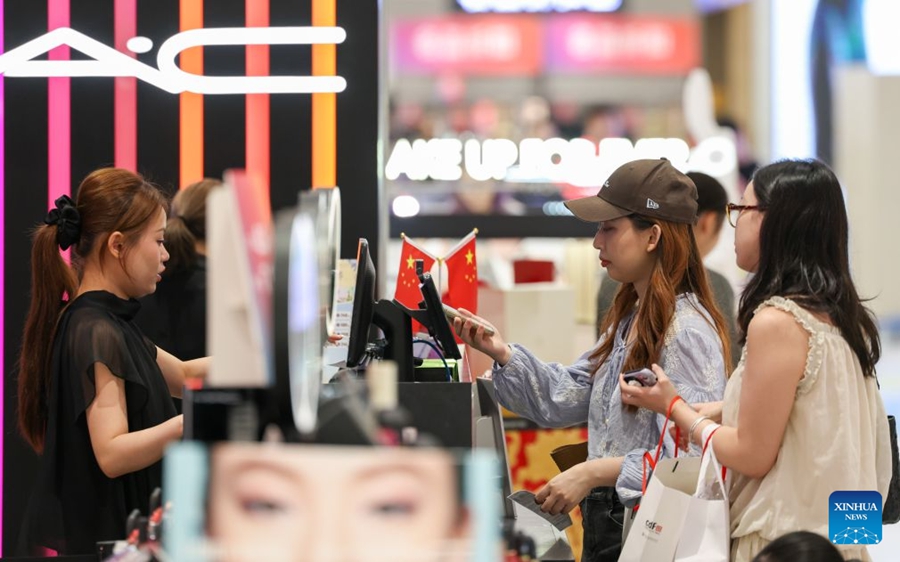
Customers pay bills at a duty-free shop in Haikou, south China's Hainan Province, Oct. 7, 2026. [Photo/Xinhua]
Imagine telling a friend that you have decided to chop off your hand. That would sound quite alarming. What terrible accident had occurred? What desperate circumstances could have led you to such a decision?
But suppose you were speaking Chinese, and the conversation was about the irresistible pair of shoes you had just ordered online. Your friend might simply laugh and admit that they were thinking of doing the same thing.
Welcome to the wonderfully dramatic world of Chinese internet slang.
The Chinese expression 剁手 (duò shǒu), literally "chop off the hand," is a humorous way of indicating that one has shopped excessively, particularly online, and finds it practically impossible to resist buying more. The logic is simple enough. Your hand keeps clicking, buying things you probably don't need. You promise yourself that this time you will be strong, but then another irresistible bargain appears, your finger moves toward the screen and another package is on its way.
Clearly, something must be done about that troublesome hand.
The term has become almost as prevalent as China's online shopping platforms themselves. From 剁手 comes 剁手党 (duò shǒu dǎng), a playful label for people who share this particular weakness. The character 党 (dǎng), meaning party or faction, is frequently used in Chinese internet language to identify groups of people with a common habit, preference or characteristic. Members of the 剁手党 are enthusiastic shoppers who recognize themselves, and perhaps one another, in the joke. A related expression, 剁手族 (duò shǒu zú), uses 族 (zú), meaning a group or tribe, to describe much the same phenomenon.
What makes these expressions especially entertaining is their self-deprecating quality. Calling yourself a member of the 剁手党 is an admission that you have once again surrendered to temptation, but it does so in a way that makes the admission amusing rather than embarrassing. You might regret your latest purchase, but at least you are in good company.
Chinese internet language has another expression that fits neatly into this little drama: 吃土 (chī tǔ), literally "eat dirt." It is a humorous way of describing being broke, often after spending too much money. Having enthusiastically purchased everything that caught your eye, you now face the prospect of surviving on dirt until your next payday.
First you chop off your hand to prevent further shopping. Then you eat dirt because you have already spent all your money. Together, these two images create a wonderfully comic account of a very ordinary human experience.
Interestingly, English has its own collection of expressions for excessive or emotionally motivated shopping, but the images and attitudes they convey are rather different. Instead of cutting off your hand, in English we "cut up your credit cards." This is probably the closest English expression to the physical drama of 剁手. Someone who has spent too freely might decide that the only solution is to take a pair of scissors to their credit cards, making further purchases more difficult. Both expressions imagine drastic action to regain control of spending, but there is a revealing difference in where the action is directed. In the English expression, the problem is the card. In the Chinese expression, the problem is the hand holding the card.
English also has its "retail therapy," which presents shopping in an entirely different light. Perhaps you have had a difficult day at work, an argument with a friend, or simply a disappointing week. Buying something new might lift your spirits. You go shopping, not necessarily because you need anything, but because the experience itself offers a little comfort. The word "therapy" makes the activity sound restorative. Shopping becomes a remedy for unhappiness, or at least a temporary escape from it.
Compare that with 剁手. Both expressions can describe someone buying things for emotional satisfaction. But one presents the activity as a form of relief, while the other emphasizes the shopper's irresistible urge to keep clicking.
The difference becomes even more interesting when contrasted with the English phrase "spending spree." A spree suggests a burst of energetic, uninhibited activity. Someone on a spending spree may be buying far more than usual, perhaps recklessly, but the expression can also convey excitement and pleasure. There is something almost celebratory about it. A "shopping binge," by contrast, places more emphasis on excess. Like binge eating or binge watching, it suggests doing something in unusually large quantities, perhaps beyond the point of good judgment. Neither expression quite captures the image of a shopper looking accusingly at their own hand and wondering how to prevent it from making another purchase, but they offer their own humorous perspectives on the shared malady of overspending.
Translating a phrase like 剁手 involves more than finding words that describe the same behavior. It also requires attention to the humor, emotional associations and attitudes carried by those words. Slang is especially difficult, because it often relies on exaggeration, humor and shared experiences. Its meaning comes not only from the words themselves, but also from the attitudes that speakers bring to them.
Of course, Chinese shoppers are not uniquely concerned about self-control any more than English speakers are uniquely inclined to regard shopping as therapy. People everywhere experience the pleasure of buying something new, the temptation of a bargain and the occasional buyer's remorse that follows.
Similarly, there is no single expression that represents an entire culture's attitude toward consumption. Chinese speakers can joke about shopping as a pleasure, just as English speakers can describe it as a dangerous habit. What differs is the particular image each expression offers. Language gives us different ways to laugh at the same familiar weakness.
And of course, this is an especially appropriate time to become acquainted with the 剁手党. November 11 is approaching, bringing with it China's highly anticipated Double 11, or Singles' Day, shopping festival. The date, 11/11, has become closely associated with online promotions, special offers and the temptation to buy just one more thing.
For anyone already inclined to join the 剁手党, the coming days may present a serious test of willpower. Perhaps the safest preparation is to delete the shopping apps, avoid looking at advertisements and tell yourself that you really don't need anything else.
Or perhaps you should simply keep your hands where you can see them.
Shelly Bryant is a writer and culture & communication consultant living in Singapore and China's Shanghai.
Opinion articles reflect the views of their authors, not necessarily those of China.org.cn.


 京公网安备 11010802027341号