 Share:


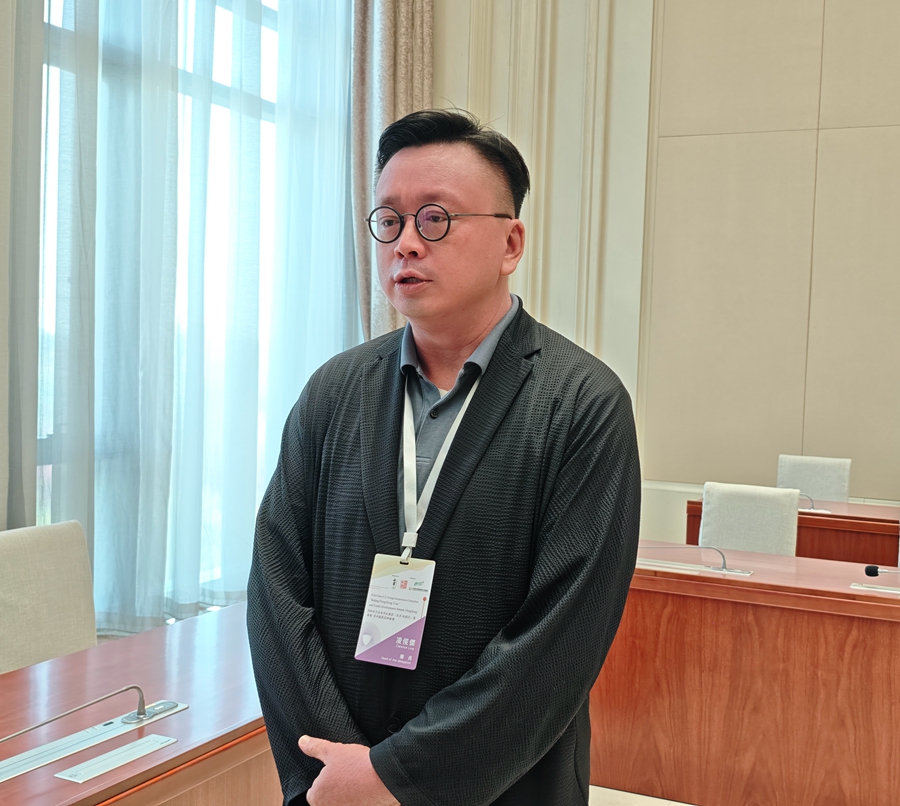
Clarence Ling Chun-kit, a member of the National Committee of the CPPCC and founding chairman of the Hong Kong-based Chinese Young Entrepreneurs Association, speaks with China.org.cn during the 2026 China-U.S. Young Entrepreneurs Delegation Beijing-Hong Kong Tour in Beijing, Nov. 3, 2026. [Photo courtesy of the Chinese Young Entrepreneurs Association]
Hong Kong can serve as a two-way bridge for Chinese and U.S. young entrepreneurs, helping them build trust and turn business opportunities into tangible cooperation, said Clarence Ling Chun-kit, a member of the National Committee of the Chinese People's Political Consultative Conference (CPPCC).
The 2026 China-U.S. Young Entrepreneurs Delegation Beijing-Hong Kong Tour runs from Oct. 31 to Nov. 8. Organized by the Hong Kong-based Chinese Young Entrepreneurs Association and led by Ling, its founding chairman, the program responds to China's initiative, announced this year, to invite 100,000 young Americans to the country for exchanges and study over the next five years.
In an interview with China.org.cn, Ling said the program offers American entrepreneurs an opportunity to gain firsthand insights into China, explore its market and identify potential partners.
The association organized the first two editions in 2024 and 2025.
"Young entrepreneurs are different from ordinary young people participating in cultural exchanges. When they come to China, they not only want to experience its culture and broaden their horizons but also have specific questions about supply chains, markets and technological cooperation," Ling said.
By getting a true, multidimensional view of China firsthand, American participants can return home with not only stories about the country but also concrete ideas for cooperation, he said.
"Trust built on genuine understanding and shared interests is much stronger than that based solely on media reports," Ling added.
Short-term exchanges are about breaking the ice and planting seeds, Ling said, but turning initial encounters into long-term partnerships requires regular exchanges and institutional mechanisms.
The association plans to develop the program into a flagship initiative, expand it to more cities and introduce specialized discussions, including roundtables on AI and forums on green and low-carbon development.
Ling also stressed the need to encourage past participants to bring business partners and friends to future exchanges.
In the short term, he hopes the program will help bridge information gaps and challenge outdated perceptions of China. Over the longer term, he expects it to create opportunities in science and technology, trade and investment.

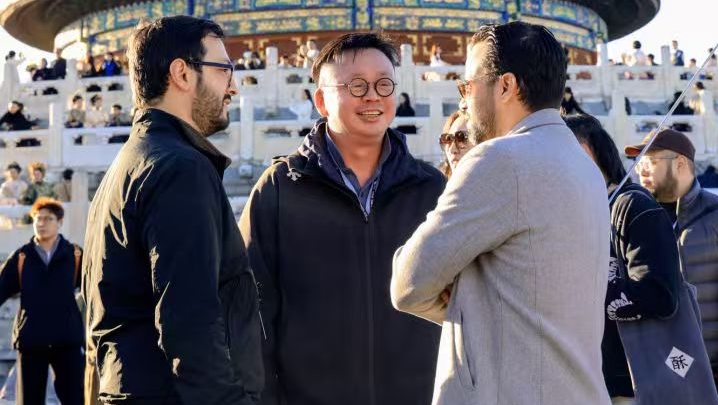
Clarence Ling Chun-kit chats with American entrepreneurs at the Temple of Heaven Park in Beijing, Nov. 1, 2026. [Photo courtesy of the Chinese Young Entrepreneurs Association]
Ling said Hong Kong offers a distinctive environment for entrepreneurship, underpinned by its international financial system, mature professional services and global networks.
He encouraged young entrepreneurs to pair these strengths with the Chinese mainland's industrial and supply chains, manufacturing capabilities and market scale.
Ling described Hong Kong's role in China-U.S. youth cooperation as a "two-way bridge." He said the city can help American entrepreneurs better understand the Chinese market and connect their projects with the manufacturing ecosystem of the Guangdong-Hong Kong-Macao Greater Bay Area, while also serving as a gateway for Chinese entrepreneurs looking to expand overseas.
Despite differences in their business environments, young entrepreneurs from China and the United States face many similar challenges, Ling said.
Both need markets, orders, supply chains, capital and talent. They also seek to translate technological innovation into practical applications while navigating regulatory requirements and uncertainties in cross-border operations.
These shared needs provide a foundation for cooperation, he said.
Ling identified AI applications and robotics, new energy vehicles and intelligent mobility, cross-border e-commerce, and cultural and creative industries as areas with strong potential for mutually beneficial cooperation.
He also sees opportunities in green and low-carbon development, healthcare technology and professional services.
Ling advised entrepreneurs to adapt their products and marketing strategies to local markets, understand different business cultures and prioritize compliance. He also recommended starting with small-scale trials before expanding cooperation.
"What is most worth cherishing is the courage of young entrepreneurs from the two countries to seek common ground amid differences and turn that shared understanding into practical cooperation," Ling said. "Trust built through mutual understanding and friendship is the most precious asset."


 京公网安备 11010802027341号