 Share:


The China Institute for Marine Affairs released a report Thursday at World Ocean Week in Xiamen, Fujian province, detailing how Chinese diplomacy, deep-sea science and South-South cooperation helped bring the U.N. high seas treaty into force.
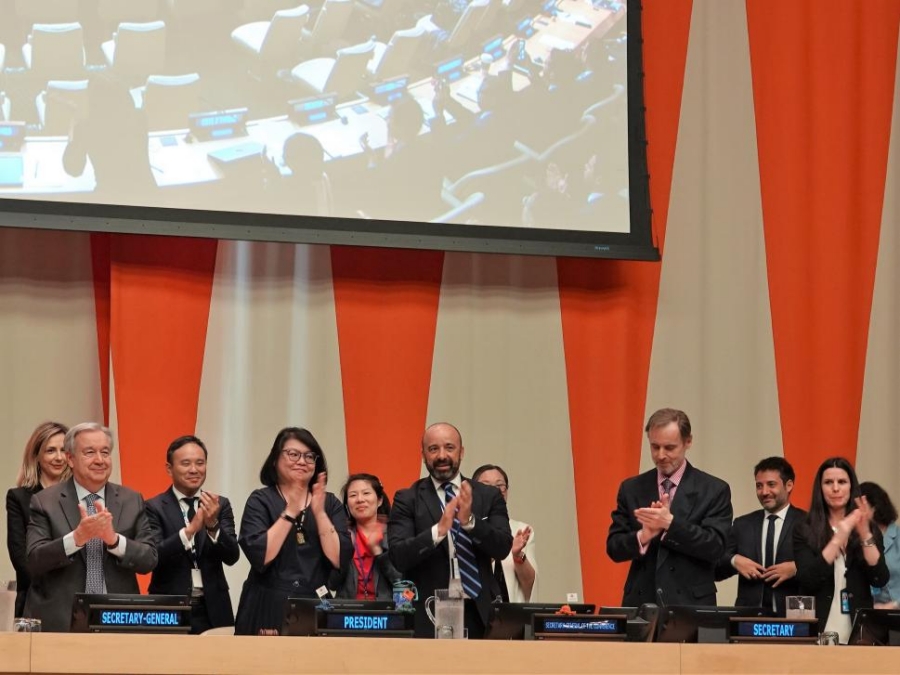
The BBNJ Agreement is adopted in New York, June 19, 2023. [File photo courtesy of the China Institute for Marine Affairs]
On Jan. 17, 2026, the Agreement under the United Nations Convention on the Law of the Sea on the Conservation and Sustainable Use of Marine Biological Diversity of Areas beyond National Jurisdiction entered into force.
Known as the BBNJ Agreement, it is the third implementing agreement under the United Nations Convention on the Law of the Sea (UNCLOS), and it covers the high seas and the international seabed area — about two-thirds of the global ocean.
For the first time, those waters have a legal framework built on four pillars: marine genetic resources (MGR), area-based management tools (ABMTs) including marine protected areas, environmental impact assessments (EIA), and capacity-building and the transfer of marine technology.
The report calls the agreement a landmark achievement of multilateralism and a major milestone in the international law of the sea.
Getting there took nearly 20 years. The negotiations moved through a working group from 2006 to 2015, a preparatory committee from 2016 to 2017 and an intergovernmental conference from 2018 to 2023. The agreement was adopted by consensus on June 19, 2023.
China took part at every stage, submitting proposals on all four pillars and helping developing countries build the capacity to implement the agreement.
On MGR, it pushed to uphold the UNCLOS principle of the common heritage of mankind and to create a mechanism for sharing both monetary and nonmonetary benefits. On ABMTs, it argued for balancing conservation with sustainable use, respecting national sovereignty and setting clear procedures to avoid creating paper parks — protected areas that exist in name only. On EIA, it supported greater transparency and consistency with existing international rules. On capacity-building, it backed a country-driven approach and the use of the Clearing-House Mechanism to match countries' needs with available support.
The report points to China's scientific platforms as practical tools for sharing benefits. China operates the crewed submersibles Jiaolong and Fendouzhe and research vessels including Shenhai Yihao (Deep Sea No. 1), and has brought partners from Bangladesh, Nigeria, Colombia, Mexico, Indonesia, Egypt and Mauritius on joint research cruises.
Through the Marine Culture Collection of China and the China National Center for Bioinformation, China has preserved nearly 60,000 marine microbial samples and opened the samples and data to international users.
On conservation, China has designated about 150,000 square kilometers of sea as ecological conservation red line areas, where development is tightly restricted. It has also set up 353 marine protected areas and carried out 194 major marine ecological restoration projects, and it is one of the few countries where mangrove cover has grown.
China leads 10 international scientific programs under the U.N. Decade of Ocean Science for Sustainable Development, including Digital Deep-sea Typical Habitats, which was launched by 64 institutions from 39 countries.
China also has hands-on experience with EIAs for deep-sea activities. It has steadily strengthened its laws governing EIAs in the international seabed area, and its seabed mineral exploration contractors have carried out the environmental impact assessments required of them. With its environmental data, technical expertise and trained personnel, China is well-positioned, the report says, to help developing countries conduct deep-sea EIAs and to make ocean activities greener and lower-carbon.
China has built a South-South cooperation network. It has signed marine cooperation agreements with more than 50 countries and international organizations, jointly established more than 40 marine research centers and laboratories, and invested about 200 million yuan ($30 million) in more than 100 small-scale marine cooperation projects.
More than 300 training courses have reached more than 6,000 young scholars and officials from developing countries. China also uses the China-ISA Joint Training and Research Center and forums such as World Ocean Week in Xiamen and the China-Island Countries Ocean Cooperation Forum to keep those exchanges going.
The report notes that more than 100 parties had joined the agreement by October 2026. The first Conference of the Parties will meet in January 2027 to adopt rules of procedure and decide where the secretariat will be based and how it will operate.
China was among the first countries to sign and join the agreement and has applied to host the secretariat in Xiamen. It hopes to put its ocean governance experience, scientific capacity, cooperation resources and host-country support to work for all parties.
The report concludes that China has the will and the means to support the agreement's full and effective implementation and to help spread its benefits across the international community.


 京公网安备 11010802027341号