 Share:


The Institute for Ocean Rule of Law at Zhejiang University and Greenpeace East Asia released a study at World Ocean Week in Xiamen on Nov. 11, setting out how the U.N. High Seas Treaty, also known as the BBNJ Agreement, could put its marine protection rules into practice.
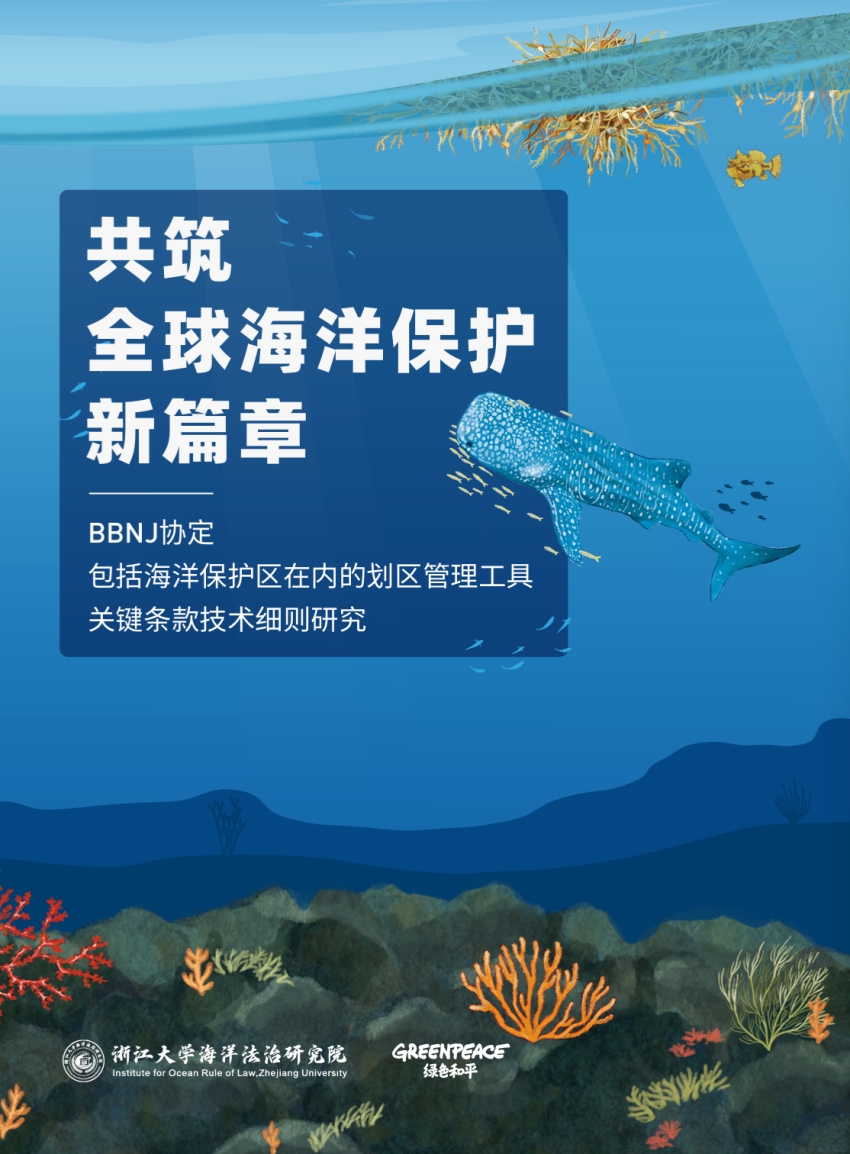
The cover of a report released by Greenpeace East Asia and the Institute for Ocean Rule of Law at Zhejiang University. [Image courtesy of Greenpeace]
The study, "Building a New Chapter in Global Ocean Protection Together: A Study on the Technical Details of Key Provisions on Area-Based Management Tools, Including Marine Protected Areas, Under the BBNJ Agreement," is a research output under the collaboration project between Zhejiang University's Guanghua Law School and Greenpeace East Asia. It examines how the treaty's area-based management tools, including marine protected areas, should be designed and run.
The BBNJ Agreement, officially the Agreement under the United Nations Convention on the Law of the Sea on the Conservation and Sustainable Use of Marine Biological Diversity of Areas beyond National Jurisdiction, was adopted on June 19, 2023, and entered into force on Jan. 17, 2026.
It rests on four pillars: area-based management tools such as marine protected areas; marine genetic resources and benefit-sharing; environmental impact assessments; and capacity-building and marine technology transfer. The first Conference of the Parties is scheduled for Jan. 11-22, 2027, at the U.N. headquarters in New York.
Shi Yubing, a professor and vice dean of Guanghua Law School and executive dean of the Institute for Ocean Rule of Law at Zhejiang University, presented the research at the 2026 annual meeting of the China Marine Protection Alliance and announced its release at World Ocean Week.
He said the BBNJ Agreement gives China a valuable opportunity to play a bigger role in global ocean governance. China can contribute further by stepping up research on the scientific and legal questions involved and by helping build a network of BBNJ marine protected areas that is ecologically representative, well connected and provides high-level protection, he added.
The report notes that China was among the agreement's first parties when it entered into force. In 2026, China also submitted its first proposal for a high-seas marine protected area, in East Antarctica's Cosmonaut Sea, to the Commission for the Conservation of Antarctic Marine Living Resources. To prepare a proposal under the agreement, the report recommends that China speed up groundwork, do more to identify candidate sites and build up data, help draft the treaty's first technical rules, and select candidate regions early. It also calls for better coordination among government departments and international bodies and closer cooperation with other parties.
On the rules themselves, the report calls for a closed-loop process, from proposal through review, that balances quality with efficiency. For the proposal stage, it lists 13 core elements for a draft management plan, built around a cycle of objectives, measures, monitoring and review. For implementation, it proposes a division of labor: the Conference of the Parties makes overall decisions, the secretariat provides information, parties carry out the work, and scientific and technical bodies conduct regular reviews.
The report stresses that detailed rules should help build the marine protected area network without creating new hurdles. To deal with scientific uncertainty, fragmented institutions and a lack of sustainable long-term funding, it recommends evidence standards suited to different circumstances, a mechanism for coordination between agencies and funding from multiple sources, along with capacity-building support for developing countries.
In the report's preface, Ma Keping, an academician of the Chinese Academy of Sciences, wrote that as China's capabilities in deep-sea research expeditions, marine ecological monitoring and international ocean cooperation grow, an important task will be translating its scientific groundwork into a greater role in making and implementing international rules.
Zhou Wei, oceans project manager at Greenpeace East Asia, said the ocean is under mounting pressure from overfishing, pollution and climate change and needs protection that genuinely works. The BBNJ Agreement already provides an important tool, Zhou said, and countries now need to work together to turn protection on paper into protection in practice. That means speeding up the creation of fully and highly protected marine areas, ensuring they are actively managed through effective measures, and giving marine life enough room to recover so that marine ecosystems stay healthy and resilient.


 京公网安备 11010802027341号