 Share:


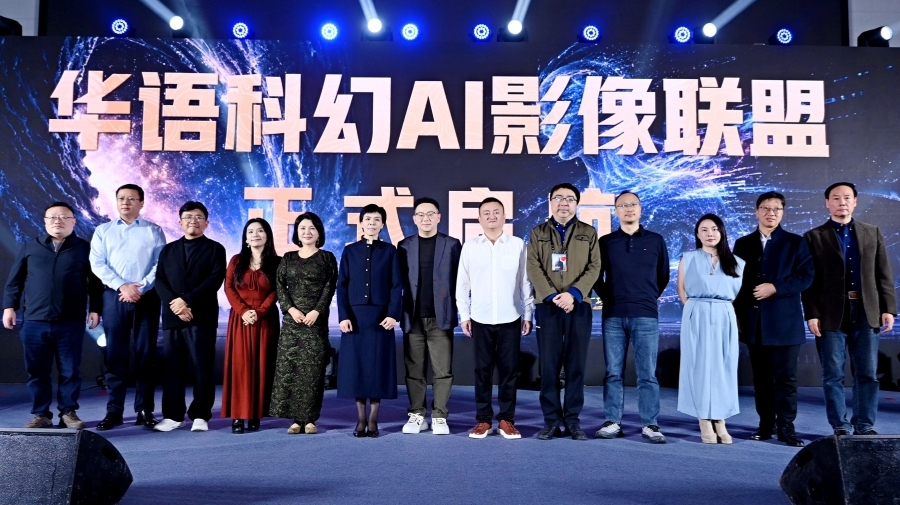
The Chinese Science Fiction AI Visual Alliance, set up to bring Chinese sci-fi to the screen with AI, launched in Chengdu, Sichuan province, on Nov. 14, unveiling its first four projects before more than 300 writers, screenwriters and industry figures.
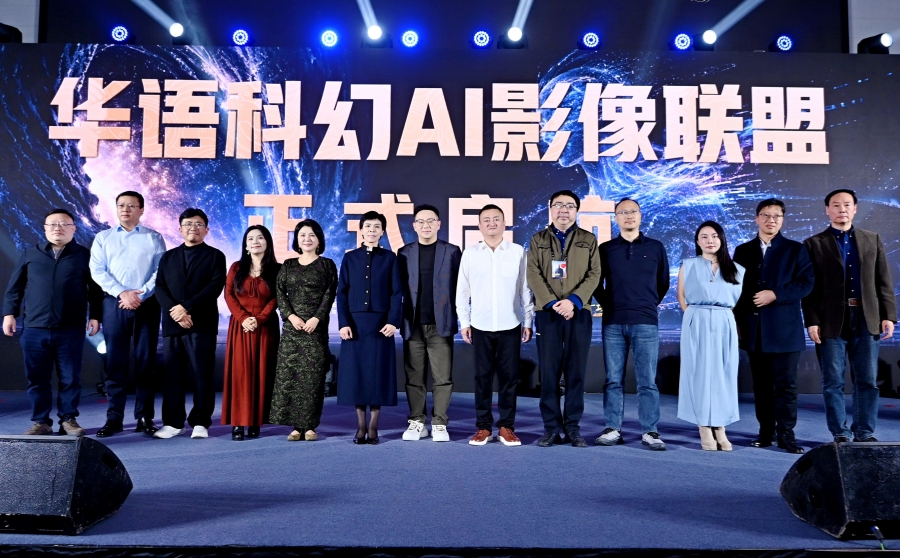
Executives from partner companies and authors of the works being adapted pose at the launch of the Chinese Science Fiction AI Visual Alliance in Chengdu, Sichuan province, Nov. 14, 2026. [Photo courtesy of EV/SFM]
The launch comes after two decades of industrial growth for Chinese science fiction. Since the genre's third wave, marked by Liu Cixin's "The Three-Body Problem," sci-fi has grown from niche reading into mainstream culture, bringing intellectual property, capital, talent and technology onto one industrial track. Hainan Eternal Vision Science Fiction Media (EV/SFM), a long-standing supporter of the Chinese Nebula Awards, has accumulated and represented the rights to 81 sci-fi works over more than a decade.
Gan Weikang, president of EV/SFM and vice chair of the Nebula Awards organizing committee, said the launch was the result of "10 years of steady work, with our original aspiration unchanged." He noted that Chinese sci-fi draws on Chinese civilization to imagine the future and serves as a vivid cultural calling card for China. But what this two-decade wave had lacked, he said, was a reliable bridge to turn written fiction into moving images, a gap the alliance was created to fill.
Founded jointly by EV/SFM, Beijing Flying Youth Culture Media and Perfect World Pictures, the alliance aims to build a complete pipeline covering story development, visual production, technical support and funding. EV/SFM provides the IP and a base of original writers; Flying Youth brings together top screenwriters, directors and producers to adapt the stories for the screen; and Perfect World Pictures contributes AI tools and investment to lower the cost barriers that have long held back effects-heavy sci-fi.
"Film is the vessel, and story is the foundation," said Zeng Yingxue, senior vice president of Perfect World Co. and head of Perfect World Pictures. She said what truly moves audiences and stands the test of time is always good stories, good characters and good emotions.
The more technology advances, the more the depth of story and warmth of emotion must be protected, Zeng said. She added that Chinese sci-fi works once held back by technology and cost now have a chance to reach the screen.
Wu Yan, a sci-fi writer and scholar, professor at Southern University of Science and Technology and co-founder of the Chinese Nebula Awards, described AI as a creative aid.
"AI is not replacing creators, but opening up a brand-new territory of expression for us," he said. He added that he hoped the alliance would "use images as the boat and AI as the sail" to craft contemporary Chinese sci-fi stories.
Liang Zhenhua, the alliance's artistic director, said screenwriting is the vital link between literature and screen. He leads a mentor group of screenwriters including Zhang Wei, Yuan Zidan, Yu Xiaoqian and Hu Yating, who will lend their experience to screen adaptations of sci-fi IP. The alliance will also work with the Youth Committee of the China Television Drama Production Industry Association to solicit creative ideas from screenwriters, directors and AI teams nationwide.
Four works make up the first development roster: He Xi's "Doomsyear," Jiang Bo's "48 Hours: South China Sea," Cheng Jingbo's "Lampspark: Legend of the Dragon" and Xiao Xinghan's "The Heterotopian Quartet of Chongqing." Shi Yi, vice president of EV/SFM, announced the projects. Shi said the four authors come from different generations and their works vary widely in style, so developing them side by side is an experiment in itself.
The alliance aligns with China's push for new quality productive forces and the "AI Plus" initiative. Sci-fi is one of the most visually demanding genres to film, which makes it a natural testing ground for AI. "While AI now touches every production stage, the industry is shifting from competing on production capacity to polishing quality works," Gan said.
The alliance's plans extend beyond AI-generated content (AIGC), with live-action series, animation and games listed as key avenues. It opened its call for submissions in Beijing in October, and the Chengdu launch carries that work forward.
AI has been a central theme of the 2026 Nebulacon, held Nov. 13-15 in Chengdu, with AIGC projects on display alongside presentations and discussions on how science fiction publishing should adapt in the AI era.
Gan stressed that AIGC is the most powerful booster of human imagination, though not the endpoint of creation.
"New technology has broken the boundaries of text, image and visual creation, turning bold Eastern imagination into frames that can be seen and felt," Gan said. "But while technology serves as the vessel, the humanistic spirit is the soul. Chinese science fiction in the new era must take technology as its wings, culture as its roots and thought as its soul."


 京公网安备 11010802027341号