 Share:


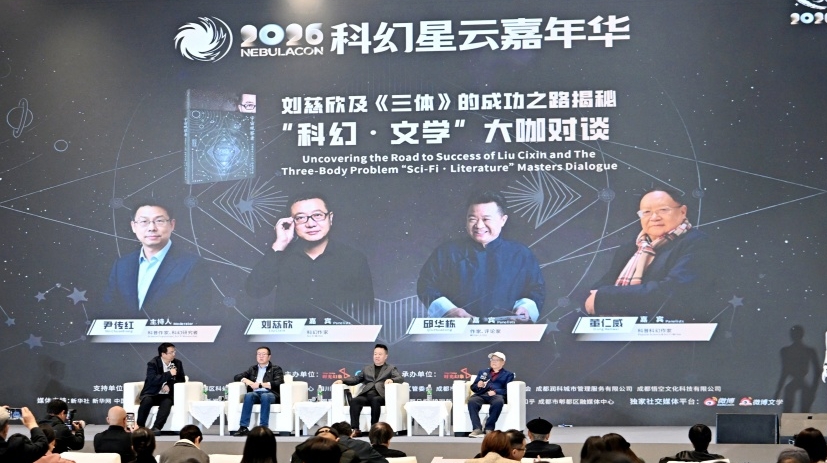
The global launch of the new book "Cosmic Observer: The Road to Success of Liu Cixin and 'The Three-Body Problem'" at the 2026 Nebulacon in Chengdu, Sichuan province, on Nov. 14 brought together writers Liu Cixin, Dong Renwei and Qiu Huadong for a conversation on why one of the world's most celebrated sci-fi sagas resonates so widely.
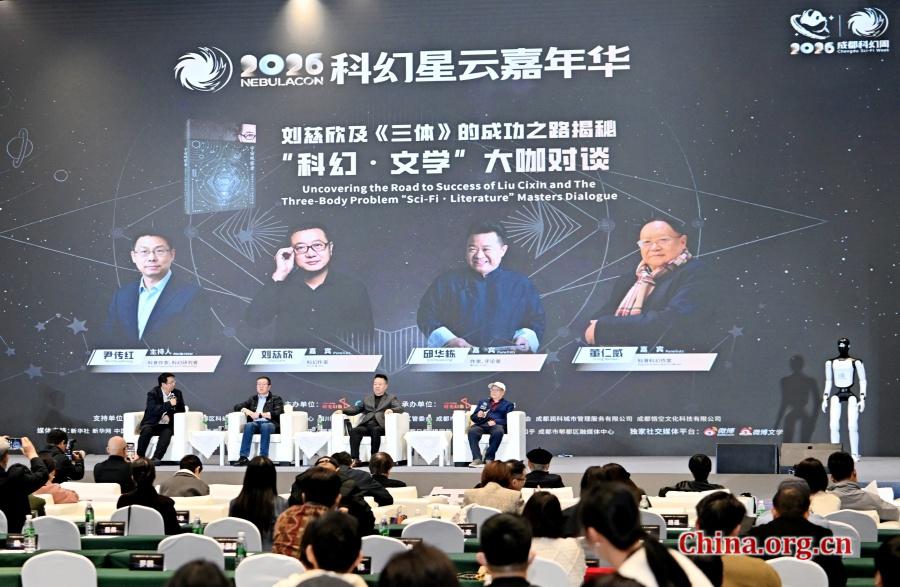
Moderator Yin Chuanhong and writers Liu Cixin, Qiu Huadong and Dong Renwei speak at a panel during the 2026 Nebulacon in Chengdu, Sichuan province, Nov. 14, 2026. [Photo/China.org.cn]
The 120,000-word book, published by the Writers Publishing House, was co-written by 84-year-old Dong Renwei, a prominent figure in Chinese popular science and sci-fi, and his son Dong Jing, a sci-fi event organizer. Billed as the most thorough portrait yet of Liu's growth and creative evolution, it draws on the senior Dong's repeated interviews with Liu since his 2012 critical biography of the writer.
In "Cosmic Observer," Dong Renwei, a co-founder of the Chinese Nebula Awards, argues that Liu's success rests on his naturalistic vision of science fiction.
He also highlighted the work's inventive worldbuilding and thought-provoking lines. The first volume of "The Three-Body Problem" alone features more than 100 original concepts, and its quotes have spread beyond genre circles into wider public discourse. He added that the momentum of the times also contributed, including the Hugo Award, support from celebrities and scholars, policy, media, China's tech development, and the popularity of the film and TV adaptations of "The Wandering Earth" and "The Three-Body Problem."
"But the value of the work itself is the foundation of all success," Dong told the audience.
He explained that mainstream literature revolves around human nature, anchored in the belief that "literature is the study of humanity." Liu's science fiction, by contrast, centers on science, framing the eternal theme of the genre as humanity's relationship with nature. To Liu, the universe is an "eternal Eden," worthy of human awe and curiosity. This sensibility extends the literary tradition of 19th-century naturalism, pushing it into a 21st-century "new naturalism."
"Science fiction thinking differs from scientific thinking," Dong said. While popular science communicates established scientific theories, science fiction roams freely within the bounds of scientific logic, drawing its literary power from the beauty of nature and science. He said that insight grew out of 16 years of listening to Liu.
In their first interview in 2011, Liu told him, "I don't focus on people, only on science." In 2025, Liu offered a more layered view of the genre, saying that although sci-fi has long been classed as genre literature, it differs from other genres because it can more directly reflect the development of the technological age, which he called the mission of serious literature.
Asked about the naturalistic label attached to his writing, Liu acknowledged the link. Science fiction places humanity against the far larger backdrop of the cosmos and respects science and natural law, he said, adding that humanity cannot escape natural law and all human striving unfolds within it. Yet he was careful not to reduce his fiction to pure naturalism. Unlike classic naturalism, which demands detached observation, sci-fi invites invention. In building imagined worlds, writers pour in their own feelings about the future and the cosmos. Every fictional universe, he noted, traces the outline of its creator's mind.
Qiu, who is also vice chairman of the China Writers Association, praised the book as a valuable portrait of Liu, rich with little-known details about his writing habits and daily life. This year also marks the 20th anniversary of "The Three-Body Problem," and Qiu said he has spotted stacks of its translated editions in bookshops around the world. He said the oft-quoted view that Liu single-handedly brought Chinese science fiction into genuine dialogue with world sci-fi is fully justified.

Sci-fi writer Liu Cixin speaks at a panel during the 2026 Nebulacon in Chengdu, Sichuan province, Nov. 14, 2026. [Photo/China.org.cn]
As of this year, the "Three-Body" trilogy has sold over 40 million copies in the Chinese mainland, with more than 400 reprints. Since the first English translation in 2014, it has been translated into 45 languages and sold about 7.3 million copies overseas, making it one of the best-selling Chinese literary work abroad. The first novel won the Hugo Award in 2015, followed by more than 10 other international science fiction prizes. Film director Zhang Yimou, who is working on a highly anticipated film adaptation, recently called it a great work of science fiction.
The book also traces a subtle shift in Liu's worldview over those two decades. Liu said that when he wrote "The Three-Body Problem," he was confident he could sketch humanity's path "20, 50, even 100 years ahead." Today, that certainty has faded. "I no longer have this confidence; the future is very hard to predict," he said. Still, he holds out hope for breakthroughs that might reshape what lies ahead.
"I hope science fiction can keep exploring the relationship between humanity and the universe," Liu said. "Whether we reach answers or not, our lives will become as broad as the universe."


 京公网安备 11010802027341号