 Share:


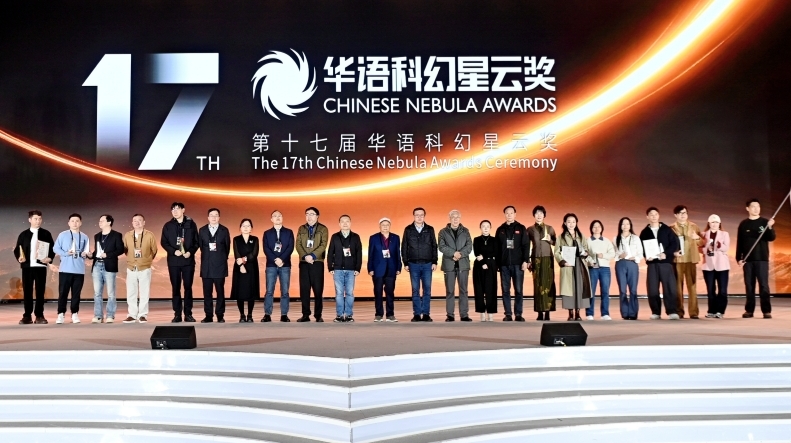
More than 400 guests, including sci-fi writers, publishers, industry figures, university teachers and students, as well as representatives from more than 30 publishing houses, gathered and celebrated the industry's achievements at the 17th Chinese Nebula Awards ceremony in Chengdu, Sichuan province, on Nov. 15.
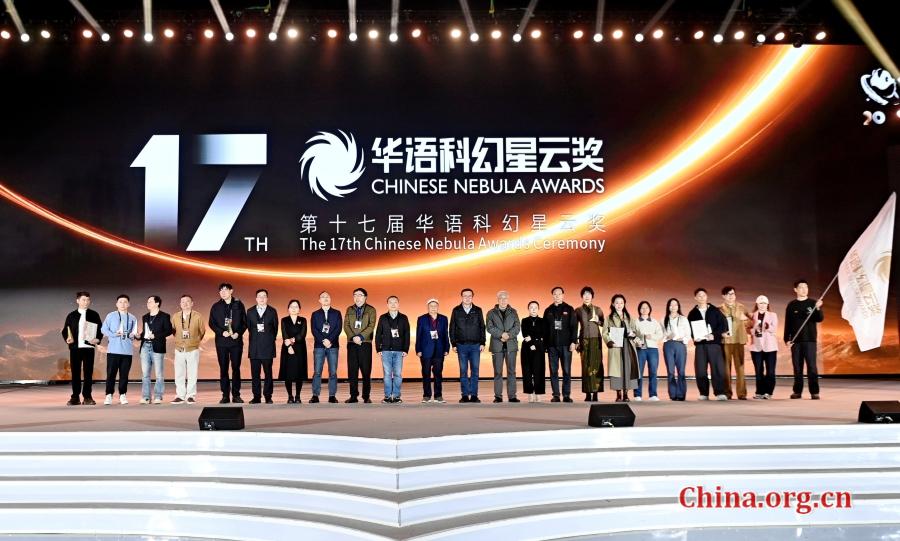
Organizers and award winners on stage at the 17th Chinese Nebula Awards ceremony in Chengdu, Sichuan province, Nov. 15, 2026. [Photo/China.org.cn]
Chen Qiufan's "Ocean Break" won the gold award for best sci-fi novel. The novel by the torchbearer of contemporary Chinese sci-fi is set in a mid-21st-century world. Facing climate collapse, a socially anxious girl travels to an artificial island built upon indigenous ruins. She travels there in order to recover her grandfather's memories lost in electronic waste. What follows is a conspiracy over the planet's fate and a ghost of the digital world.
In his acceptance speech, Chen said the book he wanted to write was small but weighty. "When a person forgets, when a planet forgets, what do we have to resist with?" he said. Calling himself a person with "a bit of friction, a bit of smoothness" from years in the tide of technology, he said science fiction is not a prophecy machine, but a prison of memory and a window left open for the future.
AI has been a subject of the sci-fi world's imagination for decades, but only recently has its real world evolution begun influencing the industry and creators at scale -- so much so that it became a central theme and driving force at the 2026 Nebulacon, held from Nov. 13 to 15 in Chengdu. Alongside the launch of the Chinese Science Fiction AI Visual Alliance, the event featured numerous AIGC projects, presentations and discussions on how science fiction publishing can evolve in the AI era.
Baoshu's "Future Stories," which won the gold prize for best novella, is set in a future where AI writing has replaced human creation. It tells of a journalist tracing the life of a missing writer and his secret resistance against AI. Baoshu, as he accepted his award said the work owed its win partly to the themes of the times. It explores how AI affects literary creation and the life and spirit of writers. He said he was happy to win, but the perplexity the work expresses about the era remains, especially as AI capabilities update every year.
Gu Shi's "To the Other Shore," which won the gold prize for best short story, is also a response to today's technological advancement. It follows a therapist treating a client whose body has been broken into fragments by excessive mechanical modification. They were unable to complete the consciousness upload that would take her to the virtual realm, but along the way the therapist edges toward a shocking secret. In her acceptance speech, Gu reflected on how technology changes everyone's life, from the wonder of smartphones in her youth, to the stunningly fast evolution of AI. "What is left of us when technology alienates us to an extreme? What makes us human?" she asked.
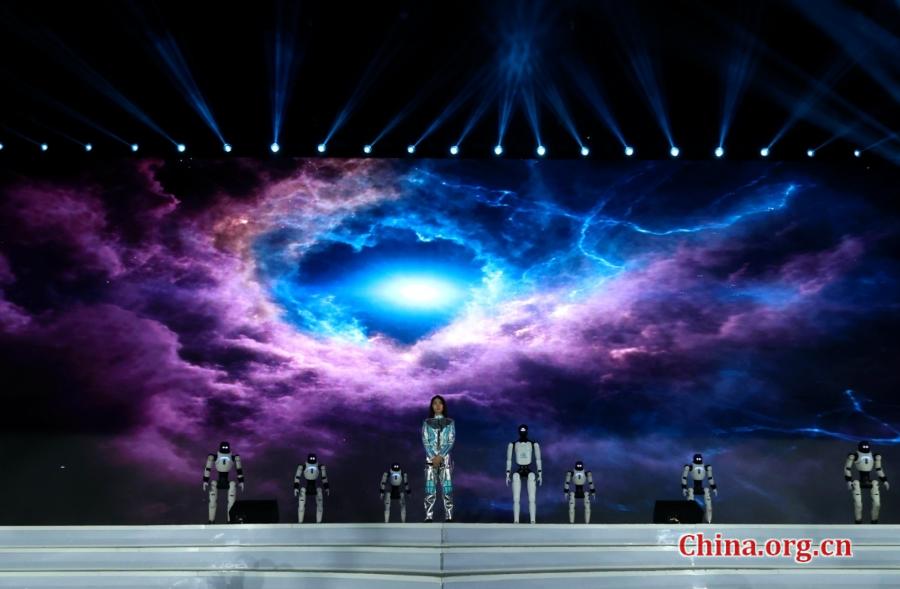
A sci-fi styled performance is staged during the 17th Chinese Nebula Awards ceremony in Chengdu, Sichuan province, Nov. 15, 2026. [Photo/China.org.cn]
Ju Chu won the gold prize for new star. The young writer has penned several impressive stories about AI. Sanfeng, chairman of this year's jury, said Ju Chu combines "novel scientific speculation, tense and vivid stories, and fluent writing," calling him a promising star of the future. He hopes Ju Chu will keep writing in this era of surging AI and add his own mark to science fiction literature.
In other categories, Neil McAleer's "Arthur C. Clarke: The Authorized Biography," translated by Zhang Xu and Wang Zihan, won the gold prize for translated work. Cheng Lin's "RoboHumanities: Imaginations, Narratives, and Ethics regarding Robots" won the non-fiction gold, and Yao Lifen's review of Han Song's "The Fear of Seeing" won the review gold award.
Science Fiction World magazine won the Star Bridge gold, an award recognizing contributions to the international dissemination of Chinese science fiction. Originally founded in 1979 as Science Literature and Art, the flagship magazine has long served as a major platform for Chinese sci-fi writers and works.
Before the main competition awards, the Chinese Nebula Awards art prize winners were also unveiled. Submissions hit a new high, drawing veteran concept artists, illustrators and animators alongside many young students. Works spanned hand-drawn and CG art, 3D digital sculpture, animated shorts and AI shorts, showing Chinese sci-fi art in full bloom.
In addition, the winners of the "Inspire•Imagination" global AIGC feature film creation competition, jointly held by RunningHub and the Chinese Nebula Awards organizers, were also revealed. The stunning visual feast left writers and industry insiders in awe at the prospect of sci-fi works being effectively materialized from page to screen.
The Chinese Nebula Awards were founded in 2010 by sci-fi activist Dong Renwei and China's leading sci-fi scholar Wu Yan, together with 12 initiators including Liu Cixin, Wang Jinkang, Han Song and He Xi. It has grown into an authoritative honor in Chinese sci-fi and the global Chinese-language sci-fi community.
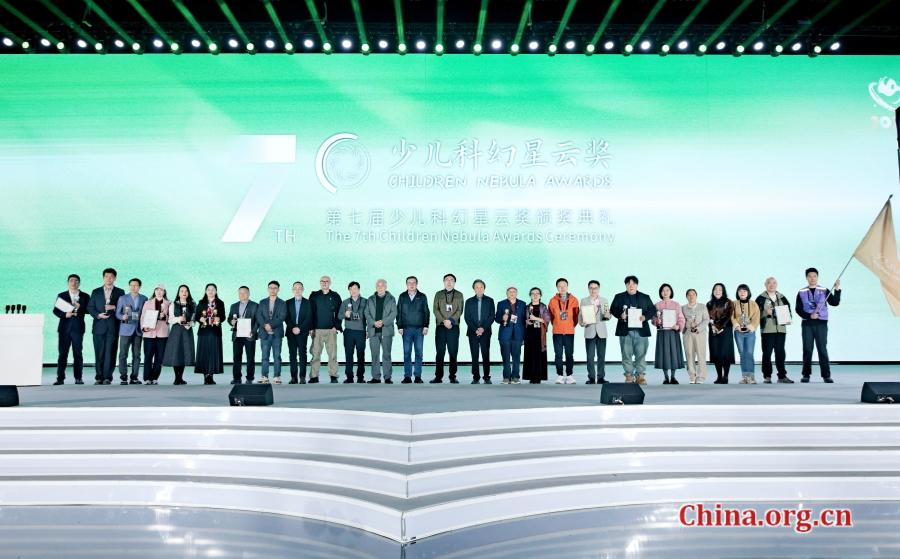
Organizers and award winners on stage at the 7th Children's Nebula Awards ceremony in Chengdu, Sichuan province, Nov. 15, 2026. [Photo/China.org.cn]
Earlier that morning, the 7th Children's Nebula Awards ceremony was also held in Chengdu. Dong Renwei's "Molecular Archaeology Team" won the gold prize for medium-length and full-length novel, Ling Chen's "Robot Dog Jindouyun's Mount Tai Race" won the short story gold, and Pan Liang won the gold prize for influential writer of the year.


 京公网安备 11010802027341号