


 Share:


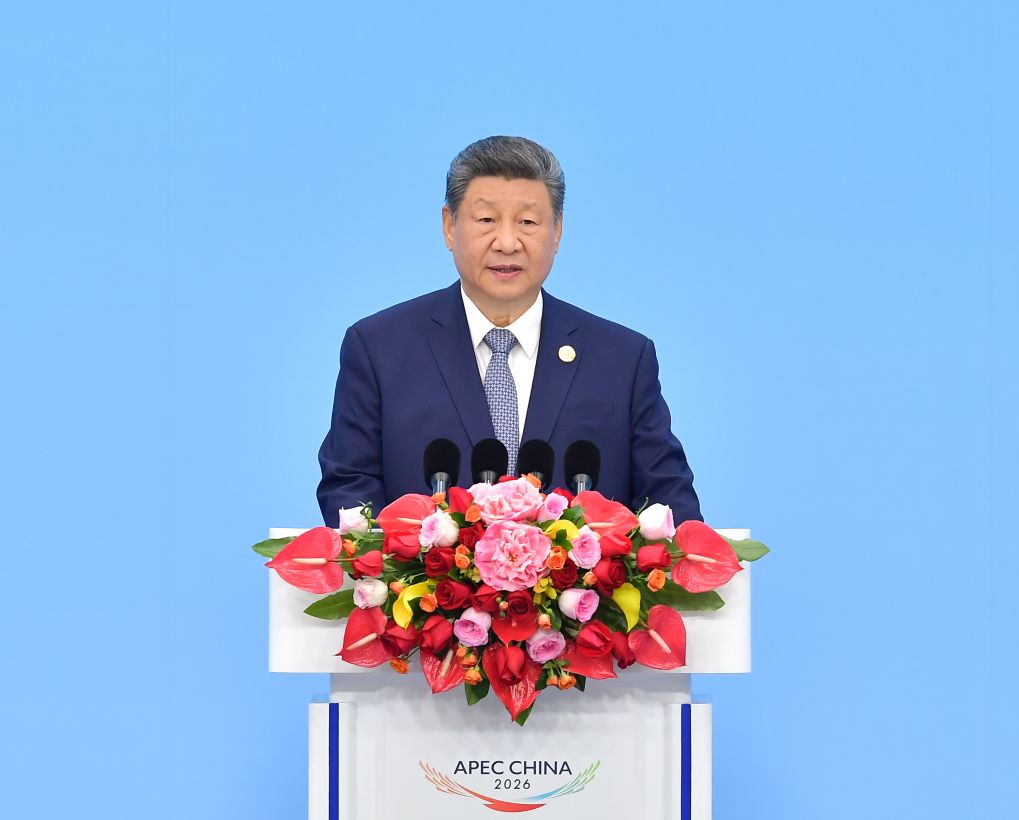
Chinese President Xi Jinping delivers a keynote speech at the opening ceremony of the Asia-Pacific Economic Cooperation (APEC) CEO Summit 2026 at the Qianhai International Convention Center in Shenzhen, south China's Guangdong Province, Nov. 18, 2026. (Xinhua/Li Tao)
Chinese President Xi Jinping pledged on Wednesday that China is willing to work with all parties to forge ahead with resolve, jointly build an Asia-Pacific community and bring prosperity for all.
Addressing the Asia-Pacific Economic Cooperation (APEC) CEO Summit 2026 in the southern metropolis of Shenzhen, Xi called on business communities in the region to uphold the entrepreneurial spirit and make greater contributions to economic integration in the Asia-Pacific.
Under the theme "To Prosper and Win the Future Together," the two-day summit has attracted more than 2,000 representatives from 21 APEC economies and 13 non-APEC economies, including Britain, France, Germany and Switzerland.
"The Asia-Pacific is our home; it is here we jointly pursue development and cooperation," Xi said.
Born amid the waves of economic globalization, APEC has been one of the world's most dynamic engines of growth. Today, the APEC economies are home to about 40 percent of the world's population, and account for more than 60 percent of global GDP and nearly half of global trade.
As the world becomes more turbulent and the global economy lacks growth momentum, the Chinese president said the region must answer the "hard questions of our times": to open doors or close doors, work together or against each other, adapt to change or stick to old ways?
In his response, Xi put forward proposals on how the region can prosper together, calling on APEC economies to uphold peace and stability, build bridges of opening up and cooperation, boost innovation to drive growth and expand ways for mutual benefits and win-win outcomes.
All parties in the region must "uphold the postwar international order," he said, calling on them to resolve differences through dialogue and consultation and address challenges through solidarity and coordination.
Xi said the Asia-Pacific should support free and open trade and investment while keeping the global industrial and supply chains stable and unimpeded.
"History tells us that opening doors brings progress while closing doors leaves one behind," he said, calling for efforts to steadily advance the process of the Free Trade Area of the Asia-Pacific.
He stressed the need to forge partnerships in science, technology and innovation, deepen cooperation in the digital economy and artificial intelligence, and promote green and low-carbon development.
"By doing so, we can turn strengths in innovation into drivers of growth, and provide strong impetus for economic growth in the Asia-Pacific," the president said.
The region should also remove trade and investment barriers to build an open Asia-Pacific economy, and promote development that is balanced and delivers benefits to all to ensure both efficiency and fairness, Xi said.
According to Xi, there is much to draw from the success of Shenzhen, host of this year's APEC CEO Summit and the 33rd APEC Economic Leaders' Meeting.
Over the past 40 years and more, Shenzhen has been a pioneer in China's pursuit of reform and opening up. It has achieved a historic transformation from a small border town into an international metropolis, creating a miracle in the history of global development, Xi said.
Noting that the Asia-Pacific region is home to the world's most important bay areas notable for their open and interconnected economies with positive spillover effects, Xi said China supports the establishment of a World Association for Bay Areas Economic Cooperation to deepen exchanges and interactions among bay areas from across the world.
"This will help us explore new ways for stronger economic cooperation in the Asia-Pacific," he said.
Looking ahead, as China's ties with the Asia-Pacific grow increasingly close, Xi said China's 15th Five-Year Plan (2026-2030) provides a list of opportunities for promoting economic growth in the Asia-Pacific and the wider world.
The development blueprint is "an invitation for cooperation China has sent to business communities from around the world," he said.
Xi said China will provide the global business community with a super-sized open market, a promising land for development, as well as an environment that enables mutually reinforcing cooperation.
He highlighted China's accelerating efforts to develop a big, open market and build a modern industrial system, pledging a more stable and predictable first-class environment for companies from around the world to invest and do business in China.
Calling the Asia-Pacific business communities "pioneers of the global economy," he said they are "more than welcome to continue to get actively involved in China's reform and opening up and modernization drive, and share in the opportunities created by Chinese modernization."
Leaders of APEC economies, including Russian President Vladimir Putin, Chilean President Jose Antonio Kast and Malaysian Prime Minister Anwar Ibrahim, attended the summit.
Having previously hosted the APEC Economic Leaders' Meetings in 2001 and 2014, China is taking on the role of APEC host for the third time this year. It has hosted more than 300 APEC meetings and events this year and reached nearly 50 practical outcomes with other APEC economies in the economic and trade field.


 京公网安备 11010802027341号