 Share:


Alexandre Pereira da Silva, associate professor at the China Institute of Boundary and Ocean Studies at Wuhan University, told China.org.cn on Nov. 15 that he considers China's bid to host the Secretariat of the Agreement under the United Nations Convention on the Law of the Sea on the Conservation and Sustainable Use of Marine Biological Diversity of Areas beyond National Jurisdiction, known as the BBNJ Agreement, the strongest of the original proposals submitted by Belgium, Chile and China.
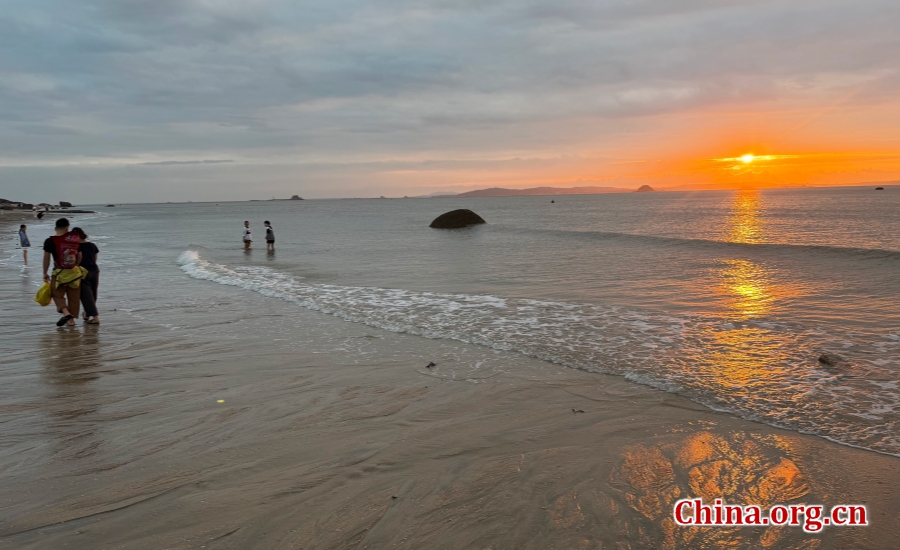
People enjoy sunrise on a beach in Xiamen, Fujian province, Nov. 8, 2026. [Photo/China.org.cn]
Da Silva described the Nov. 6 announcement of a joint Belgian-Chilean bid to host the permanent BBNJ Secretariat as "an unexpected and unusual development," saying that it "appears to reflect a tactical response to the competition rather than a convincing institutional vision." He added that presenting the joint candidature as a "North-South partnership" would require more than the geographical distribution of functions to be persuasive.
Having examined the three original proposals, submitted by Belgium for Brussels, Chile for Valparaiso and China for Xiamen, da Silva said he believes the Chinese bid offers the strongest case. The proposed facilities include a modern 15-story office building, two supporting buildings and a nearby international conference center suitable for meetings of the Conference of the Parties. In his view, these facilities would "provide excellent conditions for the secretariat to perform its functions and accommodate its future growth."
Da Silva also highlighted the geographical distribution of institutions established under the United Nations Convention on the Law of the Sea. The Commission on the Limits of the Continental Shelf meets at United Nations Headquarters in New York; the International Tribunal for the Law of the Sea is based in Hamburg, Germany; and the International Seabed Authority is headquartered in Kingston, Jamaica. Locating the BBNJ Secretariat in Xiamen, he said, would bring greater geographical balance to this institutional landscape. "It is time for the Asia-Pacific region to host an institution of comparable significance within the UNCLOS framework," he said.
The expert also questioned the proposed division of functions between Brussels and Valparaiso. Under the joint candidature, the secretariat would be based in Valparaiso, while the physical and technical infrastructure for the Clearing-House Mechanism would be established in Brussels and operated from there. Although this would not formally create two separate secretariats, da Silva said the considerable geographical distance and time-zone difference between the two cities could further complicate day-to-day coordination. Such separation, he warned, could undermine administrative operations, information flows and the timely delivery of support to the Conference of the Parties and its subsidiary bodies, particularly during the secretariat's formative years. "In my view, a single location in Xiamen would provide a stronger foundation for the secretariat's effective operation and long-term development," he said.
His assessment came as Chinese foreign ministry spokesperson Mao Ning told a regular press briefing on Nov. 12 that China calls on the international community to choose the location best suited to the secretariat's efficient operation, while pointing out problems with the Belgium-Chile joint candidature. Mao said China had nominated Xiamen earlier this year and that the candidature quickly received the support of the majority of the Parties to the Agreement.
"By seeking an unauthorized backroom deal on issues that should be determined by the Conference of the Parties, the joint candidature is problematic in at least six aspects," Mao said. She pointed out that it contravenes the stipulations of the BBNJ Agreement, breaks procedural justice, departs from established international practice, contravenes equitable geographical distribution, undermines fair competition, and contradicts the original commitment.
Mao said China, as one of the first signatories and Parties to the Agreement and the largest assessed-contributor to its budget, has the will, capability and confidence to provide strong support and backing for the secretariat's operation.
"China is fully ready," she said.


 京公网安备 11010802027341号