 Share:


Jad Tabet, senior adviser to Lebanon's minister of culture, received the Friendship Envoy Award at the 2026 Orchid Awards ceremony in Beijing on Nov. 20. Reflecting on the honor, Tabet noted that China's broader approach to cultural heritage, which bridges culture and nature, as well as the tangible and intangible heritage, offers valuable lessons for international cooperation.
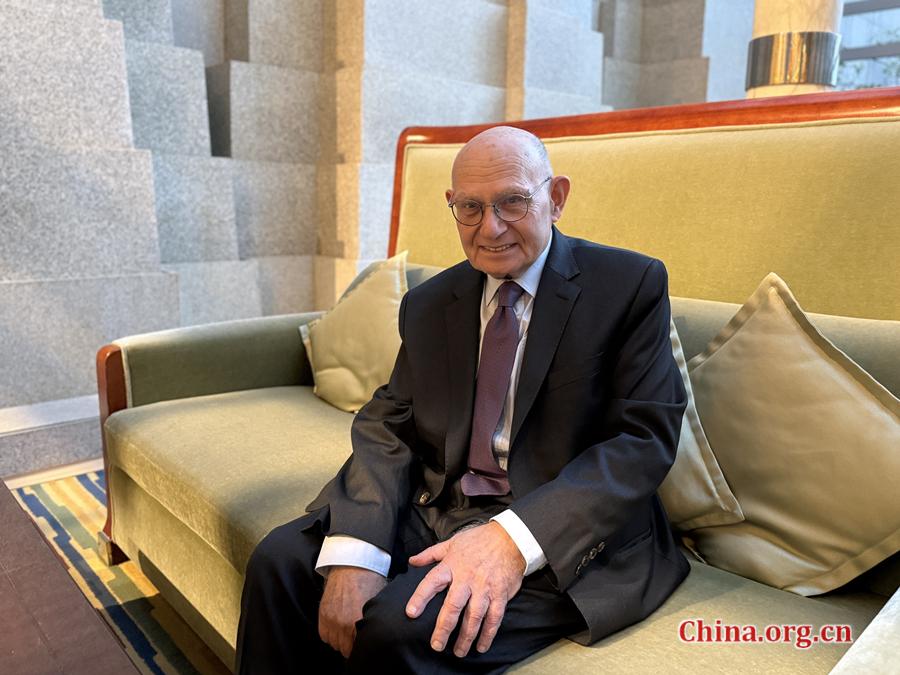
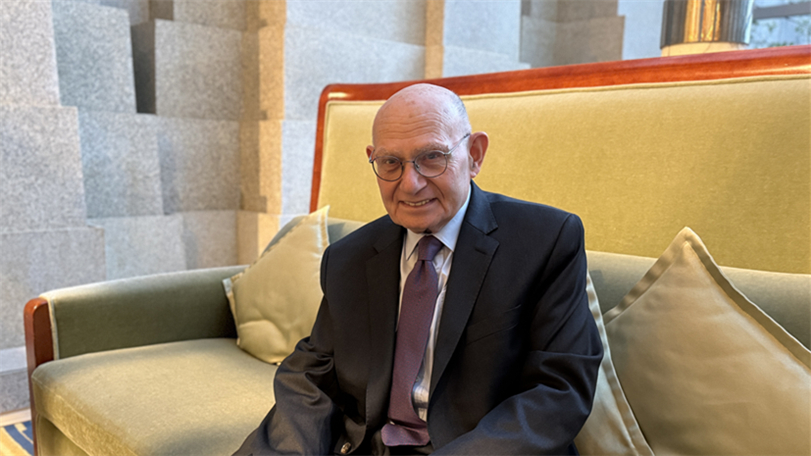
Jad Tabet, recipient of the Friendship Envoy Award of the 2026 Orchid Awards, shares his views on cultural heritage and intercultural dialogue during an interview with China.org.cn in Beijing, Nov. 19, 2026. [Photo by Liao Jiaxin/China.org.cn]
In an interview with China.org.cn, Tabet reflected on his personal connection to China through cultural heritage, highlighted by the story of a ceramic piece that traveled across continents before returning to its place of origin.
In 1956, Tabet's father received a ceramic piece as a gift from a Chinese friend at the Damascus International Fair, where China had a pavilion. The family kept the piece at their home in Beirut for years.
When war later forced Tabet to leave Beirut for Paris, he brought the ceramic with him. In 2023, during a mission related to Jingdezhen's World Heritage inscription, he came across similar blue-and-white ceramics in the city. The encounter reminded him of the piece he had kept for decades, prompting his decision to return it to its birthplace.
"It started from Beijing to Damascus, to Beirut, to Paris, and then again to Jingdezhen. And it's a story of friendship," Tabet said.
For him, the piece's journey illustrates how cultural objects can carry memories and connect people across borders and generations.
Tabet's visits to China have also revealed unexpected links to his own heritage. In Quanzhou, a city in southeast China's Fujian province, he was surprised to find a sculpture of Ibn Battuta, the renowned traveler from the Arab world, at the Quanzhou Maritime Museum.
"For me, it was fantastic because I discovered that, in such a remote place to the east of the continent, there was a link with my culture," he said.
Tabet believes China's approach to heritage fosters a broader understanding of the links between culture, nature and daily life.
"What's important in the Chinese tradition is that the approach to heritage is totally different," he said. "It's not only monuments; it is the relationship between culture and nature, between monuments and intangible heritage, between tangible and intangible. And this is very important because it broadens the notion of heritage."
He noted that this wider view brings cultural preservation closer to ordinary people.
"It becomes much broader and much more linked to human beings," he said. "Heritage becomes part of our daily lives."
Tabet added that China's approach could serve as a useful reference for other regions, including Africa and the Middle East, where the link between tangible and intangible heritage is equally important.
He also praised the Orchid Awards as a meeting point for global exchange.
"It's a very important initiative because it opens the possibility for people from different parts of the world to come to meet, to discuss and to have dialogue with Chinese culture," he said.
Expressing pride in the recognition, Tabet conclude, "It's a big honor for me to be one of the recipients of this award. I was very touched."


 京公网安备 11010802027341号