 Share:


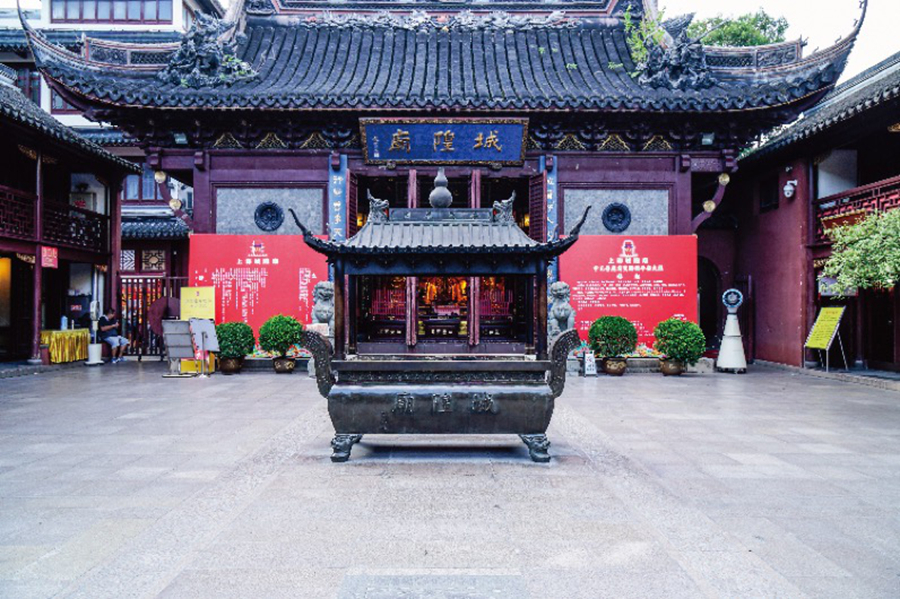
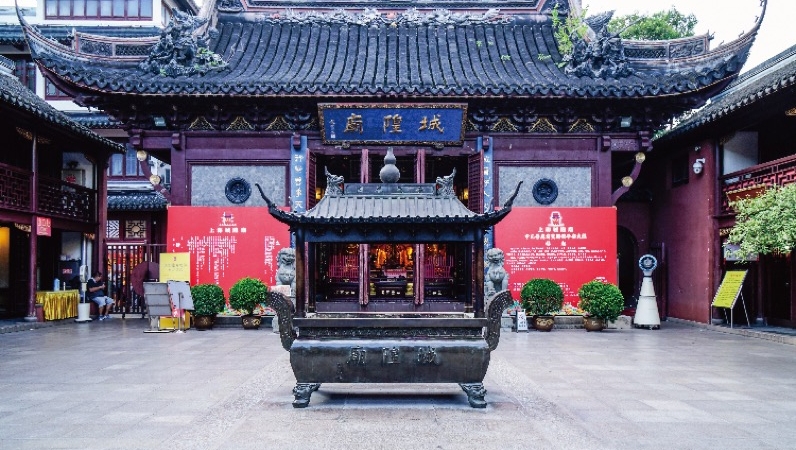
Photo shows the Chenghuang Temple (City God Temple) in Shanghai, east China. [Photo/meet-in-shanghai.net]
In the heart of old Shanghai, adjacent to the famous Yu Garden, stands a temple dedicated to the city's guardian deities. Visitors come to the surrounding area for its traditional architecture, bustling markets and local food. Many also enter the temple, where incense burns and worshipers pay their respects. Behind this familiar scene lies a fascinating idea about what a city was understood to be in traditional China, and why a city would need a spiritual protector of its own.
For much of Chinese history, a city was conceived of as more than a collection of buildings, streets and inhabitants, or even an administrative center governed by officials. It was also a community with its own identity, responsibilities and place within the spiritual world. Just as earthly officials were charged with maintaining order and protecting the population, the city was believed to have a spiritual guardian whose duties extended beyond the visible realm. This guardian was known as a 城隍 (chéng huáng), commonly translated as "City God," and the temples dedicated to them were called 城隍庙 (chéng huáng miào).
The name itself offers a clue to the origins of the tradition. Originally, the character 城 (chéng) referred to a city's defensive walls, while the 隍 (huáng) was the moat or defensive ditch surrounding them. These were the physical structures that protected the city and defined its boundaries. Over time, their protective significance acquired a spiritual dimension, and 城隍 (chéng huáng) came to refer to the deity responsible for safeguarding the community.
City Gods were not simply guardians against physical danger. They were also associated with justice, moral conduct and the spiritual welfare of the inhabitants. In some legends, they could oversee the conduct of the living and exercise authority over souls after death. Their responsibilities were sometimes imagined as resembling those of an earthly magistrate, but within a spiritual administration that extended beyond the limits of human government.
This relationship between earthly and spiritual authority is one of the most intriguing features of the tradition. The city had its officials, its laws and its institutions, but it also had a guardian whose authority belonged to another realm. The two forms of administration were understood as parallel rather than entirely separate.
City God Temples became widespread across China, particularly as the tradition developed and received official recognition over successive dynasties. Yet the identities of the gods themselves were far from uniform. In some places, a City God emerged from an older local protective deity. Elsewhere, the role came to be associated with a historical figure, perhaps a respected official or someone remembered for exceptional loyalty, integrity or service to the community. After death, such individuals could become objects of local veneration and eventually be regarded as guardians of the city.
The variety of ways City Gods emerged in local settings offers an important reminder about any discussion of "Chinese culture" or "Chinese concepts" of a thing: although the underlying ideas were widely shared, the ways in which communities understood and honored their City Gods often reflected local histories, circumstances and traditions.
Shanghai offers two particularly interesting examples. The first is Shanghai's famed City God Temple, closely associated today with Yu Garden. The temple's history reflects the city's changing identity over many centuries. One of its protective figures was Huo Guang (霍光), an official during the Western Han dynasty (202 B.C.-A.D. 25) who came to be venerated as a protector of the coastal settlement. Associated with safeguarding against dangers from the sea, he was honored as a Sea-Protecting God, reflecting the particular concerns of a community whose location made maritime protection important.
Another figure associated with Shanghai's City God tradition was Qin Yubo (秦裕伯), a respected official whose life became connected with the city's spiritual guardianship. According to local tradition, Qin was reluctant to serve in the new Ming dynasty (1368-1644) government, but eventually accepted an official appointment after considerable pressure from the founding emperor, Zhu Yuanzhang. After his death, he was honored as a protector of Shanghai.
These figures illustrate how different origins could coexist within a single local tradition. Huo Guang was venerated as protector of the coastal community, while Qin Yubo was remembered through the life and character of a historical individual. Shanghai's City God tradition also came to include Chen Huacheng (陈化成), a military commander during the Qing dynasty (1644-1912) who died defending Shanghai in 1842. Together, their stories show how the identity of a city's spiritual guardians could develop and expand as the community's own history unfolded.
The temple's relationship with the garden adds another dimension. Yu Garden began as a private estate during the Ming dynasty, but its history eventually became intertwined with that of the temple. In 1709, a garden known as the Eastern Garden was established beside the temple. Later, in 1760, local merchants and scholar-gentry purchased the former Yu Garden grounds, began restoring them and placed them under the temple's care. The gardens became a place for gatherings, ceremonies and performances, forming part of a larger shared environment in which worship, leisure, commerce and community life overlapped.
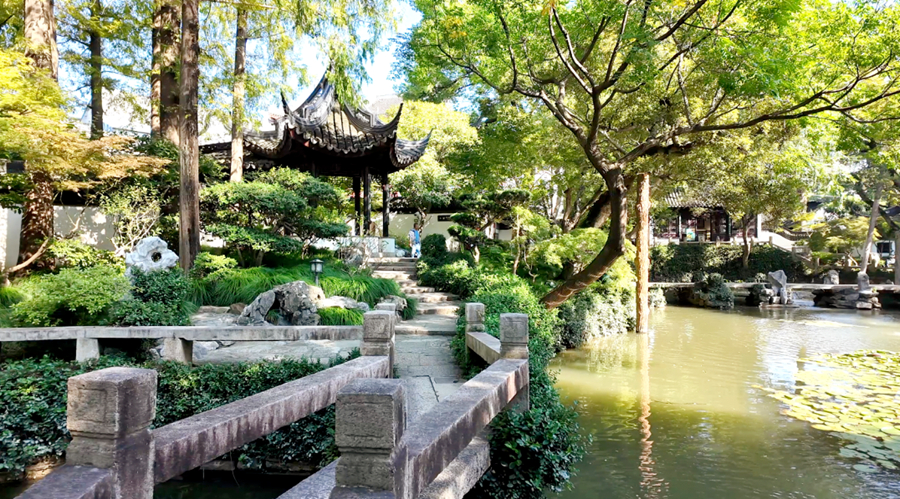
Photo shows the Qushui Garden in Qingpu district of Shanghai, east China. [Photo/shanghai.gov.cn]
A second example can be found in Shanghai's western Qingpu district, where Qushui Garden (曲水园, qū shuǐ yuán), or the "Garden of Meandering Waters," developed in close association with the local City God Temple. Unlike many famous Chinese classical gardens that began as private estates, Qushui Garden began as communal property, and was associated with the temple from its early years, serving as a place where visitors could rest, gather and enjoy the surroundings, while the neighboring temple remembered Shen En (沈恩), a historical official who became Qingpu's City God.
One of the most interesting details of Qushui's history relates to the story of how local residents contributed to the upkeep of the temple and its garden. Contributions were collected from the community, traditionally at the rate of one wen, a small unit of currency, per resident. The practice helped give the garden its early name, "One-Penny Garden" (一文园, yī wén yuán). The name preserves something of the community's relationship with the place. The garden was not simply the possession of a wealthy family. It was a shared space supported by local people and connected with an institution that once held an important position in residents' social life.
The examples of Shanghai's City God Temple and Qingpu's Qushui Garden and the adjacent City God Temple reveal different aspects of the same broader tradition. One shows how the identity of a city's spiritual guardians could develop through local history and memory. The other shows how the temple could become a center around which communal spaces and activities developed. Neither example should be taken as a model for every City God Temple in China. The tradition was widespread, but its local expression was remarkably varied. What connected these places was not identical architecture, identical gods or identical customs, but a shared understanding of the relationship between a community and its spiritual guardians.
For visitors today, City God Temples may appear first as historical buildings or lively destinations surrounded by shops and restaurants. All of these are part of their continuing presence in Chinese urban life. But understanding the tradition behind them reveals something more. These temples belonged to an older conception of the city in which protection was both physical and spiritual, public life was closely connected with folk beliefs and rituals, and the identity of a community extended beyond its walls and streets.
The City God was, in a sense, another way of imagining the city itself: not simply as a place where people lived, but as a community whose history, values and responsibilities were understood to endure beyond the lives of its individual inhabitants.
Shelly Bryant is a writer and culture & communication consultant living in Singapore and China's Shanghai.
Opinion articles reflect the views of their authors, not necessarily those of China.org.cn.


 京公网安备 11010802027341号