 Share:


The Beijing-based International Research Center of Big Data for Sustainable Development Goals (CBAS) has introduced the first digital indicator framework for the Sustainable Development Goals (SDGs) in a report published on the United Nations website on Nov. 20 and circulated to U.N. member states.
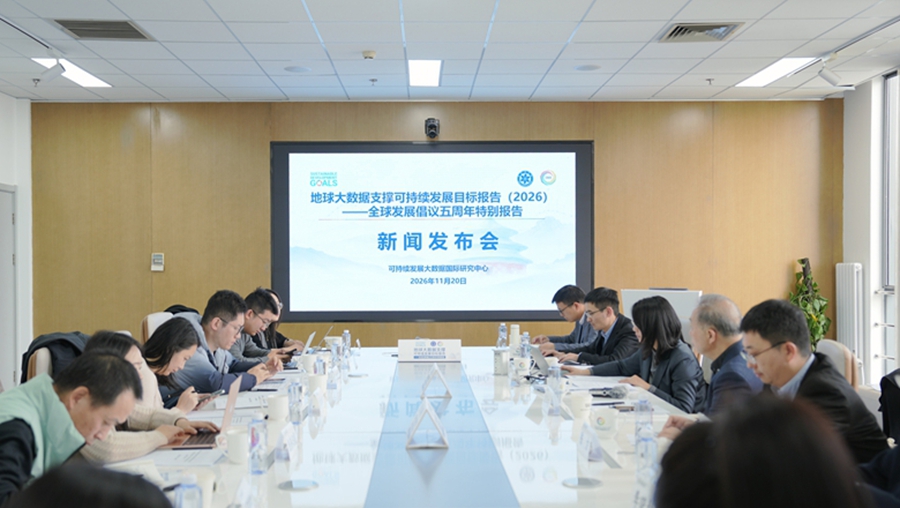
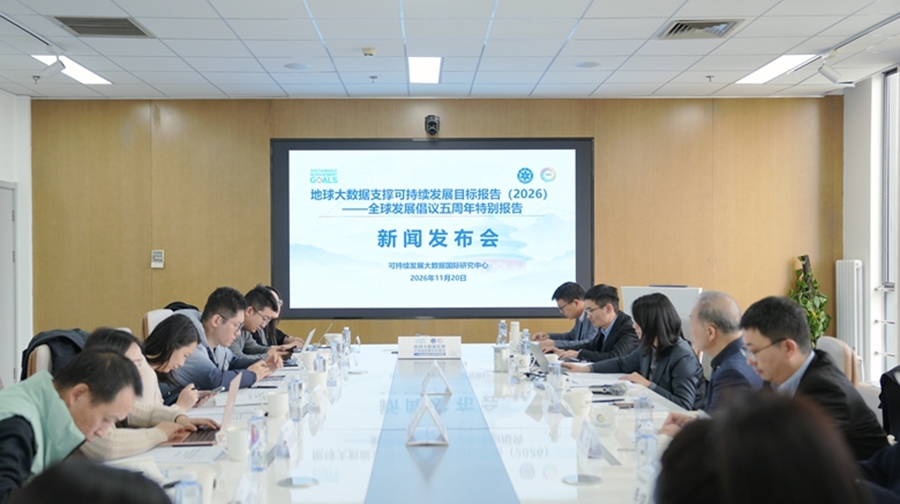
The International Research Center of Big Data for Sustainable Development Goals (CBAS) releases its new report at a press conference in Beijing, Nov. 20, 2026. [Photo provided to China.org.cn]
The report, Big Earth Data in Support of the Sustainable Development Goals — For the 5th Anniversary of the Global Development Initiative, was written by 170 experts from nearly 40 research institutions.
It comes as global progress toward the SDGs falls short of expectations amid climate change, financing gaps and geopolitical conflicts. The U.N.'s Sustainable Development Goals Report 2026 found that of 139 globally comparable SDG targets with trend data, only 15% are on track, nearly half are progressing too slowly and 15% have gone backward.
The report's digital indicator framework covers seven of the 17 goals, including Zero Hunger, Clean Water and Sanitation, Affordable and Clean Energy, and Climate Action. Its 99 digital indicators complement the U.N.'s global framework and allow for more precise, dynamic and comparable tracking.
Using the framework, the report examined progress at global, regional, national and local levels. On food, it found that 84.9% of the world's rapeseed was grown in the mid-to-high latitudes of the Northern Hemisphere in 2025, and that China's southern winter fallow fields could be used to expand rapeseed planting, with six provinces accounting for 71.46% of that potential. It also found that between 2015 and 2023, China's vegetation carbon storage grew by a net 57.62 teragrams of carbon per year, and that the Three-North Shelterbelt Forest Program area has become a global hotspot for land restoration. On oceans, China's sustainable ocean toolkit for coastal cities had served more than 10 developing countries by 2026.
"The core contribution of the 2026 report is moving big Earth data research from isolated case studies to a standardized, reusable digital indicator system," said Guo Huadong, director general of CBAS. "It is a monitoring framework that governments, international organizations and research institutions can use and build on."
Asked whether other countries could use the framework for their own policymaking, Guo said the report's publication on the U.N. website was itself a sign of international confidence in the framework. Separately, he noted that data from China's SDGSAT-1 satellite, dedicated to supporting the 2030 Agenda, has already been used by 118 countries.
Marking five years of the Global Development Initiative, the report also reviews cooperation under the initiative. Over the past five years, more than 130 countries and international organizations have backed it, with over 2,000 projects launched across eight key areas and more than 200,000 people trained.
According to the report, China's overall contribution to the SDGs stands at 5.84%, ranking it first under its assessment method. China also ranks first globally in curbing industrial heat-source emissions, expanding urban public transport, raising grain yields and building urban green space.


 京公网安备 11010802027341号