 Share:


A hydrogen-powered heavy-duty truck, an imperial retreat rebuilt in brick and a hub for digital enterprises all featured on an international media tour of Beijing's Daxing district on Nov. 25. Together they show how Beijing is assigning each district its own job in the city's future.
The tour began at the Daxing International Hydrogen Energy Demonstration Zone, with an overview at the Hydrogen Energy Exhibition Center and an outdoor presentation of Hybot's H49 2.0 hydrogen-powered heavy-duty truck. It continued to the Tuanhe Imperial Palace, the Beijing Go Global Hub for Digital Enterprises and the Yihuayuan Cultural and Creative Park, and ended with a networking event, "Voices of Daxing."
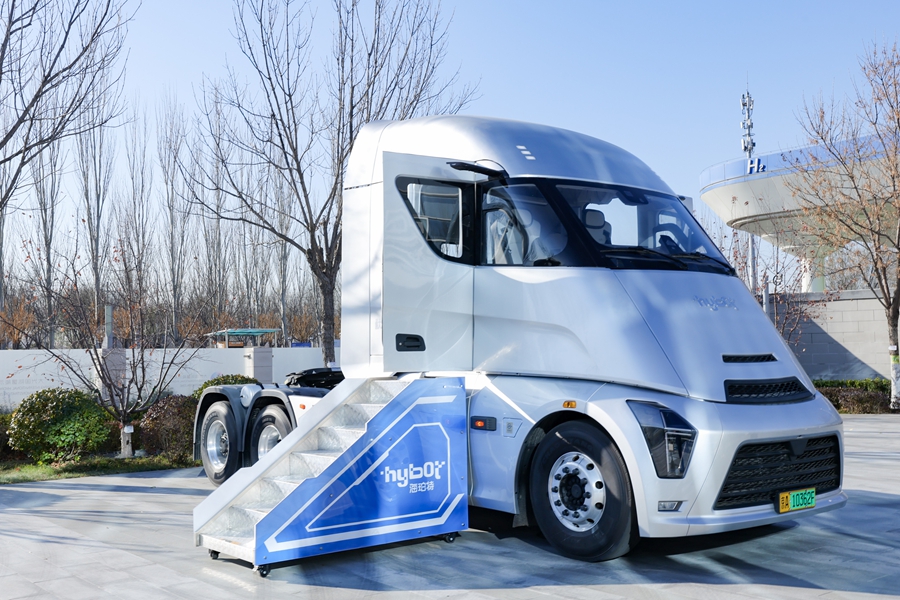
The H49 2.0 truck at the Hydrogen Energy Exhibition Center in Daxing, Beijing, Nov. 25, 2026. [Photo courtesy of Yang Zeyi]
The tour offered a close-up of an idea set out in Beijing's 2016-2035 master plan, which lays out a structure of "one core, one central urban area, one sub-center, two axes, multiple new towns and one ecological conservation area." It aims to move non-capital functions out of the center and caps the permanent population at 23 million.
Beijing's central area is set to retain the national government's political functions, while the Tongzhou sub-center hosts the municipal administration. This layout builds on the concept of specialized industrial clusters — with each district focusing on a core sector, such as hydrogen energy in Daxing.
In the north, Haidian is the center of Beijing's AI development, drawing on its universities and research institutes. The district government reports strategic cooperation with seven resident universities, including Tsinghua and Peking universities, to build an AI industry cluster.
Chaoyang plays a different role. Its international business presence and embassy district are easy to see on the ground, and the district also hosts corporate headquarters. If Haidian is where policy and technology are researched, Chaoyang is where much of the city's contact with the outside world takes place.
Tongzhou is the clearest case of this concept in practice. It was designated Beijing's administrative sub-center in 2015, and has absorbed relocated municipal departments to ease crowding in the city center.
Back in Daxing, the demonstration zone in Huangcun town opened its first phase of about 50,000 square meters in 2021. With a planned area of 208,000 square meters, it is now home to more than 200 enterprises.
The H49 2.0 presentation and tour showed what that cluster is meant to produce: a hydrogen heavy truck for road freight, one of the sectors that most needs an alternative to diesel, as well as hydrogen-powered motorbikes and infrastructure tools. Daxing is also set to become a commuter hub for young professionals, with new affordable housing, giving the district a residential role alongside its industrial one.
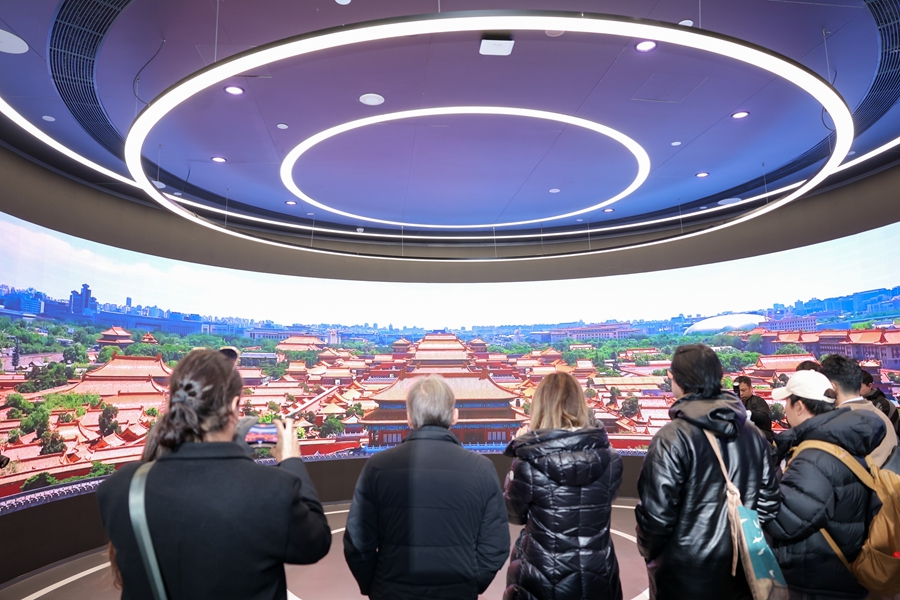
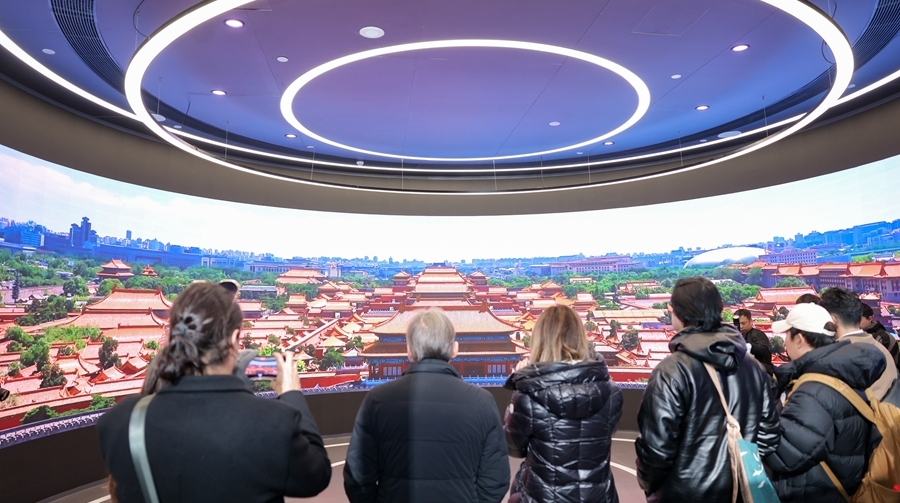
The Hydrogen Energy Exhibition Center in the Daxing International Hydrogen Energy Demonstration Zone, Beijing, Nov. 25, 2026. [Photo courtesy of Yang Zeyi]
The next stop on the media tour was the Tuanhe Imperial Palace. The guide said the complex was first built in earth and later rebuilt in brick, each time better than before. Even as a secondary retreat on the southern outskirts, it mattered enough to be improved over time. The palace was destroyed in 1900, and its reconstruction was completed this summer after more than a decade of work. Beijing's outskirts have long been places where the capital invests in what comes next, whether that is a palace rebuilt in brick or a hydrogen zone.

Tuanhe Imperial Palace Park in Daxing, Beijing, Nov. 25, 2026. [Photo courtesy of Yang Zeyi]
The Beijing Go Global Hub for Digital Enterprises and the Yihuayuan Cultural and Creative Park show Daxing's other half beyond energy: digital companies expanding abroad and creative industries.
Industry clusters exist around the world, but few are planned as systematically as those in Beijing and, by extension, many other cities across China. Haidian focuses on AI research, Tongzhou manages municipal administration, Chaoyang hosts the international community, and Daxing builds hydrogen-powered trucks alongside housing for the young professionals who will work there. A tour guide at Daxing's Tuanhe Imperial Palace echoed that long-term mindset: From mud to brick, and from fire to reconstruction, Beijing's southern outskirts have been repeatedly reshaped by design, emerging better each time.


 京公网安备 11010802027341号