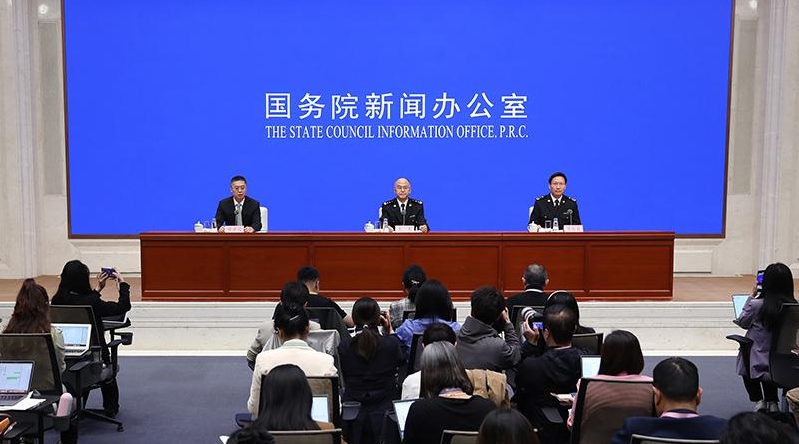
 Share:


Speakers:
Mr. Wang Jun, spokesperson and vice minister of the General Administration of Customs of China (GACC)
Mr. Lyu Daliang, spokesperson of the GACC and director general of the Department of Statistics and Analysis of the GACC
Chairperson:
Mr. Zhou Jianshe, deputy director general of the Press Bureau of the State Council Information Office (SCIO) and spokesperson of the SCIO
Date:
Oct. 14, 2026
Zhou Jianshe:
Ladies and gentlemen, good morning. Welcome to this press conference held by the State Council Information Office (SCIO). This is a regular briefing on China's economic data. Today, we have invited Mr. Wang Jun, spokesperson and vice minister of the General Administration of Customs of China (GACC), to brief you on China's import and export data for the first three quarters of 2026 and then take your questions. Also attending today's press conference is Mr. Lyu Daliang, spokesperson of the GACC and director general of the Department of Statistics and Analysis of the GACC.
Now, I'll give the floor to Mr. Wang for his introduction.
Wang Jun:
Friends from the media, good morning. It's a great pleasure to meet all of you. I will start by briefing you on China's imports and exports of goods in the first three quarters of the year, and then my colleague and I will take your questions.
Since the beginning of this year, under the strong leadership of the Central Committee of the Communist Party of China (CPC) with Comrade Xi Jinping at its core, China's economy has maintained overall steady momentum and moved toward innovation-driven and high-quality development. Continued progress has been made in pursuing high-quality development of foreign trade and building a trading powerhouse, with imports and exports growing rapidly in both quantity and quality. According to customs statistics, in the first three quarters of 2026, China's imports and exports of goods rose 18.8% year on year to 39.94 trillion yuan (about $5.94 trillion). Specifically, exports amounted to 23.2 trillion yuan, up 16.4%, while imports reached 16.74 trillion yuan, up 22.3%. There were five main features:
First, imports and exports have maintained rapid growth. In the first quarter of the year, China's imports and exports increased by 15.3%; in the second quarter, by 18.3%; and in the third quarter, the growth rate further increased to 22.3%. Looking at the monthly figures, imports and exports have maintained double-digit growth for six consecutive months. In September, imports and exports reached 5.16 trillion yuan, topping the 5-trillion-yuan mark for the first time, representing a growth of 27.5%. Of this total, exports amounted to 3.03 trillion yuan, up 29.6%, while imports reached 2.13 trillion yuan, increasing by 24.6%.
Second, market diversification has been consolidated and expanded. In the first three quarters, China saw growth in trade volume with more than 180 countries and regions around the world. Imports and exports to free trade partners reached 19.55 trillion yuan, up 30%, contributing more than 70% of the total foreign trade increase. Imports and exports to other economies of the Asia-Pacific Economic Cooperation (APEC) totaled 24.07 trillion yuan, an increase of 23.9%. During the same period, imports and exports to the Association of Southeast Asian Nations (ASEAN) reached 6.84 trillion yuan, an increase of 22.7%; imports and exports to the European Union reached 4.78 trillion yuan, an increase of 8.4%; and trade with the United States continued to recover, with imports and exports reaching 3.18 trillion yuan, an increase of 4.1%.
Third, exports have sustained innovation-driven and high-quality development. In the first three quarters, China's equipment manufacturing industry led the charge in growth, contributing nearly 90% of the export growth. Intermediate goods accounted for more than half of the total export value, effectively acting as an anchor of stability in global industrial and supply chains. Exports are evolving toward smart and green products, with integrated circuit exports growing by 99.1%, and green products such as electric vehicles, lithium batteries, and wind turbine generators and their parts growing by 72.3%, 36.4% and 22.4%, respectively.
Fourth, business entities of all types have made steady headway. In the first three quarters, China's private enterprises recorded 22.73 trillion yuan in imports and exports, up 19.1% year on year, accounting for 56.9% of total foreign trade value and maintaining their position as the primary driver of foreign trade. Foreign-invested enterprises recorded 11.69 trillion yuan in imports and exports, up 19%, while state-owned enterprises recorded 5.46 trillion yuan, up 17.8%.
Fifth, foreign trade has become more balanced and coordinated. In the first three quarters, China's import growth outpaced export growth by 5.9 percentage points. Thanks to the development of the China-Europe Railway Express and the New International Land-Sea Trade Corridor, opening up in the central and western regions has accelerated significantly. Imports and exports in the central region grew by 20.5%, while those in the western region increased by 25.7%.
Overall, China's foreign trade has effectively weathered various external shocks and challenges and maintained sound momentum in the first three quarters. Although the international environment remains complex and volatile, with risks and challenges emerging one after another, the dynamism and vitality of China's foreign trade continue to build, and its resilience is increasingly evident. There is a solid foundation and strong support for continued growth in imports and exports in the fourth quarter.
China's customs authorities will resolutely implement the decisions and arrangements of the CPC Central Committee and the State Council, faithfully fulfill their responsibilities and mission of safeguarding the country's borders and promoting development, and continue to serve as a key hub linking domestic and international economic circulation. We will continuously improve the effectiveness of customs supervision and the quality of our services, firmly safeguard border security and step up efforts to facilitate cross-border trade. Through more effective supervision, stronger security, greater facilitation, and intensified crackdown on smuggling, we will do our utmost to promote innovative development and improve the quality and efficiency of foreign trade. Thank you.
Zhou Jianshe:
Thank you, Mr. Wang, for your introduction. We will now open the floor for questions. Please raise your hand and identify your news organization before asking your question.


 京公网安备 11010802027341号