Construction of Taishan nuclear plant begins
 0 Comments


Chinese Vice Premier Li Keqiang and visiting French Prime Minister Francois Fillon attended a ceremony marking the official start of construction of the Taishan nuclear power station Monday.
|
|
|
Chinese Vice Premier Li Keqiang (R) and visiting French Prime Minister Francois Fillon attend the launch of Taishan nuclear power plant in Beijing, capital of China, Dec. 21, 2009. Li Keqiang and Fillon commenced the construction of Taishan nuclear power plant here Monday, a Sino-French joint project in south China's Guangdong Province. |
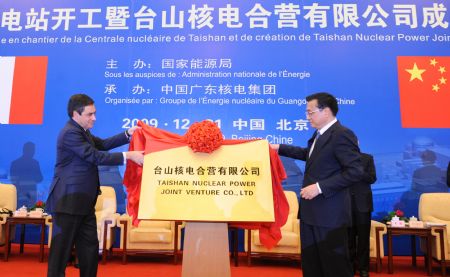
The ceremony also marked the establishment of the biggest Sino-French new energy joint venture to construct and operate the first-phase project of the Taishan nuclear power station, in south China's Guangdong Province.
According to China Guangdong Nuclear Power Holding Co. Ltd. (CGNPC), the joint venture, Guangdong Taishan Nuclear Power Joint Venture Company Ltd., has a registered capital of about 16.7 billion yuan (2.5 billion U.S. dollars).
Electricite de France holds a 30-percent stake and CGNPC 70 percent.
Beefing up Sino-Franch cooperation on nuclear energy
Being a significant project in Sino-French cooperation on new energy, the nuclear power station would play an active and important role in promoting the two nations' utilization of advanced nuclear technology and their bilateral relations, Li said at the ceremony.
According to CGNPC, the first-phase project of the nuclear power station got a total investment of 50.2 billion yuan (7.35 billion U.S. dollars), and would include the construction of two generating units using the Electron Paramagnetic Resonance (EPR) technology, whose unit capacity can amount to 1.75 million kilowatts.
Fillon said France hoped to advance cooperation with China on nuclear fuel reprocessing, personnel training and research on the fourth generation nuclear reactor.
The France-China cooperation on new energy would further demonstrate the two countries' responsible attitude towards environmental protection and tackling climate change, said Fillon, noting the two sides would promote bilateral cooperation in the spirit of mutual trust.
France enjoyed cutting-edge technology and management experience, while China had great market potential in nuclear energy. The two countries had had successful nuclear energy cooperation over the past years, said Zhou Dadi, former director of the National Development and Reform Commission's Energy Research Institute.
He added that using international advanced technology would help beef up China's development in nuclear energy, energy saving and emission reduction.
The attendance of the two leaders at the ceremony reflected the importance the two countries attached to enhancing nuclear energy cooperation, CGNPC chairman Qian Zhimin said at the ceremony.
China's resolution to improve energy structure
As a major energy-producer and consumer in the world, China has been making continuous efforts to improve its energy structure.
When attending the UN Climate Change Summit, Chinese President Hu Jintao said China will endeavor to increase the share of non-fossil fuels in primary energy consumption to around 15 percent by 2020.
According to the country's long and mid-term development plan of nuclear power plants, nuclear power installed capacity will reach 40 million kilowatts by 2020 and will generate 260 billion to 280 billion kilowatt hours of electricity each year, accounting for 4 percent to 6 percent of the country's total.
Actively developing nuclear energy was an important step taken by China to adjust energy structure, said Li Keqiang earlier Monday when meeting with Fillon.
In 2009, China plans to launch construction of four other nuclear power plants, which are located in Zhejiang, Shandong and Hainan provinces. Construction of three of these plants has already been underway.
Fillon is on his first official visit to China since taking office.
He is also expected to meet Chinese President Hu Jintao, top legislator Wu Bangguo and Premier Wen Jiabao.


Comments