Expert questions gov't role in distribution of spill funds
- By Zhang Junmian
 0 Comment(s)
 Print
Print E-mail China.org.cn, March 20, 2012


The Chinese government dominates the distribution of the US oil firm ConocoPhillips' compensation for the Bohai Bay oil spill last June, triggering experts' concerns over the dangers of government intervention in the handling of environmental incidents, according to a report by China's financial news website Caixin.com.
 |
|
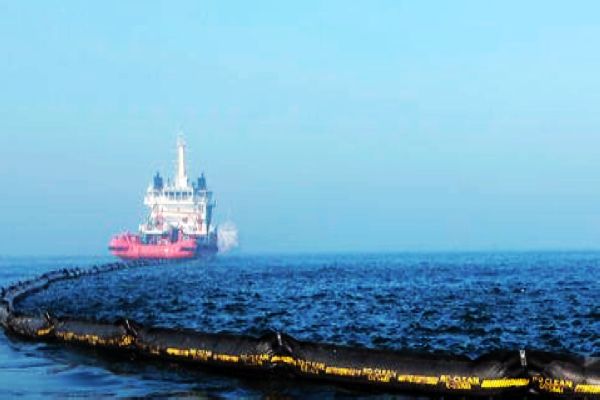
A ship is cleaning up the oil spills from Platform C of the Penglai 19-3 Oilfield in north China's Bohai Bay, July 9, 2010. [caixin.com] |
Until now, China's Ministry of Agriculture as well as Liaoning and Hebei provinces, have released neither the official distribution plan nor the specific distribution guidelines. However, sources close to the aquaculture authorities of the affected local communities said that the government's primary allocation plan will be based on the test results of oil particles.
Other coastal areas in provinces around the bay, including Tianjin and Shandong, also claimed that they suffered certain losses from ConocoPhillips' oil leak at its Penglai 19-3 oilfield last year. However, tests of oil particles collected, found that only a few from the shorelines of Liaoning's Suizhong County and Hebei's Leting (under Tangshan City) and Changli (under Qinhuangdao City) counties could be traced back to the oil spills.
There is an unconfirmed report going around that Liaoning Province, Hebei's Tangshan and Qinhuangdao cities will receive over 300 million yuan (US$47.4 million) in compensation, respectively. While another report says that the government will allocate the money to all of those who have suffered losses in the oil spills.
It has been found that the two aqua economies of Changli and Leting counties in Hebei Province have already launched preliminary undertakings concerning compensation. The staff at the local aqua authorities confirmed that the government had finalized the allocation plans. "All the money will be handed to those who have suffered losses , including the aqua raisers and fishermen."
The government has also been drawing up the overall compensation procedures. A staff member at Changli's aqua watchdog said, "How the money should be allocated is decided by the government at a higher level. Presently, our work is to calculate the losses of local fishermen in different categories and map out a compensation plan for the higher-level government's reference. The government will announce its general solutions and make adjustments in line with the feedback before the final plan can be set in motion." The whole process will take several months.
A source close to Leting's aqua authorities said that fairness is the government's guiding principle in handling the compensation allocation, which will, most probably, be implemented on a unified standard developed on the basis of breeding acreage. "Differences in losses and whether or not the losses were really caused by the oil spills will not be delved into, as it may be hard to find out the facts."
Many lawyers and scholars in the field of environmental protection commented that it's admirable that the Chinese government has made such big progress compared to the past, by taking on an active role in the negotiations with ConocoPhillips for compensation and adhering to the principle that all compensation funds should be entirely delivered to those affected without anything being retained. However, such an approach only shows that the traditional way of government involvement has improved. The outline reflects that the government is backsliding into its old tracks of resolving environmental incidents mainly through government intervention rather than through legal processes.
One environmental scholar explained: "The danger of this pattern lies in the fact that the government is changing itself from being the sufferer of environmental damages and formulator of compensation rules to the compensation dominator, which finds itself with all types of other conflicts and troubles." Such a solution is generally considered bad practice as it cannot help determine the real environmental damages on any legal basis to force the pollution-makers to pay a high enough price. Nor does it ensure that the compensation is appropriate to fully cover the sufferers' economic losses.
The scholar further said, "In this mode, the final result may be that both the culprits and those affected will be discontented. The government will fall into the traditional vicious circle, in which the public keep appealing to the higher authorities, whereas the government is busy maintaining social stability."


Go to Forum >>0 Comment(s)