IP salon eyes innovative trend in China
- By Wu Jin
 0 Comment(s)
 Print
 E-mail China.org.cn, March 18, 2015


|
|
|
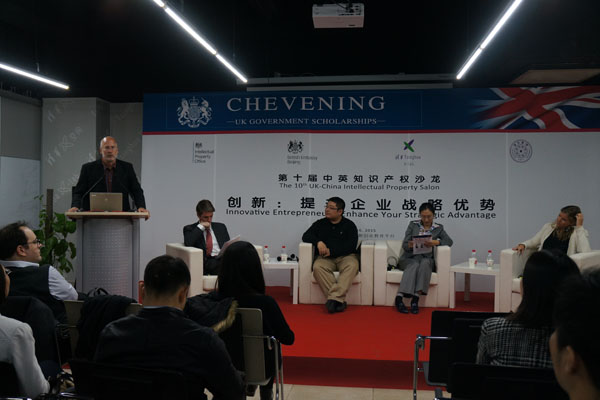
Steven White (first on left), professor in the Department of Innovation, Entrepreneurship, and Strategy at Tsinghua University, delivers a keynote speech at the 10th U.K.-China Intellectual Property Salon jointly held in Beijing on Monday by the British Embassy in Beijing and Tsinghua University X-lab. [China.org.cn / by Wu Jin] |
22-year-olds Lu Kuan and Wang Tianyu are among the fresh graduates who want to earn their first paychecks by trading their campus innovations in the market.
Unlike their conventional parents who have never stopped trying to persuade them to find stable lifetime jobs and patiently wait for promotions, the two young men have initiated a partnership in an attempt to start their own business developing hardware technologies for cell phones.
They are now busy knocking on the doors of big companies that they believe could be potential customers or even collaborators, but they have a difficult and uncertain road ahead of them.
In addition to encountering numerous refusals, the two aspiring entrepreneurs also have to worry a lot about plagiarism in the domestic market. According to them, an intellectual property lawsuit would cost too much and the ensuing enforcement would take too much time.
"Sometimes you win the lawsuit, but you lose the market because technological products upgrade very quickly," said Lu.
In response to the concerns of young people with entrepreneurial spirit, the British Embassy in Beijing and Tsinghua University X-lab, a two-year-old educational institute for people who want to start their own businesses, jointly held a workshop on Monday evening, inviting a number of figures in the fields of venture capital, technological collaboration and IP protection.
"China is transforming from a very good copycat -- an imitator in some cases -- of intellectual property to creating IP and using its own IP to be competitive," said Steven White, a professor from the Department of Innovation, Entrepreneurship and Strategy at Tsinghua University.
"That's a fascinating transition to watch," he said at the workshop, named the 10th U.K.-China Intellectual Property Salon at Tsinghua X-Lab in Beijing.
But experts believe that before China's innovative society matures, China should spare no pains to improve its IP market.
Phillippa Hall, Chief Economist of the U.K. IP Office and a speaker at the workshop, said that the funding, system and enforcement of IP is a very valuable part of China's quest to build an innovative society that will in turn help the country maintain 7-percent economic growth.
Tom Duke, IP Attaché of the British Embassy in Beijing and the moderator of the workshop, said that start-ups also need to consider IP issues when they are trying to make their businesses grow.
"The bigger [a start-up] grows the more crucial its need to think about IP," he said.
When touching on specific issues concerning start-ups like Lu and Wang's, Zhang Jie, head of the China Research Center of British Telecom, a British telecommunication provider, provided her advice.
According to Zhang, BT is partnering with universities such as the University of Cambridge, Massachusetts Institute of Technology and Tsinghua University to share innovations.
But she stressed that before presenting their ideas, start-ups should already have prototypes in hand so that companies like BT can evaluate the feasibility of the innovations in the market before deciding whether to buy them.
Zhang also noted that many start-ups need investors to finance their development, but that it is very challenging to persuade the market to inject money into their businesses.
Jeff Wang, a venture capitalist partner at Kaiwu Capital and a panelist at the workshop, said that investing in the early stage of a technology is very challenging because investors are really not quite sure if "they are getting the right piece of treasure." But he advised the start-ups to learn more about IP rules, play in a global context and more importantly show their true faces so that investors may be quick to find a way in which they can help.
But based on Lu and Wang's experience, access to assistance may not be so easily obtained. Investors demand to know the competitiveness of their innovations, while the start-ups have to decide to what degree they should share core technology with investors so as not to jeopardize their appropriate rights to ownership of the products.
Meanwhile, while they are going back and forth between big-name companies, legal consulting institutes and universities, their classmates have already deposited several monthly paychecks in their accounts from their first jobs.
"We are really under great pressure," said Lu, "but we don't want to give up. Even if we fail, we will appreciate the start-up as our unique life experience."
China is trying to maintain its market vitality and restructure its industries amid an economic slowdown by encouraging innovation in the upcoming decades, as Chinese Premier Li asserted at a press conference held right after the conclusion of the Two Sessions last Sunday. He said the government will continue to "remove roadblocks and pave the way" for entrepreneurship.


Go to Forum >>0 Comment(s)