Chinese e-sellers into Russia
 0 Comment(s)
 Print
 E-mail CRI, June 21, 2015


As online shopping quickly grows around the world, leading Chinese online retailers are taking a stride into the Russian market.
|
|
| Russian President Vladimir Putin meets representatives of companies who are invited to the 19th St. Petersberg International Economic Forum in Russia on June 19th, 2015. Alibaba's President Jack Ma attends the meeting. [Photo: ifeng.com] |
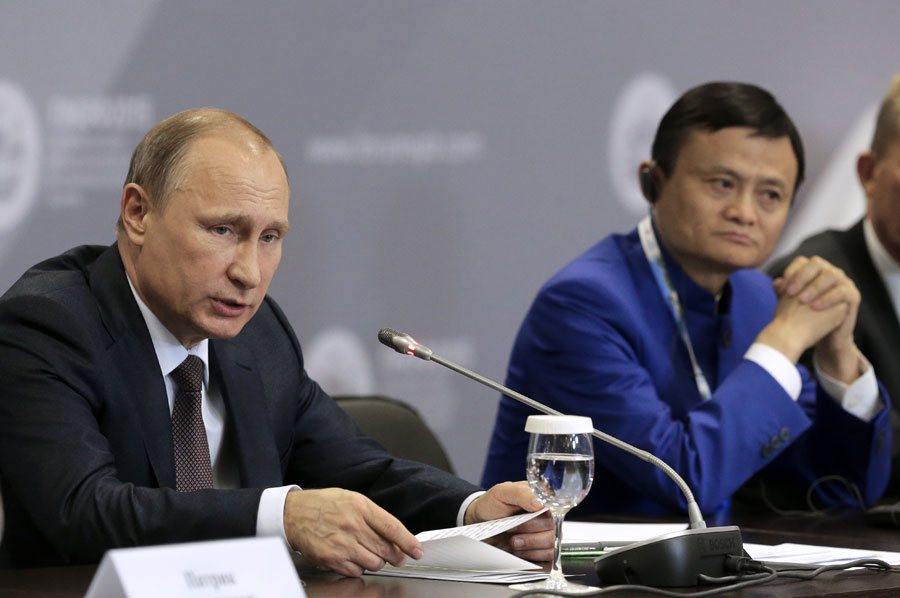
In his speech to this year's St. Petersberg International Economic Forum, Alibaba's President Jack Ma highlighted the role of the internet in changing people's life and encouraged young Russians to start their own business online.
"15 years ago, nobody had heard of Google, iPhone, Facebook, Yandex and alibaba. But today, it seems so many people cannot live if there is no such a company existing there. What's the magic behind it? I think it's because of the internet. If I were a Russian young people, use internet, create something and sell something online, the future is going to be good. And I and Alibaba will do anything to support young people and small businesses."
It's widely believed that Ma's speech is also a promotion for his firm's expansion in Russia.
Since entering Russia three years ago, Alibaba's global retail platform Aliexpress has seen robust development in the country and soaring popularity among young locals.
Mark Zavadskiy is Chief Business Development Officer of Aliexpress' Russian branch.
"Despite the current economic difficulty in Russia, Alibaba is confident about the role of the Russian market in Europe. Over the past three years, Aliexpress has grown rapidly. Now, we have become the most popular online shopping platform in Russia and ranked 9th among all websites in the country that also include Yandex and Facebook."
About a month ago, as its latest step to tap into local market, Alibaba opened its representative office in Russia in a bid to facilitate goods purchase and delivery and the payment system integration.
Ali is not the only Chinese online seller eyeing the potential of the Russian market.
Recently, cross-border trade platform Osell opened an exhibition hall in Moscow and began to regularly hold promotional activities for its Russian and Chinese users.
Vice president of Osell, Su Mingpu said:"Experience activities will be held at least twice a month under different themes to set up a bridge between buyers and sellers of consumer goods and industrial products. In China's emerging export destinations like Russia, Brazil, India and Dubai, establishing a display platform or a local partnership is helpful for a Chinese enterprise to explore the local market."
Facing the fast rise of Chinese firms, Boris Titov, chairman of the Russian part of the China-Russia Friendship Committee for Peace and Development, suggests there be more native competitors.
"Giant companies like Alibaba have dominated the e-commerce market. It's foreseeable that great changes will happen to the market system and most trade in the future will be completed through internet-based enterprises. It's the direction of trade development. Russia also needs to foster Alibaba-like companies to compete with Chinese traders."
Currently, internet service covers about 70 percent of the Russian population, while online shopping accounts for less than 3 percent of the country's retail sector, which many believe leaves huge room for the growth of Chinese companies.


Go to Forum >>0 Comment(s)