Production capacity co-op needed to boost China's overseas demand
- By Zhang Lulu
 0 Comment(s)
 Print
 E-mail China.org.cn, September 10, 2015


|
|
| Xu Shaoshi, head of the National Development and Reform Commission, speaks during the annual meeting of the New Champions of the World Economic Forum held in the coastal city of Dalian. [Photo by Zhang Lulu] |
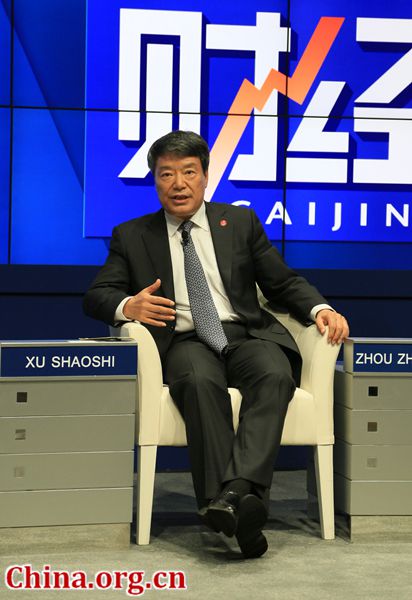
China needs to promote international cooperation in production capacity to boost its overseas demand, Xu Shaoshi, head of the country's top economic planning body, said on Wednesday.
"China cannot rely solely on the export of consumer goods, but also needs to transition to international cooperation on production capacity and equipment manufacturing," said Xu, head of the National Development and Reform Commission, during the annual meeting of the New Champions of the World Economic Forum held in China's coastal city of Dalian.
China's exports declined 6.1 percent in August from the previous month and saw a total contraction of 1.6 percent in the first eight months of the year, according to the latest figures released by the customs agency. Net exports accounted for about 22.6 percent of China's GDP in 2014.
The world's second largest economy has seen a slower growth rate as it makes a transition from an investment- and export-led economy to a consumption-driven one. While sending out the message that China's economic fundamentals are still "healthy," the country's top economic planner emphasized the importance of enhancing international cooperation on industrial capacity.
"China has more than 200 types of world-class industrial products, a wide variety of industries and rich production capacity, thus it must seize the opportunity to promote international cooperation in production capacity and equipment manufacturing," he said.
Such cooperation efforts have been prominent in recent months. China agreed on production capacity cooperation with Kazakhstan in December 2014, producing agreements worth billions of dollars since. Some have described it as a new means of building economic ties between China and foreign countries.
Cooperation & early results
China's State Council issued a guiding opinion in May this year, saying that such international cooperation will help maintain the nation's growth, advance economic openness, and carry out win-win cooperation.
In the document, 12 industries have been singled out as key areas for capacity cooperation: iron and steel, non-ferrous metal, construction materials, railway, electricity, chemical engineering, light textile, automobile, telecommunication, engineering machinery, aerospace, ships and marine engineering.
The Chinese economy is still facing downward pressure, and overcapacity is a sign of it, Xu said. However, he also emphasized that the excess capacity, instead of backward, is relatively advanced, which meets technological and environmental standards, he said.
Cooperation is mainly realized through investment and building factories, production lines, infrastructure, industrial chains, and industrial cluster zones, he said. It is carried out by companies through such means as direct investment in overseas countries or technological cooperation with suitable government guidance.
So far, China is working with 15 countries, which are in Asia, Africa, Latin America, and Europe, Xu revealed. The most "representative" is Kazakhstan. The two countries reached a first round of cooperation of 25 projects worth US$23 billion and a recent second batch of 42 projects are worth US$30 billion.
Kazakhstan is the "fulcrum" in carrying out cooperation of production capacity and equipment manufacturing in Central Asia, while China has also inked deals with Pakistan, Russia, Indonesia and Egypt, among other countries.
The country is also cooperating with large international organizations, including the European Union, the African Union, and ASEAN, and a series of funds have been set up to promote the cooperation, Xu said.
Third-party cooperative means are also being explored, exemplified by China working with France to build nuclear power facilities for the UK, Xu added.
The cooperation will help the global economy to recover from the aftermath of the 2007 financial crisis, the economic planner said.
In an answer to a South African participant of the forum, Xu said that the cooperation will involve the hiring of local workers, procurement of local equipment, and helping to increase local income and taxation.


Go to Forum >>0 Comment(s)