China-US co-op on clean energy drives sustainable development
- By Tang Xinhua
 0 Comment(s)
 Print
 E-mail China Today, October 8, 2015


|
|
|
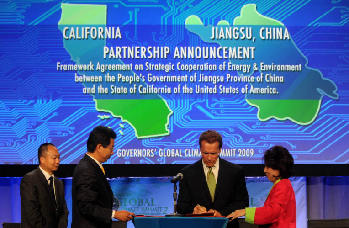
Jiangsu Province of China and the State of California of the U.S. sign the Framework Agreement on Strategic Cooperation of Energy and Environment on October 2, 2009. It is the first pact on new energy and emission reduction between local governments of the two countries.[File photo] |
Bilateral and Global Significance
Climate change presents a grim challenge to humankind in the 21st century, and is manifested in the increasing frequency of extreme weather events such as droughts, floods and cyclones. Coping with this challenge will require concerted effort and worldwide action. As the world’s largest developing and developed countries, it behooves China and the U.S. to join hands in this mission in order to inspire more forceful global action. They set a good example in 2014 by issuing a joint communiqué on climate change that lent support to the Lima conference.
The Paris conference convening in December is expected to produce a new universal agreement on climate change for post-2020. Its outcome will determine whether humankind will reach the goal of limiting global warming to no more than 2°C – a failure here would unleash catastrophic consequences on the planet, and complicate the transition to green, sustainable development in the course of industrialization. It is also critical to constructing a model of global governance through the broadest ever collective consultation.
From this perspective, China and the U.S., as representatives respectively of the developing and developed world, must bolster their communication and coordination, adhere to the principles of common but differentiated responsibilities, equity and respective capabilities, and solidify their consensus to the utmost extent, while concerting their efforts to seek balanced, proportional results at the Paris conference.
The currently flagging global economy is primarily attributable to an aging population, the widening rich-poor divide, and regional economic bubbles, all of which result in a lack of effective demand in the real economy. Measures to ameliorate climate change, however, can generate this much-needed “creative demand.” Green growth in the U.S. has proven a boon for its economy, bestowing on it yet another competitive edge in the age of innovation. In China, the pressing problems of a slowing economy, severe pollution, and the urgent need for industrial upgrade and innovation all translate into a huge demand for green industries. Business opportunities abound in areas such as emissions reduction, efficient construction, and exploitation and use of clean energy, as well as remediation and protection of the eco-system. China and the U.S. can expand their cooperation in these areas in technology, management, marketing, financing and manufacturing; this will stimulate their domestic growth and industrial restructuring – in addition to that of the larger world – and thus usher in a new cycle of industrial revolution.
The Chinese and U.S. economies both heavily depend on fossil fuels such as coal, natural gas and oil, much of it imported. This poses a threat to their respective energy security. Each drastic change in human energy use leads to a revolution in global industry. As the cost of clean energy falls appreciably, thanks to technological advancements, world energy consumption is increasingly tilting towards the low-carbon end. Countries globally are looking to solar, wind, hydropower, biomass, oceanic, and nuclear sources for more energy supplies. Integration of advanced technologies such as distributed generation (DG) and smart grids in the power system have also wrought revolutionary changes on power supply and have hence shored up national energy security.
Earlier this year, the Obama administration announced more than US $4 billion in private sector commitments and executive actions to increase investment in clean energy innovation. It later unveiled the Clean Power Plan, an important step in reducing carbon pollution from power plants. These initiatives offer the potential for cooperation between the U.S., which boasts the world’s best technologies, and China, with the world’s largest market for technological applications. This will accordingly benefit both in their transition towards low-carbon development.
The new-model major-country relationship between China and the U.S. rests on the old basis of conventional security. Vulnerable to shifts in bilateral ties and the regional/international environment, it is thus inherently unstable. A solution to this problem is to expand bases and areas of cooperation to increase their strategic confluences. Climate change is opening up a new front and highlight in their collaboration. Since the inauguration of the S&ED in 2009, climate change, energy conservation and environmental protection have figured more prominently in their talks, and featured in half of the achievements reached at the seventh round of the S&ED. It is evident that practical cooperation between the two countries on climate, environment and clean energy has become another pillar of the new-model major country relationship between them.
Abundant scope exists for deepened and expanded cooperation between China and the U.S in clean energy and environmental protection, with a future focus on energy, the Internet and sustainable use of energy and water. With the merits of high workability, quick effects, tangible benefits and broad influence, this cooperation should indeed receive the attention from both sides it deserves.


Go to Forum >>0 Comment(s)