Restructuring while maintaining high growth
 0 Comment(s)
 Print
 E-mail China Daily, October 20, 2015


 |
|
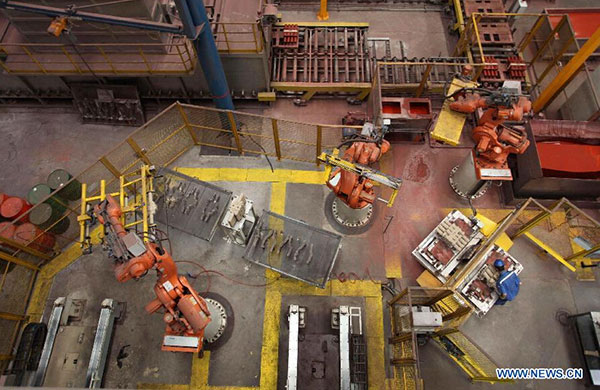
A man works in a workshop of the Foton auto company in the Shuangluan District of Chengde, north China's Hebei Province, Sept. 12, 2015. China's economy grew by 6.9 percent year on year in the first three quarters of 2015, according to figures issued by the National Bureau of Statistics on Oct. 19, 2015. [Xinhua] |
The growth rate of China' GDP fell to 6.9 percent in third quarter of this year, which may cause concern, since it is the weakest since 2009 and less than the targeted seven percent for the whole year, but it is not worth worrying about.
The truth is that China is successfully restructuring economy while maintaining a high growth.
Considering the current huge size of its economy, the 6.9 percent is still very high. Though it is lower than the targeted seven percent growth rate, the 0.1 percent difference is very subtle. And, the government has said that seven percent is not really an exact estimation and a difference around 0.5 percent can be regarded as normal.
However, although GDP may be regarded as the king of economic statistics and it neatly sums up production and output into one number, what it includes and excludes, which is more important to decode the reality, is often ignored.
With a close look at the economy, we may find that the slight fluctuation is caused by some temporary impacts while a transition to new mode of growth is keeping undergoing.
We may recall that the third quarter has experienced a sharp decline in the stock market. Its impact on economy is complex, but it surely affects the growth of financial industry and domestic demand.
Another influence comes from the weak external demand, since the world economic recovery is less than expected. The export growth rate declines 4.6 percentage points compared to that in the second quarter.
Despite these negative factors, the pace of economic restructuring does not slow down.
On the one hand, the traditional industries, which depend on government investments and have accumulated excess production capacity, are experiencing a slowdown in the growth rate of both production and investment.
The growth rate in the traditional industries of the resource extraction industry, heavy industry, processing and manufacturing decreased. We find that the crude steel production fell 2.1 percent and cement production fell 4.7 percent for the third quarter.
The fixed asset investment growth rate declines, too. The growth rate from January to September rose only 10.3 percent, down 1.1 percentage points compared with the first half year.
On the other hand, a new and healthier growth pattern is also gathering strength.
The contribution of consumption to GDP growth was 58.4 percent, with an increase of 9.3 percent compared with the same period of last year.
Though the financial industry had been affected by the decline in the stock market, the contribution of tertiary industry to GDP accounted for 51.4 percent, with 2.3 percent increase compared with the same period of previous year and it is 10.8 percent higher than the contribution of the second industry.
To sum up, it does not means economic problems that the growth rate of GDP is slightly less than seven percent. Instead, the economy continues a translation towards a healthier economy growth mode.
However, some economists' concerns about the Chinese economy are not incomprehensible.
Besides China's huge economic scale, the economy has a very different structure (at least from the Washington Consensus), which makes it is difficult to decode.
Many economists suppose that with extensive government's inefficient intervention in the economy, the high speed economic growth is not sustainable. Some believe that the economic crisis is on the way.
No wonder that a sudden decline in the yuan exchange rate recently makes many economists think that Chinese economy is experiencing serious difficulties.
The worries may arise because of neglects of China's economic growth stage and market features.
China's per capita GDP in 2014 is about $7,589, while the per capita of the United States is $54,597, which is 7.2 times of China's. China is not a wealthy community. But it has an advantage of a huge unified market.
In this context, the central government needs sufficient resources to solve two problems: one is to enhance the unified market, the other is to balance development of different regions.
At this stage, the society need rapidly improve its infrastructure and basic industrial facilities. Since the products, such as mining industry, transport, telecommunications and electricity, are standard products with mature technology for the stage, it can be regarded as an efficient choice that these products are uniformly provided in the whole country by State-owned enterprises.
Now China has equipped the market with fine infrastructure, it is time for government to retreat from competitive industries and switch its role from a production-oriented government to a service-oriented one.
Chinese are still not rich and they are hard-working people with full of longing for a better life, which means a great potential for economic growth. With such a huge unified market, as long as the restructuring of economy steadily continues, we would remain optimistic about its economic growth.


Go to Forum >>0 Comment(s)