Chinese students keen to be entrepreneurs in UK
 0 Comment(s)
 Print
 E-mail Xinhua, October 27, 2015


|
|
|
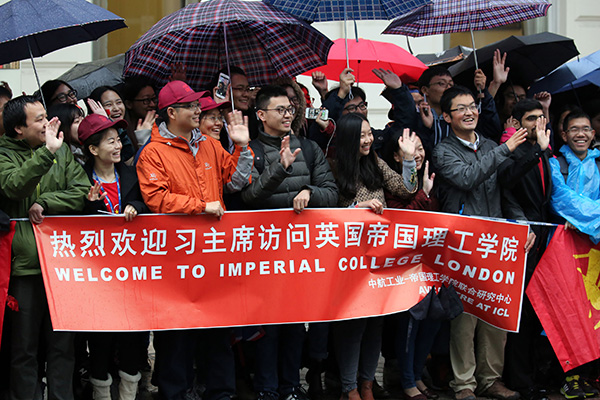
Chinese students at the Imperial College London to welcome the arrival of Chinese President Xi Jinping on Oct 21,2015. Xi praised cooperation between the college and Zhejiang University, a top-notch college in China. [Photo/China Daily] |
For Yao Ting, studying in the United Kingdom is more than just going to classes and finishing assignments.
Like many other Chinese students there, he is more eager to seize the opportunity to start his own business after Chinese President Xi Jinping's state visit last week ushered in a "golden age" in bilateral ties.
Although the 23-year-old is still a junior at the University of Warwick, he has already teamed up with other ambitious budding entrepreneurs from British and Chinese colleges to launch an online education platform called AskiNow.
His aim is to provide quality tutoring for Chinese students studying in the UK.
The idea behind Yao's start-up project is to meet the educational demands of the growing number of Chinese students.
"We hope to customize online tutoring service, so they can find the best teachers to help them improve their study," Yao said.
As bilateral ties expand, an increasing number of Chinese students are looking to achieve academic success in the UK. Around 150,000 students from China study there.
Besides education, two-way investment between China and the UK has grown rapidly. The country's investment has jumped at an annual rate of 71.7 percent during the past three years. Last year, the UK's investment in China increased by 87.6 percent year-on-year, the fastest among major European Union countries.
Nowadays, China is almost an unavoidable topic in business circles there. The UK'S economic environment has become more friendly to Chinese companies and investors.
Students such as Yao see that they have a chance to turn their ideas into real businesses.
"As overseas students, we have witnessed the increasing exchanges between Britain and China in such fields as business, investment and tourism in recent years, and the time has come for us to pursue our own entrepreneurship," he said.
But it is never an easy task to secure investment for a startup project.
To find funding, Yao and his team participated in several competitions in the UK, which are popular among Chinese students with entrepreneurial vision.
"We participated in startup events and competitions in Britain and China," he said. "We can see that the market in China is more vibrant when it comes to startups, while investors in Britain tend to be calm and observant."
After fine-tuning their proposal and honing their business skills, Yao's team made it to the final round of a startup competition sponsored by the government of Beijing's Chaoyang district.
They were among the three winning teams selected from more than 200 competitors in the UK, and they will now go to Beijing to participate in the final round, presenting their projects to China's top investors.
A total of 23 teams from the United States, Australia, the UK, Israel and China entered the final round of the competition, hoping to secure funding. The competitors also had the chance to obtain investment and other preferential treatment from the government of Chaoyang district.
"The number of startups led by Chinese students is increasing in recent years," Philip Hao, chairman of the Young Entrepreneur Society Global, or Yes Global, said, adding that the organization put together the UK round of the startup competition that Yao's team participated in.
The rising trend was a result of policy supports from the two governments and the new way of doing business in the Internet era.
A large number of the Chinese student-led startups he has seen focus on online service. This is no coincidence, since even a one-man team can jump-start a business such as selling on eBay.
"But running a company is not just coming up with great ideas or being venturous," Hao said. "Nowadays, market competition is getting more intense with young entrepreneurs fighting to make it to the top tier. So, it is more about how to establish systematic management and how to control budgets. You need to attend to every detail."
In Yao's case, the local government in Suzhou has offered help to his team in securing investment in the initial phase. The University of Warwick has also promised to support them in their project's future development.
"Without such support, it would be much harder for us to enter the business world," Yao said.
Despite the challenges, UK universities quite often maintain an open mind on student entrepreneurship.
"Enterprise and startup companies are an increasingly important option for university students of all nationalities," Keith Burnett, vice-chancellor of the University of Sheffield and member of the British Prime Minister's Council of Science and Technology, said.
"The University of Sheffield encourages students to become actively involved in its enterprise activities and has the largest program of students in free enterprise in the UK," he added.
An international team of Sheffield students, working together on startup ventures in the areas of health and support for people in need, reached the global finals of the Enactus World Cup in Johannesburg in South Africa this month.
The international event is aimed at promoting entrepreneurial action as a catalyst for progress.
The university also makes funding and professional advice available to students with a great business idea.
"Our aim is that support of innovation, entrepreneurship, team working, and new business support is embedded in teaching in such a way that students are able to lead and develop ideas either as start-ups or within existing companies," he said.


Go to Forum >>0 Comment(s)