Global players adapt to 'new normal' model
 0 Comment(s)
 Print
Print E-mail China Daily, November 16, 2015


|
|
|
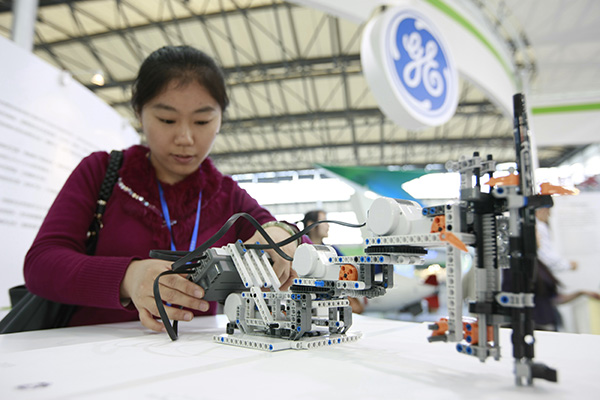
A woman inspects a robot designed by General Electric during a recent industrial fair in Shanghai. Despite the slowdown in China's economic growth, the US company is confident that the Chinese market will continue to expand. [Photo provided to China Daily] |
A slowdown in China is forcing multinational companies to treat the world's second-largest economy more like a developed market.
This has involved turning away from the headlong dash for growth to focus on premium businesses as well as improving productivity by investing in staff.
As the main driver of global growth for much of the past decade, China has been a godsend to big international firms looking to boost profits as economies elsewhere struggled.
Now, though, Beijing is attempting to rebalance its economy to a more sustainable rate of expansion dubbed the "new normal" by President Xi Jinping.
But with growth at its slowest in a generation, a slew of companies are citing China as a reason for underwhelming earnings in the past six months.
"We've entered the new phase, a new normal with slower growth, and that changes the business dynamic, and it changes the outlook," John Lawler, Ford China CEO, said at a conference for United States businesses in Shanghai.
In recent weeks, weakness in Chinese demand has been blamed for soft sales and trimmed forecasts from companies ranging from luxury fashion retailer Burberry and KFC owner Yum Brands to US computer hardware and consulting firm IBM to Japanese robot maker Yaskawa Electric Corp.
Last month, economic data also showed export growth dipping in Japan and South Korean-both blamed on the slowdown in their giant neighbor.
Companies in sectors such as construction and mining have felt the biggest pinch.
Heavy equipment maker Caterpillar plans to slash capital spending and cut about 10,000 jobs, while industrial conglomerate United Technologies Corp said its business in China could drop as much as 15 percent next year.
And the days of double-digit growth that had foreign companies scrambling to enter the country in the first decade of the millennium may not be coming back.
President Xi said early this month growth would remain around the 7 percent level for the next five years.
As Beijing tries to steer the economy away from the export and investment-led growth model that fueled China's rise, firms are having to re-evaluate their strategy.
"Generally, it has probably moved from 'go, go, go, growth, growth, growth,' to 'things are getting complicated'," Abinta Malik, general manger for Gap Inc in Greater China, said when asked at the Shanghai conference how the message from head office had changed.
In response, some firms are now investing more in development to cater to Chinese consumers' growing sophistication.
"We have reformulated our products, we have invested in innovation and renovation very much like we do in Europe," Paul Bulcke, CEO at Nestle SA, told reporters after the world's biggest packaged food firm warned in mid-October it would miss its long-term growth target this year.
China's Premier Li Keqiang said that Beijing's policymakers estimated consumption in China's vast market was still only half its capacity.
The problem is that consumers are not yet picking up the slack from falling industrial demand.
"The rapidly rising consumer spending has yet to offset the decline in traditional industrial investments," Ulrich Spiesshofer, CEO at Swiss engineering group ABB, said after reporting a fall in net profit and revenues for the third quarter.
Healthcare is one promising area to target as the Chinese consumer grows older, richer and better informed.
"The underlying fundamentals haven't changed," Jeff Bornstein, chief financial officer at General Electric, said in October of GE's healthcare technology business.
"There is still nearly 1.4 billion people. They're still building hospitals. The private market in China has grown 15 percent to 20 percent a quarter," he added.
Pharmaceutical company Hoffmann-La Roche AG, which bucked the trend by increasing third-quarter sales in China, said the market for its mainstay cancer drugs was growing strongly.
This helped offset struggling sales for older products facing generic competition.
"What we're really seeing is our strategic products that are just beginning to really find their way to patients in China are growing very well, double-digit growth overall," Dan O'Day, Roche's pharmaceuticals chief, said.
Flatlining car sales have prompted global car makers such as BMW to intensify training programs, teaching dealers, who had previously derived the bulk of their income from selling new cars, to maximize revenue from auto financing, repairs and insurance.
Services have been one of the few recent economic bright spots, with a private sector survey showing the fastest pace of expansion in three months.
ABB's Spiesshofer said the company had opened a new service center to supply spare parts, maintenance and consulting services for oil and gas, chemical, utility, metals, transport and infrastructure sectors.
"Historically, customers have not yet taken out the service offering as strongly," he said.
"We are pushing that very hard," he added.


Go to Forum >>0 Comment(s)