Innovation: The Key to Guangdong's Future
- By Bryan Michael Galvan
 0 Comment(s)
 Print
Print E-mail Beijing Review, November 23, 2015


 |
|
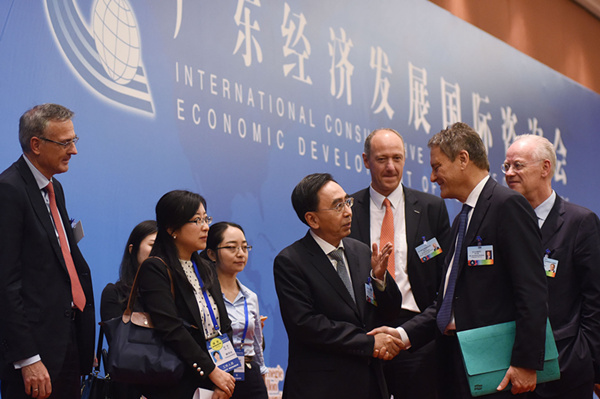
Zhu Xiaodan, Governor of Guangdong Province, talks with executives from a group of transnational companies in the province's capital city Guangzhou during the International Consultative Conference on the Future Economic Development of Guangdong Province on Nov. 19, 2015. [Photo/China.org.cn] |
At the individual level, Scharping encouraged people to "think, discuss, make decisions and act-- be ready to act informatively and most of all, be ready to take risks." Regarding changes to Chinese society, he also encouraged "creating opportunities and an environment that is accepting of failure," and that "innovation is the key to making Guangdong province ready for the future."
Creating, acquiring and promoting talent-- "these represent the actual basis for innovative development", stressed Zhu. Indeed, with increased government support in emerging fields such as mobile apps, consumer electronics and renewable energies, China has seen a surge in startups with an average of 30,000 new companies registering during 2015.
Among them is Derrick Xiong, the 26-year-old co-founder of Ehang Intelligent Co., Ltd, based in Guangzhou. His company produces unmanned aerial vehicles or drones, which can be controlled through the use of a smart-phone and supports virtual reality.
Xiong, who has started companies in incubators such as Silicon Valley, Israel and Singapore is adamant about the business prospects in China.
"I feel this is the right time for entrepreneurs like me that have been educated in the West or in China and who understand a local market—they can come back to China to make a product here in a really fast pace environment and create an overseas market. So I think that is the best thing about China," he states proudly.
"Before I came to China every single Chinese overseas student or entrepreneurs always ask themselves 'when should I go back to china?' if you ask me nowadays, all these facilities and the huge, huge population that you can talk to, reach out and approach are the best resources."
"This is the best time, the best location and the best place to do business these days," Xiong exclaims, adding that more and more Western entrepreneurs are moving to China. Even Silicon Valley startups such as Uber have started encroaching on the "world's largest transport market."
Huizhou's Desay SV Automotive company also attributes its success in becoming one of the leading manufacturers of automotive electronics in China. President Tan Choom Lim states that "Chinese companies are no longer copying [others] today, but instead going into alliances with leading suppliers." Lim emphasizes that "in a globalized market economy, that is an important and legitimate way to bring about new technologies in the shortest possible time."


Go to Forum >>0 Comment(s)