China should stick to the process of industrialization
- By Wu Jin
 0 Comment(s)
 Print
Print E-mail China.org.cn, December 9, 2015


|
|
|
Li Yining speaks at the Sohu Financial and Economic Symposium. [File photo] |
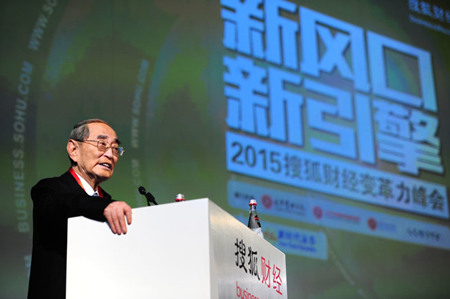
With the acceleration of the tertiary industry which accounts for over half of the proportion of the gross domestic product (GDP), Li Yining, economist and emeritus dean of Guanghua School of Management, Peking University, has warned the country must not deviate from its continuous process of industrialization.
Li made his remark at the recent Sohu Financial and Economic Symposium held a few days ahead of the annual heavyweight Economic Work Conference 2016 hosted by the central government.
It was not likely that China would be able to maintain its high economic growth when the tertiary sector accounts for over half of the proportion of GDP, Li said, therefore, China should never abandon its efforts in fulfilling its industrialization plan, particularly in the post-industrial era.
According to Li, the success of industrialization overwhelmingly relies on technological innovation, which can personalize the service of each product for different individual demands, winning the favor of overseas customers while focusing on providing domestic consumers with greater product satisfaction. In doing so, the economy can be truly reinvigorated from the current downward trend, he said.
Macro-economic control should be promoted within a certain format, balancing demand and supply, forging interaction and increasingly financing the restructuring of less competitive suppliers.
Besides, education and occupational training must play an important role in terms of innovation in the long run, Li said, adding that it was a long process requiring patience.
When forecasting the 2016 economic performance, Li said the country might still struggle, but possibly with better momentum than 2015.
Another panelist, Hu Deping, former deputy director of the Economic Commission of the CPPCC, said reform should highlight the importance of removing industrial surplus so that economic restructuring can be elevated to a new level. Hu also urged steadfast and determined macro-control policies that assisted the enterprises to efficiently judge and learn from their past.
Huang Yiping, commissioner of the Monetary Policy Committee of the People's Bank of China (PBC), said changes of the financial system had intensified as the central bank scrapped the Deposit Interest Rate Ceiling, while the RMB has been included in the Special Drawing Rights of the International Monetary Fund.
The changes challenge the financial supervision administrations of the country, where enhanced coordination and communication was a vital need, he added.
Talking about national financial reform, Huang said the interest rates should be freed in a phased way, while the capital market should not be wholly opened in one go and investors should keep a close eye on possible risks of Internet finance.


Go to Forum >>0 Comment(s)