Paulson: China should accelerate reforms
- By Li Shen
 0 Comment(s)
 Print
 E-mail China.org.cn, February 26, 2016


Former U.S. Secretary of the Treasury and Chairman of the Paulson Institute at the University of Chicago, Henry Paulson analyzed the short, medium and long term challenges facing the Chinese economy in his remarks at the Institute for International Finance G20 Conference held in Shanghai on Friday.
|
|
|
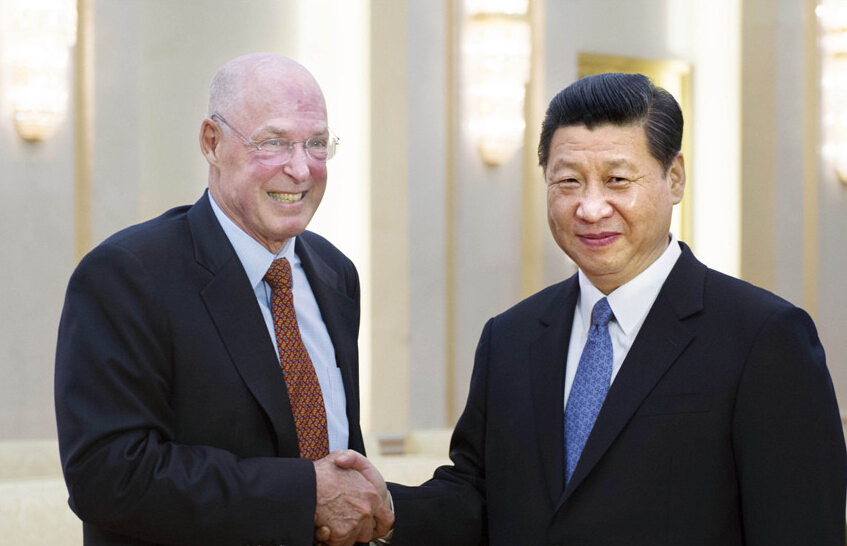
Chinese President Xi Jinping (R) meets with former U.S. Treasury Secretary Henry Paulson at the Great Hall of the People in Beijing, capital of China, April 24, 2013. [Xinhua/Xie Huanchi] |
According to Paulson, the challenges China faces are both real and difficult. In the short term, the principal challenges include currency, overcapacity, and the need to quickly restore market confidence. In the medium term, China must address the buildup of debt and leverage across the system. In the long term, the Chinese economy needs more sustainable new growth drivers which make these structural adjustments lie at the heart of President Xi Jinping's reform agenda.
China should take meaningful steps to advance the reform agenda quickly to move the country on the path to a new growth model, Paulson said.
He pointed out three areas, in particular, where China could demonstrate a seriousness of purpose and sensitivity to market concerns, while also moving its economy down the path to deepen structural reform.
First, China could take significant and visible steps to show that it is serious about dealing with underperforming and inefficient state-owned enterprises. One such step would be to dramatically reduce overcapacity in sectors such as steel and coal. China should let some of these and other failing state-owned concerns actually fail. That means dealing with them not through consolidation, but by allowing bankruptcies.
A second area where China could take meaningful steps would be through demand-side fiscal and tax policies. These should include business tax cuts to stimulate the private sector and encourage innovation, as well as programs to further encourage household consumption.
Third, China can judiciously leverage supply-side fiscal tools to support the transition of inefficient legacy industries into new growth sectors. As China seeks to "make the market decisive," doing so in a way that bolsters private sector firms will be an important signal of intent. This also would help to support President Xi's underlying strategy of rebalancing the Chinese economy.
In terms of the immediate question of the currency, China needs to deal with a substantive challenge. Regarding substance, Paulson believes China remains committed to moving toward a flexible and market-driven exchange rate regime. However, stability is important today, when speculative pressures and market sentiment are shifting toward pessimism and confidence and understanding are low.
He does not believe it is wise or prudent to opine on the Renminbi until market participants have a better understanding of the state of the Chinese economy and how the Chinese are planning to deal with it. The Chinese know as well as anyone what the downsides and trade-offs are. They are always adapting and learning.
In Paulson's opinion, the markets need to see the current volatility in a broader context both in China and globally. China's economy is still growing at above 6 percent and the biggest risks for China, and by extension the rest of the world, probably lie in the future and can be avoided if China pursues the right demand and supply side fiscal policies to deal with the immediate challenges, while accelerating President Xi's economic reform agenda. China has the necessary tools and capacity to do so. Now, it is a matter of political will.


Go to Forum >>0 Comment(s)