Chinese solar company offers advice to B20 summit
- By Gong Yingchun
 0 Comment(s)
 Print
Print E-mail China.org.cn, September 8, 2016


|
|
|
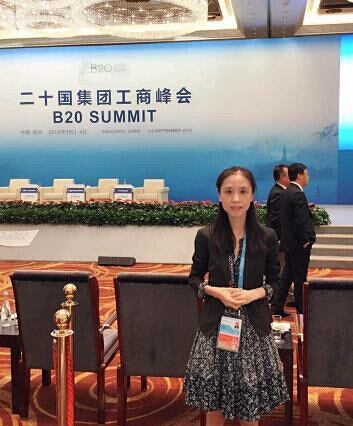
Qian Jing, vice president of Jinko Solar [Photo provided to China.org.cn] |
When addressing the opening ceremony of the G20 Hangzhou summit a few days ago, Chinese President Xi Jinping stressed China should fully leverage the radiation effect and the leading role of infrastructure connectivity so as to help developing countries and small and medium-sized companies integrate into global value chains, and make the global economy more open, interconnected and integrated.
Xi's speech impressed Qian Jing, vice president of Jinko Solar, the only representative of a new energy enterprise to attend the Business 20 (B20) summit. She believes development of a country is fueled by infrastructure construction, to which electricity supply holds the key.
"If we want to develop, we must build roads first. If we want to achieve prosperity, we must generate power first," she said during an interview with china.org.cn on the sidelines of the B20 meeting.
China.org.cn: As an industry leader in the solar sector, in what way has your company contributed its wisdom to the B20 summit?
Qian Jing: Energy power is the key to infrastructure construction. Jinko Solar, the only representative of the new energy enterprises to attend the infrastructure group meeting at the B20 summit, has explained the current situation of the solar power industry. For example, the cost of photovoltaic power in many countries is lower and sometimes far lower than thermal power. Jinko Solar has also pointed out the vital role that the solar power industry plays in various aspects, such as world economic growth, the energy revolution, [energy industry] restructuring, balanced and sustainable economic development and the possibility for cooperation among different companies in the industrial chain. Moreover, on behalf of the solar industry, Jinko Solar has discussed green finance, the necessary requirement for further industry development to expand the financing channels and reduce financing costs, and attract more private and social capital to participate in green infrastructure investment.
China.org.cn: The infrastructure and industry development in the countries along the Belt and Road are lagging behind, and the level of their opening-up to the outside world are relatively low. How to carry out infrastructure construction in such countries? What opportunities will be brought to the new energy companies?
Qian Jing: The development of a country must start from infrastructure construction. If we want to develop, we must build roads first. If we want to achieve prosperity, we must generate power first. Therefore, infrastructure construction should be the first priority when we help these countries to develop industry, especially the supply of power. For example, many manufacturing industries are reluctant to set up factories in India due to its lack of electricity, as its thermal power is heavily dependent on imported coal that leads to high electricity prices. The cost of power generation will be significantly reduced by using economical solar power. India will definitely see robust development in its industry as long as there is a guarantee of sufficient power supply. So the green infrastructure investment in the countries along the "Belt and Road" is promising.
China.org.cn: The EU slapped anti-dumping duties on three Chinese solar companies recently. In fact, the dispute over solar panels between China and Europe has been a long-term issue. How should Chinese solar companies deal with frequent anti-dumping charges? How to maintain their competitive edges?
Qian Jing: The outstanding ability of every economy that has remarkable productivity is based on free trade. The development of the United States and China serve two examples. Every economy will pay a higher price if it cuts off trade with other economies deliberately. Customers and investors will never turn to domestic companies even without trade. Instead, they will reduce consumption and halt investment. Under the circumstances, domestic companies can't be protected while the unemployment issue will become more serious. There certainly are some stubborn politicians who would like to continue to build higher barriers. In face of the current situation, Jinko Solar will improve its products' efficiency in a bid to reduce costs and increase their reliability and long-term performance, which makes Jinko's products to be more competitive.
China.org.cn: The green finance issue formed part of the G20 summit for the first time. What do you think of green finance? What influences will green finance have on the photovoltaic industry?
Qian Jing: Green finance advocates low-carbon and environmentally-friendly finance. Finance should make full use of its role as a leverage of resource distribution, redistributing various resources and channeling more capital into green industries. Moreover, green finance should prevent polluting companies from investing through financial measures. The finance industry should innovate tools to serve green industries, and attract more private and social capital into green industry investment so as to provide financial support for long-term development of green industries. The photovoltaic generation industry is a capita-intensive sector. Upstream manufacturing enterprises and downstream power-generating companies are all heavily dependent on enormous and sustainable financial support. Consequently, green finance plays a crucial part in the development of the solar photovoltaic industry.


Go to Forum >>0 Comment(s)