|
|
|
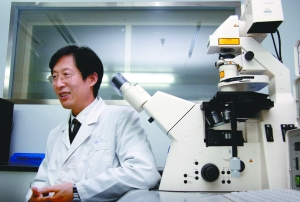
Li Jianyuan, director of the Shandong Stem Cell Engineering Center, rose to fame overnight when he announced on February 2 that his team had cloned five human blastulas from 135 eggs. [the Beijing News] |
Li Jianyuan, director of the Shandong Stem Cell Engineering Center, rose to fame overnight when he announced on February 2 that his team had cloned five human blastulas from 135 eggs. The achievement was originally reported in the online edition of the scientific journal Cloning and Stem Cells on January 29.
But doubts have been cast on the apparent breakthrough after allegations that Li may have faked his educational background. Li claims to have received a doctorate from Nobel Medical Research Center in the USA, but no trace of the institute can be found by Internet search engines.
When queried about the invisible website of the Nobel center, Li initially said there must be a problem with the spelling of the center's name, but failed to provide the correct spelling. He then added that the research had nothing to do with his education, and he had no intention to hog the limelight.
His comments were backed by his employer, Liu Yunxiang, president of Yantai Yuhuangding Hospital, who said Liu's competence was more important than his education. According to Liu's account, Li graduated from a technical school and continued his studies at Peking University's Health Science Center. He never studied abroad but received a doctorate for articles sent to an American institute, for which Liu provided no further details. The hospital president stressed there was no need to check the authenticity of Liu's academic credentials, since the important issue is Liu's competence.
But the explanations are far from satisfactory. Fang Zhouzi, a doctor from the Salk Institute and a well-known blogger on www.sina.com.cn, said any scientific achievements of a researcher who had fabricated his academic qualifications must be highly questionable. The argument may end soon as experts from the Ministry of Science and Technology will shortly evaluate Li's work.
Li cloned four human blastulas from skin fibrocytes of healthy donors and one from lymphocytes taken from patients with Parkinson's disease, CRI reported on February 3. He said the technology is expected to contribute to finding an effective treatment for Parkinson disease.
(China.org.cn by Wu Jin, February 6, 2009)