The U.S. Airways jet that survived a crash-landing Thursday in New York had lost power in both engines simultaneously before ditching safely on the Hudson River, flight data revealed Sunday.
The Airbus A320 had reached a maximum altitude of 3,200 feet (about 975 meters) before both engines cut out, National Transportation Safety Board (NTSB) official Kitty Higgins told a press conference.
 |
|
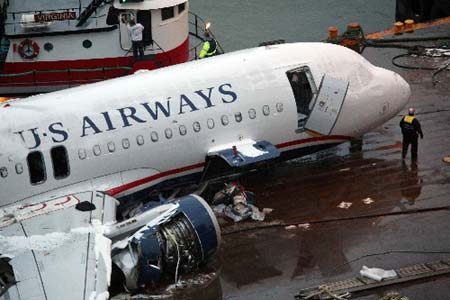
The US Airways Airbus A320 jetliner which crashed into the Hudson River awaits transportation to New Jersey for further inspection in New York January 18, 2009.[Xinhua/Reuters] |
Investigators also said cockpit recordings featuring transmissions between the crew and air traffic control was consistent with the timeline of events based on interviews with the flight crew and other collected data.
Higgins said recordings showed the captain had mentioned birds to the co-pilot about 90 seconds after takeoff.
"One second later, the cockpit voice recorder recorded the sound of thumps and rapid decrease of engine sounds. The captain acknowledges that both engines have lost power and he takes control of the aircraft," Higgins said.
The aircraft was lifted out of the icy Hudson River by salvage crews late Saturday. It was placed on a barge and will be taken to an undisclosed location in New Jersey for examination after its fuel is removed.
Investigators recovered flight data and cockpit voice recorders, known as black boxes, from the waterlogged plane.
The NTSB said ice flows in the Hudson River hindered the search for the left engine, which separated from the aircraft and sank to the bottom of the river.
(Xinhua News Agency January 19, 2009)