The first written record of noodles appears in literature of the Eastern Han Dynasty (AD 25-220). It is said that Marco Polo learned how to cook noodles, and took the recipes back to Italy in 1259.
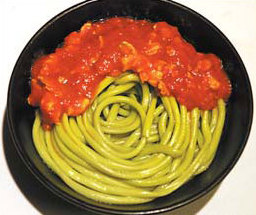
An archaeological finding in 2002 in Qinghai province revealed a bowl of well-kept noodles from 4,000 years ago.
Since ancient times, noodles have not only fed the Chinese but also brought them plenty of fun. Noodles can be eaten in so many different ways: by cutting with scissors, chopping with a knife, tearing with one's hand, stretching, and pulling with chopsticks.
"People of Shanxi province have developed noodle-making into something like acrobatics," says Lin Danshi, owner of The Noodle Loft in Beijing. "The area was one of the poorest in China and lacked food, therefore people invented many different methods of cooking using the same simple materials."
The world's second-most consumed food made of flour, after bread, noodles are what Chinese families eat to celebrate birthdays or when moving from a place.
Of course, behind every good noodle (mian in Chinese) there is a great story. Shanxi's saozi mian (noodles in spicy, sour and fragrant soup with pork and vegetables) is said to be the invention of a mother-like sister-in-law (saozi), who helped her brother become a notable scholar despite being poor. Dandan mian, a Sichuan variation, is so named because it was sold by mobile food stands carried by the vendor on a shoulder pole (dandan). Many people know this noodle style as spicy and tongue-numbing. But actually the noodles come with a great variety of classic sauces.
Over time, noodles have become part of Chinese culture. Just as boiled dumpling is used to mark a festival or the family's return, noodles are a must-eat food at birthdays, and when a family leaves home for a remote destination.
Next time you eat Chinese noodles: It is not just a bowl of food, but also Chinese culture in your bowl! Savor it and enjoy!
There is controversy over the origin of noodles. In the West, some believe noodles were invented in the Middle East during the Middle Ages, passed from the Arabians to the Italians, who then spread to Europe and across the world.
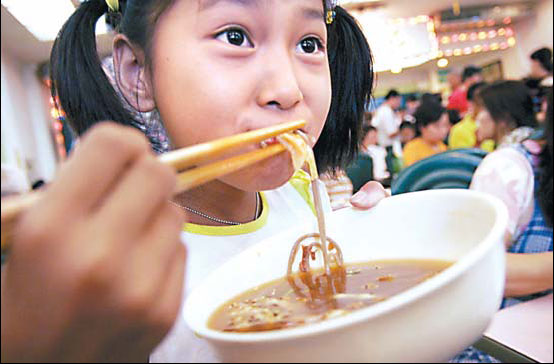 A bowl of noodles is not fast food; it embodies Chinese culture.
A tale about the origin of shaved noodles is popular among Shanxi locals. At the beginning of the Yuan Dynasty (1279-1368), the government confiscated all weapons - even knives - for cooking. Ten households were allowed to share just one knife. One day, an old woman was preparing noodles for lunch and her husband went to borrow the knife from their neighbor, but found it was being used. On his way home the man picked up a thin piece of iron. "How can we use it to cut noodles?" his wife complained. Her husband replied: "If we can't cut it, let's shave it."
Since then the tradition of making shaved noodles has been carried on in Shanxi. A chef stands in front of a big pot of boiling water, a lump of noodle dough in one hand and a thin, arc-shaped knife in the other. He shaves off bits of dough into the boiling water. A top chef can shave 200 bits a minute.
(China Daily April 21, 2008)