|

|
|
Wu Xiumei at her design studio in Hualien, East Taiwan. [China Daily] |
Wu Xiumei always thought she belonged to the Amis indigenous people of Taiwan until she met Dr Hong Qing, two years ago.
After analyzing her dialect and customs and based on the region she came from, the 41-year-old researcher of the Sakizaya tribe concluded that Wu belonged to this tribe, which is believed to have disappeared more than a century ago.
So far, 14 kinds of indigenous people have been officially confirmed in Taiwan. With their numbers totaling nearly half-a-million, the island represents the most densely populated region of indigenous people in the world.
"A long time ago, the Sakizaya had to abandon their homeland because of war and take refuge with the Amis people," says Wu.
"After living together for ages, the two tribes became integrated, but some elderly Sakizaya people retained their customs and dialect. This provided evidence of the tribe's continuing existence," she adds.
After a survey in January this year, it was verified that 335 people of the Sakizaya tribe live in Chilai plain of Hualien, East Taiwan.
Many of the tribe's identifying ways of life have been lost through the years, but Wu tries to recreate the distinctive patterns of their clothing, after a painstaking reading of historical records. "I want to display Sakizaya culture as reflected in their clothes," she says.
|

|
|
Wine bottle coats and bags designed by Wu Xiumei. [China Daily] |
The Sakizaya settlement looks very similar to any other ordinary fishing village. Concrete houses line up by a road, facing the Pacific Ocean. A recent visit showed several fishermen putting up their nets, even as others gathered in the only restaurant catering to the tribe, for a karaoke session - their favorite activity.
According to Wu, the Sakizaya are very close to the Han in terms of living habits.
Fishing and hunting are traditional occupations. Good male swimmers take up jobs at the nearby harbor, while the women take care of the housework, as well as grow vegetables and collect seaweed for their small businesses.
"The quality of life may not as good as that in cities, but we are happy with what we get," Wu says.
With the coming of summer, the tribe gets ready to welcome its most important festival, Feng Nian Ji, the equivalent of the Spring Festival.
Around the end of June, all indigenous tribes along Taiwan's eastern coast celebrate the festival, one after another. Every tribe invites the others to join the celebrations by sending their bravest man to deliver the invitation, accompanied by gifts of areca nut and pork to show the host's sincerity.
The Sakizaya celebrate the festival between August 23 and 25.
In this matrilineal society, men live in their wives' homes. But for the first two days of the Feng Nian Ji festival, only men are allowed to participate in ceremonies honoring the ancestors, while women join in only on the last day when the whole tribe has a big meal together, followed by much drinking and dancing.
This cheerful celebration is open to tourists and lucky visitors may even catch Wu's father, the tribal chief, in traditional dress leading the tribe in prayers.
|
|
|
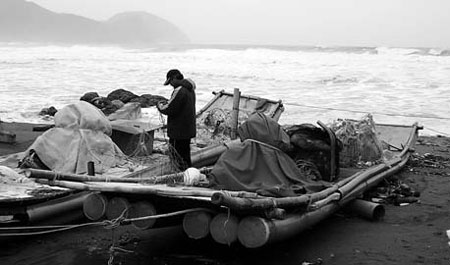
A Sakizaya fisherman prepares for his next trip. [China Daily] |
Wu David has shown a great interest in Sakizaya culture. The marketing consultant of Taiwan indigenous people says the tribe can continue to survive only when the youngsters remain within it and not leave for the cities in search of jobs.
It was at his suggestion that the tribe started the sightseeing tour last year. Wu Xiumei now puts the traditional motifs of the Sakizaya clothes on souvenirs such as handbags and table-cloths.
To her delight, these have been snapped up by not just local tourists, but also people from the mainland. When the second group of China's Amway employees arrived at Hualien port on March 25, all the items made by Wu were sold out in an hour, yielding 50,000 Taiwanese dollars ($1,471).
"Our tribe is yet to see a tour group from the mainland. I wish it will happen soon following the increasing exchanges between the two sides of the Taiwan Straits," says Wu.
(China Daily April 28, 2009)
