The financial crisis has not dampened Chinese mainlanders' enthusiasm for outbound travel, with Hong Kong ranked as the top overseas travel destination this year, a report by ACNielsen has revealed.
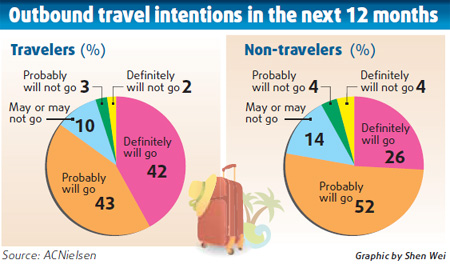
A majority of mainland travelers, or 85 percent of the interviewees, said they would "definitely" or "probably" travel outside the mainland within the year, either for leisure or business, a similar percentage as that in 2008, according to the survey by the global market research company.
The report also showed that even among non-travelers, 78 percent expressed their desire to travel this year, 19 percentage points higher than in 2008.
The survey was based on interviews with 4,000 Chinese mainlanders aged 18 to 59 across 26 cities from January to February this year, before the H1N1 flu pandemic occurred.
"Despite the economic slowdown, the Chinese mainland outbound travel market continues to boom, and is likely to grow further," said Grace Pan, head of Travel and Leisure Research, ACNielsen China.
Tour operators, however, said that the H1N1 flu pandemic, which spread further across the globe in May, has dealt outbound tourism quite a blow, especially to destinations in North America, Europe and Japan.
The ACNielsen survey result was also in sharp contrast to a recent report by IPK International, the world's largest tourism consultancy, which said the global tourism industry would come to a standstill in 2009.
In 2008, the number of mainland outbound tourists grew by 14 percent year-on-year, with 70 percent of them traveling to Hong Kong and Macao.
This trend seems to have continued. The ACNielsen report said Hong Kong was the top tourism destination, with nearly five in 10 potential mainland outbound travelers planning to go there; Macao followed closely with 31 percent.
Taiwan jumped to the third spot from the fifth position in 2008, thanks to an agreement that allowed the mainlanders to travel to the island.
Short-haul outbound trips were the most popular, with more than 60 percent intending to take outbound trips to other regions in Asia, followed by those to Europe, Oceania and North America, at 43, 24 and 20 percent, respectively.
Analysts attributed the growth in outbound tourism to the appreciation of the yuan, which made the travel cheaper.
China CYTS Tours Holding, a leading tour operator, said the outbound travel business grew steadily from January to March even as the inbound numbers posted a big drop.
But the H1N1 flu, which was declared a global pandemic by the World Health Organization last Thursday, has impacted outbound travel.
"The H1N1 flu is hurting the outbound business more deeply than the financial crisis," said Liza Feng, product manager of eLong Inc, an online tourism-related business portal.
Traditionally, the May-August period has been the peak period for outbound travel. But from early May onward, many bookings for overseas travel have been canceled, and the number of new orders has seen a decline, she said.
(China Daily June 19, 2009)