


活动标题
- Press conference on the 2008 Action Plan for 'Green Olympics'
活动描述
- On May 7, a press conference is held at the Beijing Olympic Media Center. Spokespersons from a broad range of governmental, scientific, and academic bodies brief the media on the 2008 action plan for the development of a sustainable economy and the creation of a resource-saving and environment-friendly city. China.org.cn provides live coverage of the press conference.
文字内容:
- Wang Hui:
Welcome to the press conference on the 2008 Action Plan On the Development of Sustainable Economy & the Construction of An Energy-efficient/Environmentally-friendly City. Today we will discuss the construction of the cyclical economy and other aspects. These are issues reporters have paid attention to, so in your response, we have arranged this press conference. Here we have a lot of guests from Beijing who are relevant authorities. They are Mr. Wang Haiping, vice president and spokesperson of the Beijing Municipal Development and Reform Commission; Mr. Chen Ligong, member of the Beijing Municipal Science Technology Commission; Ms. Feng Keliang, deputy director of the Beijing Municipal Construction Committee; Mr. Chai Wenzhong, deputy director of the Beijing Municipal Administration Commission; Mr. Li Shufan, deputy director of the Beijing Municipal Bureau of Industrial Development. And we also have officials from Beijing water and environmental protection bureau in the front row.
Now I may give the floor to Mr. Wang Haiping, vice president of the Beijing Municipal Development and Reform Commission.2008-05-07 16:08:37
- Wang Haiping:
My presentation has two parts: First of all I would like to briefly talk about the progress or the work we did in 2007 and the second part is to outline the plan for building an environmentally efficient city in 2008.
Overall in 2007, Beijing's results toward its goal of building an energy efficient city were impressive. We do have some statistics. First of all the GDP growth consumption has been decreased by 5.11% and water consumption also decreased by 9.6%. COD emissions, as well as SO2 emissions, decreased by 3.2% and 13%.2008-05-07 16:09:49
- Wang Haiping:
In terms of air quality in Beijing, the number of days at Grade II and above reached 246, accounting for 67.4% of the year. And in the suburban areas, water reclamation rate is quite high, reaching 47%. All of these figures show the strong results of our work in 2007.
To be more specific – in emission reduction, we did the following: First we improved the industrial layout adjustment. We put forward more stringent standards for pollution control. We shut down a lot of small plants that are high-energy consuming and polluting, and cut down machines in power plants that were heavily polluting. At the same time, we encouraged high-end businesses. The added value of the service industry has made up 71% of Beijing's GDP.2008-05-07 16:12:54
- Wang Haiping:
In CBD, financial streets as well as in the transportation areas, the result of these reforms has been very impressive. These areas contributed 40% to the GDP growth in Beijing.
We introduced a lot of policies encouraging energy efficiencies, for instance, introducing emission reduction responsibility system, and setting targets for the period from 2007 to 2010.Law enforcement has also been strengthened in 2007. In June 2007, a law enforcement inspection team was set up. 60 department stores and relevant entities were inspected for unlawful cases or practices.
2008-05-07 16:13:52
- Wang Haiping :
We stressed clean production. A lot of regulations and measures have been introduced. 17 businesses or agencies were chosen to conduct clean production auditing. Lots of power and energy have been saved, and COD discharges have been reduced.
In addition, we established an awareness campaign among the general public. We successfully organized an exhibition showcasing the energy efficiency and conservation campaigns.
Overall in 2007 we did a lot of footwork but there definitely is room for improvements.
2008-05-07 16:14:23
- Wang Haiping:
Now I'd like to brief you on our Action Plan for the sustainable development of Beijing in 2008.
This Action Plan is intended to be results-oriented with specific measures for energy-efficiency and emission reductions – a consistent step forward in the city's ongoing energy conservation efforts that began in 2005 when Beijing launched the first such annual program.
2008 Goals
In relation to additional GDP, energy consumption is expected to be reduced by 5%, water consumption by 4%, COD emissions by 4% and SO2 emissions by 10%.
2008-05-07 16:17:20
- Wang Haiping:
Ten Project Implementation
I. Town Planning
Improve services and facilities relating to commercial and domestic conditions in the six major industrial zones: Zhongguancun Science Park, the Financial Street, the Beijing Economic-Technological Development Area, the CBD, the Linkong Economic Area, and the Olympic Central Area, as well as in the cluster areas for cultural and creative industries; accelerate infrastructure development for protein technologies and increase production of low-emissions Fukuda-Cummins generators; further reduce prohibited businesses.II. New Technology Products
Promote the application of proven technologies such as the recycling of smoke, gas and tail heat, air-conditioning energy conservation, and membrane science; pilot projects such as High Temperature Air Combustion (HTAC) systems, Combined Heat and Power supply, and the use of Hybrid-Electric Vehicles in Beijing's public transportation system, as well as further research and development in emerging technologies such as exploitation of biomass and mining waste.2008-05-07 16:19:22
- Wang Haiping:
III. Reduction of Emissions
Strengthen nocturnal automobile emissions controls; improve the effectiveness of air quality contingency measures during the Games; test and improve public transportation vehicle emissions; phase out motor vehicles that do not meet new exhaust emission standards; accelerate the upgrading of 50,000 households in single-storey housing.Control the sources of dust and sand storms in Beijing and Tianjin; complete the construction of suburban parks as the first green natural "barrier"; start building the five forest-river parks, each greater than 10,000 mu (650 Hectares) and a 100km ecological landscaped avenue.
IV. Energy Conservation by Government Agencies
Complete an energy conservation audit of 32 government agencies and deliver a comprehensive reconstruction engineering plan; enhance the online heat and power use monitoring of 54 agencies that have completed energy metering retrofits.2008-05-07 16:21:31
- Wang Haiping:
V. Retrofitting Public Facilities
Introduce an energy management by contract model to designated shopping malls and hotels; retrofit 12 hospitals; carry out pilot retrofit projects in chosen public facilities and townships, and government and public office buildings.VI. Energy Conservation in High-consumption Businesses
Complete the energy audit of 50 businesses with energy consumption equivalent to or exceeding 20,000-tpa coal; review implementation of clean production in 50 businesses, including high energy consumption businesses, for online monitoring.VII. "Green" Lighting
Put in place "green" lighting systems in all member hotels and venues for the Beijing Olympics and their surrounding roads, as well as public facilities and households in core areas.2008-05-07 16:24:13
- Wang Haiping :
VIII. Renewable Energy Model Projects
Install solar street lamps, build "sunlight schools" and proceed with solar public-bath pilot projects in rural areas. Centralize straw gasification projects and pilot biomass coal central heating projects. Aggressively promote Heating Pump projects (where appropriate), targeting an increase of 7500 mu (500 hectares) covered by those projects. Begin the second-phase of the Guanting Wind Farm project.IX. Water Conservation
The annual water recycling rate in Beijing has reached 60%. Recycled water is now the main source for agricultural irrigation, river & lake ecological projects and industrial cooling water. Highly efficient irrigation projects have been launched in the recycled water irrigation area of Tongzhou district and Miyun county. Water-efficient facilities will be further promoted, adopting intelligent water-efficient control systems for public baths in schools, hospitals, department stores and government offices.2008-05-07 16:26:34
- Wang Haiping:
Increase protection of water sources, in particular, environmental control in 60 villages that are reservoir sources and 26 rivers and streams.
Speed up the construction of reclaimed water treatment plants in Changping and Gaobeidian and clean up both the Yongding and Qinghe Rivers.
X. Integrated Resource Utilization Projects
Increase the use of low quality coal waste (gangue) in road construction and concrete. Promote the industrialized development of recycling systems as a renewable resource in urban areas and introduce this system to suburbs and rural areas. Speed up construction of household garbage treatment facilities and advance leachate renovation projects in official garbage treatment plants. Regulate the operating procedures in non-official garbage treatment plants within the sixth ring road. Refuse-transfer stations will be set up in key townships with trucks provided. Relevant management and protection systems will also be improved.2008-05-07 16:28:38
- Wang Haiping:
Three Key Areas
Statistics. Establish a city-wide energy statistical monitoring system including analysis and evaluation program. Reports on energy monitoring and analysis will be released on a regular basis. Statistical systems of energy providers to be standardized.
Categorized Measurement. Develop regulations on categorized measurement of energy consumption across the city. Encourage energy consumers to improve the use of energy measuring tools and conduct measurement tests for the 159 entities with an annual energy consumption of more than 10,000-tpa coal equivalent.
Enhance Monitoring Capacity. Improve the energy consumption monitoring platform and environmental monitoring system to enhance the on-line monitoring capability of major polluters.
2008-05-07 16:30:26
- Wang Haiping:
Six Support Systems
I. Regulations & Policies
Strengthen early-stage studies on climate change in the city while implementing the Regulations on State-supported Integrated Resource Utilization Identification, recycling economy trial management programs, mid- and long-term planning for clean production as well as plans for kitchen waste and construction waste treatment. This includes the formulation of economic incentive policies to encourage the elimination of high-emission vehicles while reducing discharge of main pollutants.
2008-05-07 16:32:32
- Wang Haiping:
II. Index & Standards
Beijing will be the first city in the nation to implement the National IV vehicle emission standards. Local standards, such as energy-saving standards for fixed-asset investment projects and waste water treatment standards adjusted to water environment capacity will be formulated.III. Evaluation & Examination Systems
Map out implementation schemes and measures on energy-saving and discharge-reduction statistics, monitoring and examination, to include the timely release of information on air and water quality and pollution reduction in all districts and counties (whose administrative responsibilities will also be clearly defined).2008-05-07 16:34:32
- Wang Haiping:
IV. Supervision & Law Enforcement
Strengthen energy-efficiency supervision on consumers of more than 5,000-tpa coal equivalent annually. Fixed-asset investment projects to include increased supervision on energy-saving evaluation, and reviews including strengthened supervision and law enforcement both of existing environmental protection, and of future programs due to be launched.V. Market Service System
Foster professional service markets and intermediary systems and establish contractual energy management platforms. Efforts will also be made to boost clean production and improve the service platform for energy auditing and energy-saving evaluations. This includes promoting the cooperation of the Clean Development Mechanism (CDM) to formulate plans and set up a carbon trade market.2008-05-07 16:36:59
- Wang Haiping:
VI. Public Communication
Release of more environment-related information, including public interaction via an official website and public websites on environmental protection. Campaigns such as "Energy-saving and emission-reduction for the Olympic Games" and "Drive One Day Less" are well under way. This encourages the participation of industry associations and intermediary agencies, improved public communication, and the dissemination of information and consultation on technology. Entities and individuals achieving best-performance in energy-saving will receive public commendation and awards so as to further promote the understanding of the concept - "Conservation is also a means of development".2008-05-07 16:39:39
- Wang Hui:
Now let's proceed with questions from the reporters.2008-05-07 16:41:05
- China Business News:
Two questions. First one: Just now you said you will phase out some businesses, so of these businesses that are so called "disadvantaged business," one plant was a thermal plant that was said to be shut down. What are the arrangements for those employees later on? The second question: One of the phase two issues was technological support toward systems of the energy consumption. Can you be more specific than "technology support"? Are you saying that we don't have enough technology or that we don't apply enough technology?
2008-05-07 16:41:44
- Wang Haiping:
Well, actually, to answer your first question, we are not going to shut down thermal plants but we will shut down some of the machines inside these plants because they are not energy efficient enough. These shut downs or closures will not affect the operation of the plant. The second point I want to emphasize is, yes, some employees will have to be arranged for re-employment. The city of Beijing has a plan: The principle is to make sure the employees will find another factory job later on.
To answer your second question: In the past we used some administrative measures to encourage applications of technology which have been very effective. But from a long-term perspective of development we need more reliance on new technologies to speed up energy conservation.
2008-05-07 16:44:35
- China Water News:
I have a question for the Water Bureau official. I understand that there will be strengthened measures for water source measurement. So what is the investment? Can I get some figures and any specific measures in the protection and also on the status quo of water in Beijing?
2008-05-07 16:45:54
- Official from the Beijing Water Bureau:
For this year in terms of the water source protection in Beijing, we plan to control or manage 320 square kilometers. The investment of 500,000 yuan per square kilometers will be contributed by the government.2008-05-07 16:46:25
- Bloomberg:
My question is, how come the goal for air quality this year in Beijing is only a slight increase compared with last year? For example 67 percent was the blue-sky goal last year and this year it's 70% – so that's only a very slight increase. What do you think the major obstacle for you to reach a bigger goal? Is that you don't want to exaggerate your increase?2008-05-07 16:46:54
- Zhong Langxi :
I should say that for air quality control we actually have already covered a lot of areas including coal emissions and car pollution and right now we have to consider the status quo. We are working very hard and try to achieve that goal.2008-05-07 16:47:29
- Reuters:
You mentioned some employees of these industries may be stood down. Can you give us figures on exactly how many of these will be stood down? And also, what is the contingency plan of Beijing and other surrounding provinces to cut down the emissions for the Olympics – what kinds of monetary terms have been set out? How much has being outlaid in its budget to allow this contingency plan to happen?2008-05-07 16:48:45
- Zhong Liangxi :
So your question regards the contingency plans. For the assurance of the air quality in the Olympics, we previously held press conferences on the closure and on coal emissions and other projects. At that conference, a lot of details were given and also available on our government website.2008-05-07 16:50:43
- Wang Hui:
For the question raised by the journalist from Reuters, we can make arrangements for you to do a special interview.2008-05-07 16:51:23
- South China Morning Post:
This question has more to do with actual figures and stuff. I'm just wondering, to date – how much has been spent on these development plans? And could I have some figures of how much has been spent and how much has been spent on hospitals and other projects to improve the health of people during the Olympics and after?2008-05-07 16:52:07
- Wang Haiping:
In Beijing we are developing the sustainable economy and trying to build an environmentally friendly city and this has been ongoing for three years. In 2005, the first action plan was laid out, in 2006 we built on that. I already gave you a brief update of the progress which we saw in 2007. I should say that they are comprehensive, they are helpful in reducing the emissions as well as improving the energy consumption and the reforms help to control the air quality as well as to make the city more livable for the Beijing people. All the people here in Beijing are benefiting from all of these measures. Over 2 billion yuan have been spent on these measures.2008-05-07 16:52:41
- Ep.net.cn:
I wondered why in 2000 when Beijing made its Olympic bid, the standards when it comes to Nitrogen dioxide NO2 seem to have been lowered. And also, I wonder why the Ozone measurement, which the United Nations has indicated is an incredibly important pollutant, is no longer reported in the air pollution index? Why was the standard for nitrogen dioxide changed and why is Ozone no longer being reported? Secondly, officials have acknowledged that monitoring stations have been moved in Beijing. You've mentioned that monitoring needs to be improved; why are these stations moved and why does air pollution monitoring need to be improved?2008-05-07 16:53:07
- Zhong Liangxi:
First, the NO2. At the moment, we are working along with the National Standards and Regulations, which is our guiding principle.2008-05-07 16:53:44
- Information Magazine:
For electronic waste treatment, do we have specific waste products that are illegal and do we have any restriction on them?2008-05-07 16:54:30
- Wang Haiping:
For electronic waste and collection, there are four areas. First, we need to test electronic waste recollection and the discharge working system. Secondly, Beijing has also established a program to dismantle electronic equipment. Two production lines are working on dismantling and reclamation respectively. Their annual capacity is handling over 400,000 machines. In 2007, we dismantled over 100,000 machines. Thirdly, businesses engaged in electronic waste treatment have received financial support from the government. Such government input totaled 12 million yuan. And fourthly, we have established the online monitoring. Next question.2008-05-07 16:55:16
- Worker's Daily:
Probably not directly related to today's press conference, but people are very concerned with issues about the Olympic tickets sales. People are saying that for the third phase tickets for almost all those co-host cities have been sold out. So for the future do people still have opportunity to buy tickets?2008-05-07 16:55:38
- Wang Hui:
I'll answer myself. Today is 3rd day of our third phase ticket sales. In Beijing and Hong Kong, tickets have been sold out at the moment. For soccer event preliminaries in co-host cities, we still have some tickets available. I have seen that tickets have been booked, but that does not necessarily mean the tickets have been sold. Those who reserved tickets should pay by 14th of June, but if they haven't paid for it that day the ticks will be taken back and will be available again.
In the first hour of the second phase, we had 8,000,000 people log on. But for 3rd phase on the May 5, in the first hour of the first day we had over 27,000,000 people clicking on our website and our website was still working well.
2008-05-07 16:56:09
- Journalist:
You mentioned that there are "environmental doctors" entering enterprises. Who are those "environmental doctors"? And in terms of support for government supervision measures, could you give us more examples and details? Just now you mentioned the use of new technology and interest in the IT contributions in this area.2008-05-07 16:57:29
- Wang Haiping:
The "environmental doctors" should be energy efficiency advisors to all companies. It's a very professional role in companies and enterprises. The plan for the advisory program is enterprise specific and for the development of the plan we urgently need some of the professional experts to contribute and find out which measures and plans are not quite feasible and need to be improved. We need to step up efforts to find out the best ways to reduce energy consumption and discharge. With the diagnosis, we can map out our next step plans. In a word, we just want to introduce experts and professionals to give us advice and help enterprises to find more efficient ways for energy discharge reduction and consumption reduction.
For the conservation of energy we have had laws and regulations and standards in place to regulate and standardize company’s behavior. In addition we have some environmental protection monitoring measures. We also have a set of technology standards for companies or the producers.
2008-05-07 16:58:25
- Wen Wei Po:
This question first goes to Ms Wang. During the Olympic Games, is there a standard for the indoor temperature at the Olympic village and relevant venues? Is it the same as last year -- the temperature from the air conditioning system is 26 degrees at the lowest? My second question is for Ms Feng. During the Olympic games preparations, you have been working on those badly finished buildings. Are there still any of those buildings now in Beijing?
2008-05-07 16:59:31
- Wang Hui:
Just now you mentioned the indoor temperatures of our Olympic venues. The Olympic Games had been held for 26 times, there are very strict standards in place in terms of the size and temperature of the venues. Beijing Olympic Games will strictly work in line with IOC's regulations. All those will be the same.2008-05-07 17:00:09
- Feng Keliang:
Sorry I'm not responsible for the badly finished buildings so I can't take your questions here.2008-05-07 17:00:41
- Financial Times:
Mr. Wang mentioned the structural adjustments in the semi-conductor industry. What is Beijing government's attitude in this area? Many people thought those companies have to consume a lot of electricity and water and are not in line with Beijing's plan or environment protection.2008-05-07 17:02:33
- Li Shufan:
For the industry structural adjustment, Mr. Wang has given a very detailed presentation. We have been encouraging their development and support their technological innovations, which is one way to better their operation, to improve their water usage and also the use of underground water.2008-05-07 17:03:09
- China People's Radio Station:
From the news release, I've been reading about the green lighting for households and public facilities. What are the coverage for the green lighting and the next plan for those households in central area of Beijing? How are we going to further improve and make the public benefit from it?2008-05-07 17:03:52
- Wang Haiping:
This project has been developing in several ways specifically in public bathrooms, parks, schools, we have been doing retrofitting in phases. In rural villages, we set up solar street lamp projects and for the rural households we set up solar bathing machines and solar power generation. We are encouraging the use and application of energy saving light bulbs. Through such measures, we aim to promote the prevalence of the new technologies as well as to make sure all the people can benefit from the technological application.2008-05-07 17:04:20
- Wang Haiping:
We all know that in rural areas of Beijing, the development has been backwards relatively speaking. Water, power, road, infrastructure development and public facility development have not been sophisticated. Now, starting from suburban areas, we started promoting new socialist township development specifically in villages. Some reconstruction has been made and village roads have been renovated. Some of the roads before didn't have street lamps, but through such projects now, these roads are lit up. That benefits all the local villagers and also solved the problem of the dark roads. And the solar powered showers also helped the villagers and farmers improve their quality of life. Before it was really cold for them to have a bath, so they really do benefit from our projects.2008-05-07 17:05:09
- National Public Radio:
My question is related to outside Beijing. How big has China's northern area contributed to the Olympic games--be it water or a closure of their businesses. Economically speaking what kind of contribution have they been doing? Do they receive compensation and how much compensation do they receive?2008-05-07 17:05:20
- Wang Haiping:
The "New Beijing, Great Olympics" project has been supported by all the surrounding provinces in preparing for Beijing Olympic games. In improving the environment of Beijing, all these cities and provinces have made tremendous contributions in the following ways.
First, in urban development: We have many construction teams that come from other provinces and municipalities and they support the urban construction and development and improve urban sources in Beijing. At the same time they also earned opportunity and employment as a result. Why so many migrant workers are here? They come to Beijing from all the way from other provinces is because they see good opportunities here and secondly, because the environment has been improving in Beijing and that relies on efforts of Beijing as well as joint efforts form other surrounding areas.
2008-05-07 17:05:57
- Wang Haiping:
The protection of the water in Beijing's upstream areas including Inner Mongolia and Hebei has been making contribution towards Beijing. As for the atmosphere, we all know the atmosphere is air flowing. Of course we need restructuring of industries in Beijing, but we definitely need the help from the upstream areas in the surrounding provinces and municipalities.2008-05-07 17:06:31
- Wang Haiping:
For the water protection implementation they definitely had some sacrifices.
The agricultural contribution from surrounding areas is also significant. Beijing has over 16 million people; they consume a lot of foods, and need a lot of energy, including vegetable and dairy products, all in large quantities. The market supply is part from Beijing, but for large parts, the supply is from surrounding areas -- Hebei, Tianjin, Inner Mongolia, and in terms of coal-burning powers, other provinces also make contributions. Natural gas is from Shanxi Province, so we should say that our development is relying on all the provinces. How much a contribution? I can't really put a number on it. Beijing and its people know the contribution made by the other provinces and we do have policies for compensation. As for the greening of Beijing, we also helped Hebei and relevant areas in their vegetation forestation as well as protect of local forests. We did give them compensation for their protection of forests.2008-05-07 17:06:57
- Wang Hui:
Thanks for all of your questions and all the answers. I think today's press conference has a lot of substance. You probably are not satisfied with some of the answers in which case BOCOG can make arrangements for special interviews.2008-05-07 17:07:24
图片内容:
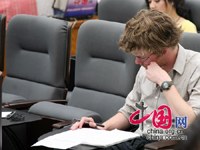 A journalist read materials before the press conference started.
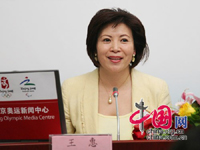 Wang Hui, hostess of the press conference
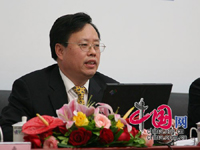 Wang Haiping, vice president of the Beijing Municipal Development and Reform Commission
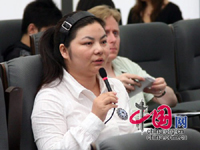 Reporter from China Business News asks questions.
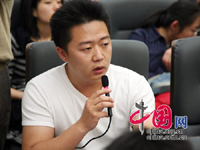 Reporter for China Water News raises questions.
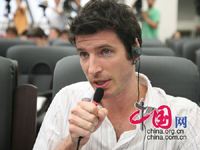 Reporter from Reuters raises questions.
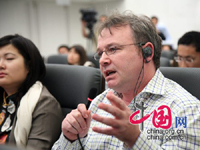 Reporter from South China Morning Post asks questions.
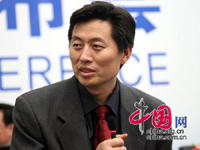 Zhong Liangxi, a senior official from the Beijing Environmental Protection Bureau
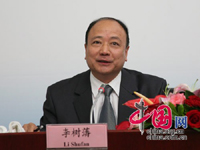 Li Shufan, deputy director of the Beijing Municipal Bureau of Industrial Development
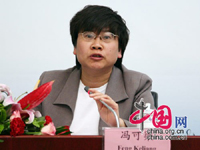 Feng Keliang, deputy director of the Beijing Municipal Construction Committee
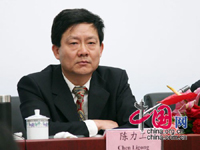 Chen Ligong, member of the Beijing Municipal Science Technology Commission
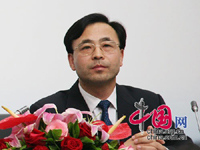 Chai Wenzhong, deputy director of the Beijing Municipal Administration Commission
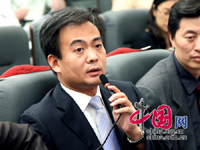 Shi Haibo, senior official from Beijing Water Authority
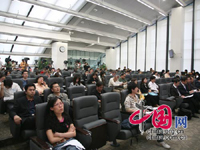 Scene of the press conference
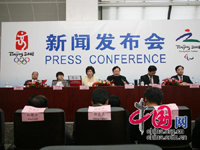 Spokespersons at the press conference

