Share:

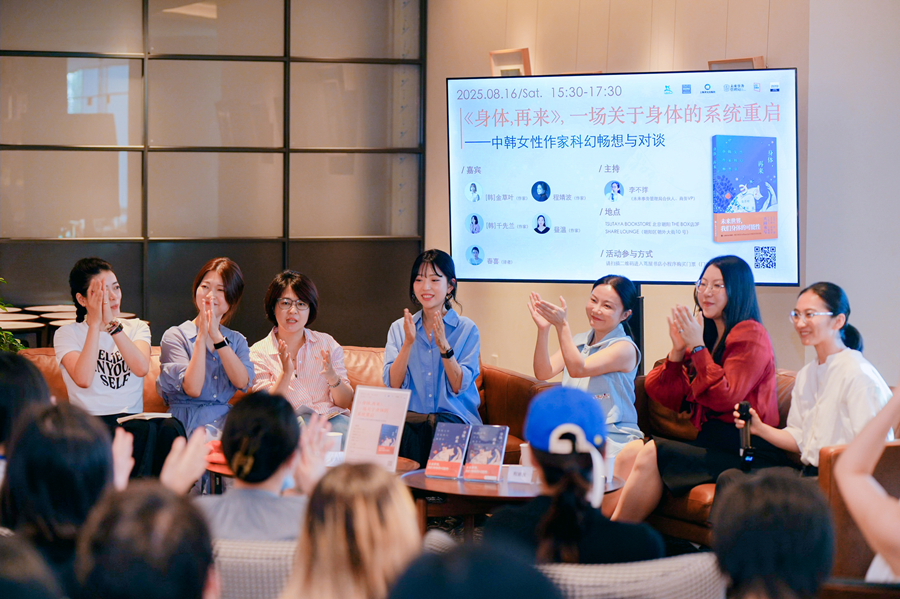
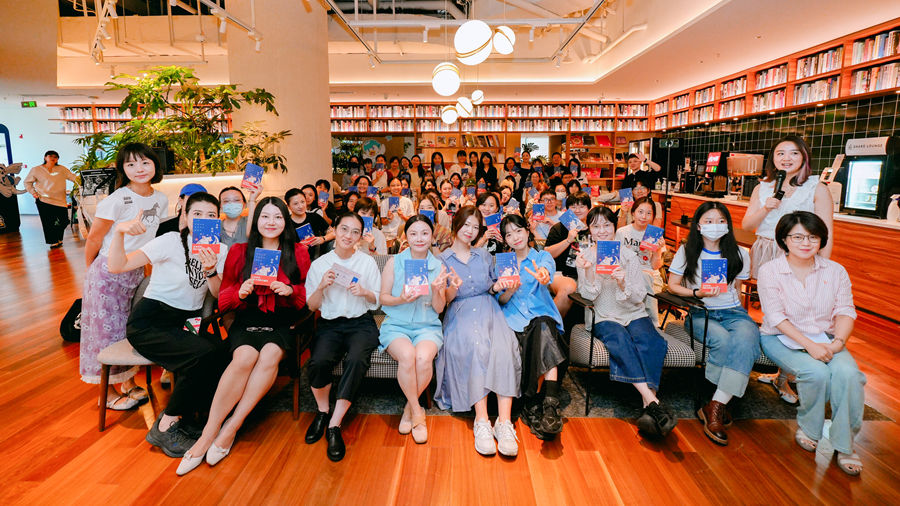
Writers and translators for "Body, Again" interact with readers at a book promotion event in Beijing, Aug. 16, 2025. [Photo courtesy of Future Affairs Administration]
The anthology examines women's embodied experiences in three chapters. In the "Bodies in Memory" section, Kim Choyeop follows a virtual beekeeper navigating a quantum world where digital humans — reduced to meaningless data fragments — seek purpose beyond existential despair. Zhou Wen's story depicts two girls infected by a disease that alters language processing, forcing them to navigate rapidly changing tongues and invented dialects as physical transformations break down communication.
In "Bodies that Meet Up," Kim Cheonggyul tells of an android who abandons eternal circuitry after witnessing discrimination against augmented bodies, choosing human flesh over immortality. Cheng Jingbo weaves folk beliefs with time travel through an elderly daughter bonding with her younger mother.
In the "Impossible Bodies" section, Cheon Seonran's story follows a woman who rejects neural implants and walks alone through a post-apocalyptic world, reclaiming the body as a site of resistance. Wang Kanyu explores how neural implants transform four women's lives, revealing technology's impact on human identity and nature.
Senior sci-fi researcher and critic Ren Dongmei said the anthology transforms the common theme of "bodily anxiety" in science fiction into "bodily sovereignty."
"In traditional cyberpunk novels, the body is often reduced to replaceable prosthetics or uploadable consciousness, whereas women writers return the body to concrete experiences: menstruation, childbirth, pain, feeding, touch, mourning," she said. "These experiences are no longer objects to be observed but engines of narrative."


 京公网安备 11010802027341号