 Share:


China Financial and Economic News:
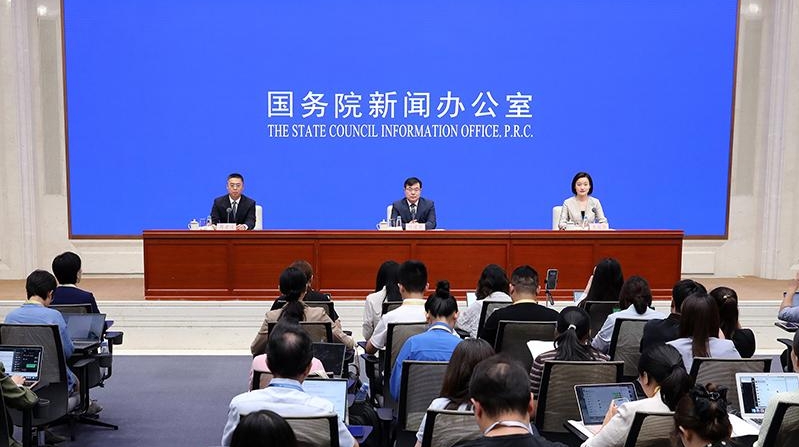
The Political Bureau of the CPC Central Committee, at its meeting at the end of July, urged faster transition to new growth drivers. Based on the data for July, what are the latest figures regarding industrial upgrading, new growth drivers and new products? How much are new growth drivers contributing to the economy? Thank you.
Fu Linghui:
Thank you for your questions. I would like to invite Ms. Wang to answer them.
Wang Guanhua:
Thank you for your questions. Since the beginning of this year, despite a complex and changing external environment and headwinds facing the economy, China has remained committed to pursuing high-quality development and has continued to foster new growth drivers and strengths through innovation. The economy has shown momentum shifting toward new growth drivers and an improving structure, a trend that continued in July. Specifically:
First, the economy is becoming increasingly innovation-driven, with emerging industries playing a greater supporting role. Emerging industries are key areas for fostering new quality productive forces. Last year, the value added of the "three new" economy, centered on new industries, new forms of business and new business models, accounted for 18.39% of GDP and has been rising year by year. During the 14th Five-Year Plan period, its share rose by a cumulative 1.9 percentage points, reflecting China's sustained efforts over the years to promote industrial transformation and foster innovation-driven growth. This year, new industries and new growth drivers have continued to contribute more to economic growth, emerging as a key pillar underpinning the stable performance of the Chinese economy amid a complex environment. Preliminary estimates show that during the first seven months, new growth drivers contributed 50.9% of the growth in output of industrial enterprises above designated size, up 3 percentage points from the first half of the year. In July, equipment manufacturing and high-tech manufacturing maintained sound growth momentum, with growth accelerating by 1.3 percentage points for equipment manufacturing and 2.8 percentage points for high-tech manufacturing from the previous month. Equipment manufacturing is where a country's industrial strength is most visible, while high-tech manufacturing is characterized by relatively high levels of R&D investment and value added. Growth in these two areas indicates that China's manufacturing sector is moving toward the medium- and high-end of industrial and value chains. This represents a qualitative improvement that is more noteworthy than quantitative expansion. In the service sector, integrated business formats blending culture, tourism, sports and commerce have continued to diversify, while the deep integration of advanced manufacturing and modern services has provided strong impetus for economic transformation and upgrading. During the first seven months, two modern service industries together contributed more than 40% of the growth in the services production index: information transmission, software and information technology services, and leasing and business services.
Second, the economy is becoming increasingly intelligent, with AI accelerating the shift from old to new drivers. Since the beginning of this year, AI has accelerated its integration into a wide range of industries and sectors. It has upgraded traditional industries and continuously given rise to new industries and business formats, making R&D iterations faster, production more intelligent and products better. In this way, AI has expedited the transformation of growth drivers. On the production side, digital product manufacturing has performed particularly well. In July, the value added of AI-related electronic component and equipment manufacturing rose 24.7%, while smart equipment manufacturing climbed 15.1%. Output rose 21.1% for optical fiber and 65.7% for 3D printing equipment, while output of smart wristbands doubled. On the consumption side, smart products such as AI-powered smartphones and AI glasses are iterating rapidly. From January to July, retail sales of smart wearable devices by enterprises above designated size more than doubled. A range of immersive and interactive consumption scenarios, including AI-powered tour guides and virtual fitting rooms, are rolling out faster. These innovations have not only made the consumption experience more convenient and engaging but also unlocked new consumption potential. On the investment side, investment from January to July grew 19.2% in information services and 7.1% in electronic and communication equipment manufacturing. Investment in these new growth areas represents both current demand and future high-quality supply, enhancing the sustainability of China's economic growth.
Third, the economy is becoming increasingly green, with new green growth drivers gaining momentum. China is fostering new industries and expanding new markets in its green transformation, continuously turning ecological strengths into development advantages. On the production side, a number of new industries and products that align with green and low-carbon trends have grown rapidly. In July, the value added of the bio-based materials manufacturing industry increased 20.6% year on year. Increased demand for new energy vehicles (NEVs) and new-type energy storage led to a 58.8% increase in lithium-ion battery production. Output rose 79.4% for hydropower generating units and 18.6% for water pollution control equipment, meeting domestic needs for the green transition and ecological and environmental governance. In the first seven months, China supported higher-quality industrial growth with lower energy consumption. Energy consumption per unit of value added of industrial enterprises above designated size decreased 3.5% year on year, showing that China's energy and resource utilization efficiency is improving and that energy-saving retrofits in industry have achieved tangible results. On the demand side, green consumption and green trade are gaining momentum. The retail penetration rate of new energy passenger vehicles has exceeded 60% for four consecutive months, reaching 65.1% in July, meaning that roughly two out of every three passenger vehicles sold were NEVs.
Together, these developments indicate that China's economic performance is undergoing many positive and profound changes, and that its development model is shifting rapidly from a traditional factor-driven one to an innovation-driven one. Of course, we must also recognize that industrial transformation and upgrading, as well as the shift from old to new growth drivers, do not advance in lockstep. The pace of development will inevitably vary, with some areas advancing faster and others slower. While we can see the positive aspects of the rapid growth of new drivers and the shift of the economy toward new and higher-quality development, we must also face the reality that the transition between old and new growth drivers will take time and that some sectors are facing short-term difficulties. We must follow the decisions and arrangements of the CPC Central Committee and the State Council, continue to promote high-quality development, coordinate the upgrading of traditional industries, the expansion of emerging industries and the cultivation of future industries, and facilitate a smooth transition between old and new growth drivers. Thank you.


 京公网安备 11010802027341号