 Share:


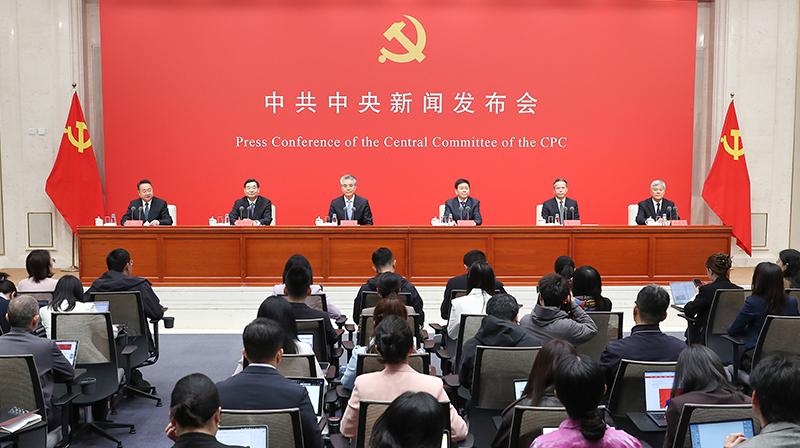
Speakers:
Mr. Zhang Fuhai, deputy secretary of the Central Commission for Discipline Inspection of the Communist Party of China (CPC) and deputy director of the National Commission of Supervision
Mr. Huang Jianfa, deputy director in charge of routine work of the Organization Department of the CPC Central Committee
Mr. Hu Heping, deputy director in charge of routine work of the Publicity Department of the CPC Central Committee
Mr. Tang Fangyu, director of the Policy Research Office of the CPC Central Committee
Mr. Xie Chuntao, vice president in charge of routine work of the Party School of the CPC Central Committee (National Academy of Governance)
Chairperson:
Mr. Wang Gang, deputy director of the Publicity Department of the CPC Central Committee
Date:
Oct. 30, 2026
Wang Gang:
Ladies and gentlemen, friends from the media, good morning. Welcome to this press conference held by the Central Committee of the Communist Party of China (CPC).
The fifth plenary session of the 20th CPC Central Committee was convened in Beijing from Oct. 26 to 29. This plenary session was a highly important meeting held at a critical stage for basically realizing socialist modernization. The session deliberated and adopted the Resolution of the Central Committee of the Communist Party of China on Certain Major Issues concerning Persevering with Full and Rigorous Party Self-Governance, and successfully completed all items on its agenda. Today, we have invited leading officials from relevant departments to brief you on and interpret the session's guiding principles, and to answer your questions.
Present at today's press conference are:
Mr. Zhang Fuhai, deputy secretary of the Central Commission for Discipline Inspection of the CPC and deputy director of the National Commission of Supervision;
Mr. Huang Jianfa, deputy director in charge of routine work of the Organization Department of the CPC Central Committee;
Mr. Hu Heping, deputy director in charge of routine work of the Publicity Department of the CPC Central Committee;
Mr. Tang Fangyu, director of the Policy Research Office of the CPC Central Committee;
and Mr. Xie Chuntao, vice president in charge of routine work of the Party School of the CPC Central Committee (National Academy of Governance).
Now, I'll give the floor to Mr. Tang Fangyu, who will brief you on the plenary session, the document drafting work, and the importance, urgency and overall requirements of persevering with full and rigorous Party self-governance.
Tang Fangyu:
Hello, friends from the media. It's my pleasure to brief you on the fifth plenary session of the 20th CPC Central Committee.
As you know, the fifth plenary session of the 20th CPC Central Committee was held in Beijing from Oct. 26 to 29. The Political Bureau of the Central Committee presided over the meeting. The Central Committee heard and discussed a report on the work of the Political Bureau, presented by General Secretary Xi Jinping on behalf of the Political Bureau. They also deliberated and adopted the Resolution of the Central Committee of the Communist Party of China on Certain Major Issues concerning Persevering with Full and Rigorous Party Self-Governance. General Secretary Xi Jinping delivered explanatory remarks on the resolution and gave an important address at the second plenary meeting of the session. The Central Committee also decided to convene the 21st CPC National Congress and completed matters regarding supplementary elections, filling of empty seats on the Central Committee, and disciplinary actions. Successfully completing all items on its agenda, the plenary session was an important meeting that unified thinking, rallied the support of the people and boosted morale.
At the session, the Central Committee fully affirmed the work of the Political Bureau since the fourth plenary session of the 20th Central Committee. It was unanimously agreed that the Political Bureau has earnestly implemented the guiding principles from the Party's 20th National Congress and the plenary sessions of the 20th CPC Central Committee; adhered to the general principle of pursuing progress while ensuring stability; fully and faithfully applied the new development philosophy on all fronts; implemented the Five-Sphere Integrated Plan and the Four-Pronged Comprehensive Strategy in a coordinated way; balanced domestic and international imperatives; and ensured both development and security. The Political Bureau has made solid progress in all areas of work, and meticulously advanced a series of major undertakings. The 14th Five-Year Plan (2021-2025) has been successfully concluded and the 15th Five-Year Plan period (2026-2030) is off to a good start, with new progress and results achieved in the cause of the Party and the country. The achievements of the past year were hard-won, as they were made amid an acceleration of profound changes unseen in a century and growing uncertainties and unforeseen factors facing China, with the country having withstood tremendous pressure and overcome various risks and challenges. These achievements are fundamentally attributable to the CPC Central Committee with Comrade Xi Jinping at its core, which has been at the helm charting the course, and to Xi Jinping Thought on Socialism with Chinese Characteristics for a New Era, which has provided us with sound guidance.
The most important outcome of the plenary session was the deliberation and adoption of the resolution. Our Party has dedicated itself to achieving lasting greatness for the Chinese nation, and Party building is of vital importance to the Party's future and destiny, as well as to the success of the cause of the Party and the country. At the crucial juncture marked by the 105th anniversary of the founding of the CPC and the start of the 15th Five-Year Plan, it was both highly important and necessary for the plenary session to make systematic plans for persevering with full and rigorous Party self-governance.
The resolution was drafted under the leadership of the CPC Central Committee, with General Secretary Xi Jinping acting as the chief of the document drafting group, personally planning the work, providing guidance throughout the process and setting the overall vision. Xi presided over two symposiums to solicit opinions, three meetings of the Standing Committee of the Political Bureau of the CPC Central Committee, and two meetings of the Political Bureau of the CPC Central Committee, providing guidance on research into major related issues. Xi devoted tremendous effort and played a decisive role in drafting the document. The drafting process followed the principles of fully practicing democracy, forging broad consensus, and pooling the wisdom of the whole Party. On Jan. 31, the CPC Central Committee issued a circular soliciting opinions from various localities and departments on the agenda of the plenary session. At the same time, 16 institutions were commissioned to conduct research on 23 key topics. On Aug. 3, the draft resolution was distributed to all localities, departments and sectors for their feedback, generating a total of 1,173 suggestions for revisions. Of these, 208 were adopted after study. At the session, participants proposed another 100 revisions to the draft in their discussions, of which 13 were adopted after review. It can be said that the resolution fully embodies the common will of the entire Party and the shared aspiration of the Chinese people.
The resolution consists of three main sections. The first section, which is the first part, provides a general overview that explains the importance and urgency of persevering with full and rigorous Party self-governance as well as the overall requirements for doing so. The second section is the discussion section, outlining the strategic tasks for persevering with full and rigorous Party self-governance in seven parts: strengthening the Party spirit of Communists; strictly practicing democratic centralism; cultivating high-caliber officials capable of shouldering the mission of national rejuvenation; building a well-knit organizational system characterized by cross-level alignment and effective implementation; improving conduct and tightening discipline on an ongoing basis; taking firm and coordinated action against corruption; and running the Party with systems and regulations. The third section makes plans on two fronts: refining Party and state oversight systems and fulfilling the political responsibility for full and rigorous Party self-governance.
During the plenary session, participants spoke highly of the resolution. It was widely agreed that the resolution offers a profound analysis of the situation, sound overall planning, clearly defined tasks, and practical measures and requirements, and serves as a programmatic document for advancing the great new project of Party building in the new era.
That concludes the overview of the plenary session and the drafting of the document. I will now briefly introduce the general overview of the resolution, which mainly covers five areas. First, it reviews the glorious 105-year journey during which our Party has consistently strengthened Party building and united and led the people in winning one victory after another, profoundly revealing the key to our Party's success and its unique discoveries in Party building. Second, it summarizes the great achievements made in exercising full and rigorous Party self-governance since the 18th CPC National Congress, explaining the great significance of the formation of Xi Jinping Thought on Party Building and fully demonstrating our Party's confidence in persevering with full and rigorous Party self-governance. Third, it analyzes the new circumstances, tasks and challenges facing full and rigorous Party self-governance, fully inspiring a sense of responsibility and urgency throughout the Party for persevering with this mission. Fourth, it sets forth the guiding philosophy for persevering with full and rigorous Party self-governance, clearly establishing the theoretical guidance, basic approach, and objectives and requirements for this sustained effort. Fifth, it elucidates the seven principles to be followed in persevering with full and rigorous Party self-governance, clearly demonstrating our Party's scientific attitude and pragmatic work style in this endeavor.
That's all from me. Thank you.
Wang Gang:
Thank you, Mr. Tang. Now, Mr. Hu will brief us on strengthening the Party spirit of Communists and strictly practicing democratic centralism.
Hu Heping:
Hello, everyone. I will brief you on strengthening the Party spirit of Communists and strictly practicing democratic centralism.
Firstly, strengthening the Party spirit of Communists. The strong Party spirit of Chinese Communists is an important guarantee for our Party to maintain its advanced nature and integrity and improve its leadership and governance capacity. The resolution places "strengthening the Party spirit of Communists" first among its strategic tasks. It states that strengthening the Party spirit represents a fundamental task of our efforts to ensure full and rigorous Party self-governance, and calls on Party members and officials to maintain a lifelong commitment to cultivating stronger Party spirit and devote efforts to strengthening ideals and convictions, forging strong loyalty to the Party, fostering deep affection for the people, always seeking truth from facts, building moral character, and preserving honesty and integrity. It makes specific arrangements in five areas.
First, we must strengthen education on loyalty to the Party. We must gain a deep understanding of the decisive significance of establishing Comrade Xi Jinping's core position on the CPC Central Committee and in the Party as a whole and of establishing the guiding role of Xi Jinping Thought on Socialism with Chinese Characteristics for a New Era; be more conscious of the need to maintain political integrity, think in big-picture terms, follow the leadership core, and keep in alignment with the central Party leadership; stay confident in the path, theory, system, and culture of socialism with Chinese characteristics; and uphold Comrade Xi Jinping's core position on the CPC Central Committee and in the Party as a whole and uphold the CPC Central Committee's authority and its centralized, unified leadership. We must enforce strict political discipline and rules and improve the Party's political ecosystem. Second, we must build cohesion and inner strength with the Party's latest theories. We must regard studying, understanding and applying the Party's latest theories as the fundamental means of cultivating stronger Party spirit, thoroughly study and implement Xi Jinping Thought on Party Building, enrich the methods of theoretical study and education, and foster a Marxist style of learning. Third, we must nurture the Party spirit with the Party's good traditions and fine traditional Chinese culture. We must carry forward the Party's fine conduct, pass on our revolutionary traditions and heritage, and explore and make good use of the moral concepts in fine traditional Chinese culture. Fourth, we must temper Party spirit through practice. We must temper Party spirit while implementing the decisions and plans of the CPC Central Committee, completing urgent, difficult, dangerous and vital tasks, and withstanding major tests, and while handling relations between right and wrong, public and private interests, and gains and losses. We must give play to the important role of intraparty political activities in this respect. Fifth, we must enhance Party spirit appraisal. We must make Party spirit an important criterion in vetting officials and in the democratic appraisal of Party members, and make good use of Party spirit appraisal results in the selection and appointment of officials and in the evaluation for commendations.
Secondly, strictly practicing democratic centralism. Democratic centralism is the Party's fundamental organizational principle and leadership system, and it serves as an important guarantee for safeguarding the Party's centralized unity, effectively implementing the major decisions and plans of the CPC Central Committee, and regulating leadership teams' and officials' performance of duties and exercise of power. The resolution identifies strictly practicing democratic centralism as an important focus of exercising full and rigorous Party self-governance and sets out specific plans in four areas.
First, we must uphold and strengthen the centralized, unified leadership of the CPC Central Committee. We must improve the systems and mechanisms for the centralized, unified leadership of the CPC Central Committee, refine the mechanisms for implementing its major decisions and plans, strictly enforce the system for requesting instructions from and reporting to the CPC Central Committee, and make political oversight more concrete, targeted and regular. Second, we must improve the efficacy of intraparty democracy. We must uphold and improve the systems for intraparty democracy, refine the systems for briefing and reporting on intraparty matters, and maintain comradely relations based on democracy and equality within the Party. Third, we must strictly implement deliberation rules and decision-making procedures for leadership teams. We must improve the deliberation rules and decision-making procedures of Party committees (leading Party members groups), strengthen the legal compliance review of major decisions, and improve the oversight mechanisms for major decisions, important personnel appointments and removals, major projects, and the use of large sums of money. Fourth, we must regulate leadership team heads' performance of duties and exercise of power. We must implement the systems and provisions for strengthening oversight of leadership teams and their heads, improve the mechanisms for checking the exercise of power by leadership teams, and refine the institutions and mechanisms for oversight at the same level.
That's all from me. Thank you.
Wang Gang:
Thank you, Mr. Hu. I would now like to invite Mr. Huang to speak on cultivating high-caliber officials capable of shouldering the mission of national rejuvenation and building a well-knit organizational system characterized by cross-level alignment and effective implementation.
Huang Jianfa:
Good morning, friends from the media. Party organizations at all levels, as well as Party members and officials, play the principal role in exercising full and rigorous Party self-governance, and serve as key forces in advancing the cause of the Party and the country. Today, the CPC has more than 100 million members and over 5.4 million primary-level Party organizations. This gives us a great strength that no other political party in the world possesses. The resolution makes strategic arrangements for strengthening the Party's organizations. I would like to give an introduction in this regard.
Firstly, cultivating high-caliber officials capable of shouldering the mission of national rejuvenation. Strict management of officials is the key to full and rigorous Party self-governance. The resolution states that we must apply stringent standards to the education, cultivation, selection, appointment, management and oversight of officials. On this basis, we will build up the ranks of high-caliber officials with firm political commitment, outstanding professional competence, excellent work conduct, and strict discipline. The resolution sets out arrangements in six areas. First, we should follow sound guidelines in appointing officials. The resolution emphasizes that we should adhere to the principle of the Party supervising officials, and apply the standards for good officials in the new era. We should select and appoint officials who are loyal to the Party, consistent in word and deed, responsible and conscientious, outstanding in performance, as well as honest and upright. Those who shy away from difficulties and responsibilities, are mediocre, lazy and inactive, or have a superficial work style must not be appointed, while those who are disloyal to the Party, duplicitous, or abuse power for personal gain must be removed. Second, we should take targeted, well-designed measures to select and appoint officials. We will adhere to selecting officials through Party organizations, appointing them fairly and matching candidates to specific posts. We will strictly implement the principles and procedures for selecting and appointing officials, and resolutely rectify misconduct in personnel appointments. Third, we should inspire officials to foster and act on the correct view of performance. We will deepen education on the correct view of performance, improve the assessment of officials' performance in promoting high-quality development, and refine working mechanisms to effectively prevent and correct deviations in the view of performance. By doing so, we will guide officials to deliver for the people through hard work. Fourth, we should enhance officials' competence in fulfilling their duties and breaking new ground. We will strengthen officials' theoretical grounding, political tempering, practical experience and professional competence, so as to enhance their capabilities in promoting high-quality development, serving the people, preventing and defusing risks and applying the rule of law in their work. Fifth, we should improve the training and selection of outstanding young officials. We will place equal emphasis on training and management and guide the healthy growth of young officials. Sixth, we should strengthen the management and oversight of officials. We will start with senior officials to strengthen comprehensive management and regular oversight. The resolution emphasizes the need to balance strict management with genuine support, using incentives and clear boundaries to ensure better mechanisms for encouraging and protecting officials who take responsibility and deliver results. Meanwhile, we will uphold the principle of the Party overseeing talent, deepen the reform of talent development systems and mechanisms, and promote the training, recruitment and utilization of talented people across the board, so as to bring together outstanding talent from all fields for the cause of the Party and the people.
Secondly, building a well-knit organizational system characterized by cross-level alignment and effective implementation. The Party's strength comes from its organizations. The Party's overall leadership and all its work must be realized through its strong organizational system. The resolution states that it is essential to systematically advance the development of Party organizations at all levels and in all sectors to strengthen their political and organizational functions. This will help ensure that the Party's lines, principles and policies, as well as the Party Central Committee's decisions and plans are implemented through well-coordinated, targeted and effective efforts. The resolution sets out measures in six areas: First, we should give play to the exemplary role of the Party organizations of central Party and state organs. We will further strengthen the political building of government organs, and build central Party and state organs into exemplary institutions that are politically committed, disciplined, responsible and efficient. Second, we should bolster the functions of local Party committees. The resolution stresses that local Party committees must fulfill their responsibilities in their respective regions by setting the development direction, managing the overall situation, making decisions and ensuring effective implementation. We will build local Party committees into strong organizations that resolutely follow the command of the Party Central Committee, ensure effective implementation, and are highly disciplined, unified and corruption-free. Third, we should take coordinated steps to improve primary-level Party organizations across all sectors. We will step up efforts to focus on the primary level, using Party building initiatives to propel rural revitalization and intensify Party-building efforts in urban subdistricts and communities. We will better guide efforts to conduct community-level governance and strengthen primary-level governments through Party building. Fourth, we should promote Party building in emerging sectors. We will enhance Party building in new economic and social organizations and among people in new forms of employment, expanding the coverage of Party organizations and Party work to enhance the Party's appeal, cohesion and influence in these emerging fields. Fifth, we should build a strong contingent of Party members. We will take political commitment as the primary criterion. We will improve the quality of Party member recruitment, optimize the structure of the Party membership, and strengthen Party member education and management. We will also refine and implement mechanisms for Party members to play their roles. Sixth, we should refine mechanisms to ensure alignment across different levels of Party organizations. We will ensure that higher-level Party organizations take the lead and guide lower-level ones, ensuring implementation at every level. We will also ensure that Party committee (leading Party members group) secretaries are subject to substantive performance evaluations and reviews on their efforts in primary-level Party building. In this way, we will promote the comprehensive progress and strengthening of Party organizations at all levels. We will follow the decisions and plans of the Party Central Committee, and earnestly implement the Party's organizational line for the new era. We will build strong Party organizations and ensure effective management, thereby providing a strong organizational guarantee for building a great country and advancing national rejuvenation.
That's all from me. Thank you.
Wang Gang:
Thank you, Mr. Huang. Now, I'd like to invite Mr. Zhang to speak on improving conduct and tightening discipline on an ongoing basis; taking firm and coordinated action against corruption; and refining Party and state oversight systems.
Zhang Fuhai:
Friends from the media, good morning. Improving conduct, tightening discipline, combating corruption and strengthening oversight are important aspects of exercising full and rigorous Party self-governance. Now, I will briefly introduce the relevant content of the resolution.
Improving conduct and tightening discipline are effective measures to advance full and rigorous Party self-governance. Since the 18th CPC National Congress, the CPC Central Committee with Comrade Xi Jinping at its core kicked off efforts by formulating and implementing the central Party leadership's eight-point decision on improving work conduct. It has employed discipline enforcement as an essential tool in exercising full and rigorous Party self-governance, and consistently improved conduct and tightened discipline with strict standards. Following the 20th CPC National Congress, it has successively launched education campaigns on increasing awareness of Party discipline and on fully implementing the central Party leadership's eight-point decision on improving work conduct, so as to continuously consolidate and expand the achievements in conduct improvement and discipline enforcement. As a result, the Party's discipline and rules have been further tightened, and the conduct of the Party, the government and society has taken on an entirely new look. Since the 18th CPC National Congress, discipline inspection and supervisory organs across the country have investigated and handled 1.644 million cases involving practices of pointless formalities, bureaucratism, hedonism and extravagance. A total of 2.257 million people have been criticized, educated or disciplined.
In improving conduct and tightening discipline, we must make consistent and sustained efforts to tackle deep-seated and recurrent problems that have plagued the Party for a long time. The resolution calls for working in concert to enhance Party spirit, improve Party conduct and tighten Party discipline, and integrating conduct improvement and discipline enforcement with anti-corruption measures. It sets out plans in five areas. It calls on us to follow the Party's mass line in the new era, steadfastly implement the central Party leadership's eight-point decision on improving work conduct, make consistent and sustained efforts to improve conduct, ensure more rigorous discipline enforcement, and make full use of discipline as a guide, restraint, guarantee and incentive.
Taking integrated steps to ensure that officials do not have the audacity, opportunity or desire to commit corruption is both an important strategy for full and rigorous Party self-governance and a fundamental guideline for our fight against corruption. Since the 18th CPC National Congress, the CPC Central Committee with Comrade Xi Jinping at its core has remained committed to fighting every instance of corruption, punishing every corrupt official and rooting out all such crimes. It has led the entire Party to strengthen deterrence, tighten institutional constraints and raise awareness of discipline among officials so that they do not dare to, are unable to and have no desire to commit corruption. It has resolutely rooted out any viruses that would erode the Party's health, so as to secure an overwhelming victory and fully consolidate its gains in the fight against corruption. Since the 18th CPC National Congress, discipline inspection and supervisory organs across the country have filed a total of 8.105 million cases and punished 7.922 million people, including 963 officials registered at and supervised by the CPC Central Committee.
Meanwhile, we must recognize that the fight against corruption remains grave and complex, and that eradicating breeding grounds and conditions for corruption remains an arduous and formidable task. The resolution emphasizes the importance of steadfastly following a distinctive Chinese path of anti-corruption, and sets out plans in four areas. First, we should maintain a tough stance against corruption. We will intensify efforts to uproot corruption in sectors with a high concentration of power, funds and resources. Specifically, we will investigate and handle cases including corruption that involve both political and economic elements, collusion between government officials and businesspeople, and the infiltration of capital into the political sphere. Meanwhile, we will also thoroughly investigate new and disguised forms of corruption, and address on a regular basis misconduct and corruption close to the people. Second, we should strengthen checks on and oversight over the exercise of power. We will improve institutional mechanisms that integrate the delegation, exercise and check of power in a unified manner, making them clear, transparent and traceable, so as to confine power to an institutional cage with more scientific and effective efforts. Third, we should fortify the cultural-ethical foundations for championing integrity and disdaining corruption. We will strengthen the culture of integrity in the new era, and use the ideals, convictions, values, moral standards, and discipline and law awareness embodied in the Party's latest theories to foster integrity among Party members and officials. Fourth, we should enhance coordinated efforts to prevent corruption by rooting out audacity, opportunity and desire. We will make solid efforts in using real cases to promote rectification and better governance, so as to enhance the penetrating power of anti-corruption efforts.
Further improving the Party and state oversight systems is an inherent requirement for persevering with full and rigorous Party self-governance. The resolution outlines plans in four main areas. First, it calls for ensuring that Party committees (leading Party members groups) exercise general oversight. Second, it calls for strengthening coordination among disciplinary oversight, supervisory oversight, oversight by resident disciplinary inspection teams and inspection oversight. Third, it calls for improving the primary-level oversight system. Fourth, it calls for promoting the deep integration and efficient coordination of intraparty oversight with other avenues of oversight to build synergy.
That's all from me. Thank you.
Wang Gang:
Thank you, Mr. Zhang. Now, Mr. Xie will brief us on running the Party with systems and regulations and fulfilling the political responsibility for full and rigorous Party self-governance.
Xie Chuntao:
Good morning, everyone. I will focus my briefing on two areas: running the Party with systems and regulations, and fulfilling the political responsibility for full and rigorous Party self-governance.
On running the Party with systems and regulations, the resolution states that "strengthening Party regulations and institutions represents a long-term, fundamental strategy for ensuring full and rigorous Party self-governance." Since the 18th CPC National Congress, General Secretary Xi Jinping has creatively proposed running the Party with regulations and made a series of important statements on it, making regulation-based Party self-governance a fundamental approach to Party self-supervision and self-governance. This has brought about major innovations in the philosophy, strategy and practical approaches of Party self-supervision and self-governance, and made them more rationally-conceived, institutionalized and procedure-based. The resolution makes further arrangements in the following three areas:
First, improving the framework of Party regulations and institutions. The focus is on strengthening top-level design, addressing gaps and deficiencies, and improving quality and effectiveness. This includes developing sound plans for formulating Party regulations; coordinating their formulation, revision, repeal and interpretation; promptly addressing institutional shortcomings; and improving the quality of rulemaking.
Second, ensuring the enforcement of institutions. The effectiveness of regulations and institutions depends on their enforcement. At present, rules for Party self-supervision and self-governance are generally in place, but their implementation needs to be further strengthened. In this regard, the resolution sets out measures to make Party regulations more transparent, strengthen education and training on regulations and institutions, and reinforce their implementation and oversight.
Third, eliminating hidden rules. For some time, hidden rules have persisted to varying degrees both within and outside the Party, undermining the authority and implementation of Party rules and disciplinary regulations and prompting strong complaints from officials and the public. The CPC Central Committee has attached great importance to this issue, with General Secretary Xi Jinping repeatedly setting out clear requirements in this regard. The resolution calls for establishing clear rules as a starting point and proposes corresponding measures to increase transparency in Party and government affairs, strengthen education and guidance, address related misconduct, and establish and improve relevant institutions and mechanisms.
As for fulfilling the political responsibility for full and rigorous Party self-governance, who should carry out this task in a party as large as ours? Party organizations at all levels and all Party members and officials must work together to fulfill this responsibility. Therefore, full and rigorous Party self-governance cannot be achieved without clearly defined responsibilities, effective implementation and strict accountability. Since the 18th CPC National Congress, years of effort have established a framework for Party building in which Party committees, their secretaries and relevant departments all take charge, with each level responsible for the level below and effective implementation ensured throughout.
The resolution further clarifies the primary responsibilities of Party committees (leading Party members groups), the oversight responsibilities of commissions for discipline inspection, the responsibilities of secretaries of Party committees (leading Party members groups) as the first persons responsible, the dual responsibilities of other members of leadership teams for both their posts and Party self-governance, and the specific responsibilities of Party members and officials. This improves a coordinated accountability system in which all parties perform their respective duties. It requires Party organizations at all levels to enhance their political commitment, take the initiative in fulfilling their duties, exercise rigorous oversight, refine and clarify lists of responsibilities, and ensure that responsibilities are fulfilled and pressure is transmitted at every level.
The resolution requires Party committees (leading Party members groups) at or above the county level to hear reports at least once a year from members of their leadership teams on how they have fulfilled their responsibilities for Party self-supervision and self-governance. It also requires lower-level commissions for discipline inspection (dispatched discipline inspection and supervision teams) to report at least once every six months to higher-level commissions for discipline inspection (dispatching authorities) on how members of the leadership teams of Party committees (leading Party members groups), especially their principal leaders, have performed their duties and exercised their powers, as well as how they themselves have fulfilled their oversight responsibilities. The resolution reiterates that leading officials, especially senior officials, must lead by example in fulfilling their responsibilities for Party building, avoiding formalism in advancing Party building and making proper and precise use of accountability as a powerful tool, thereby ensuring that responsibilities are fully implemented.
That's all from me. Thank you.
Wang Gang:
Thank you, Mr. Xie. The floor is now open to questions. Please identify the media outlet you represent before raising your questions.


 京公网安备 11010802027341号