|


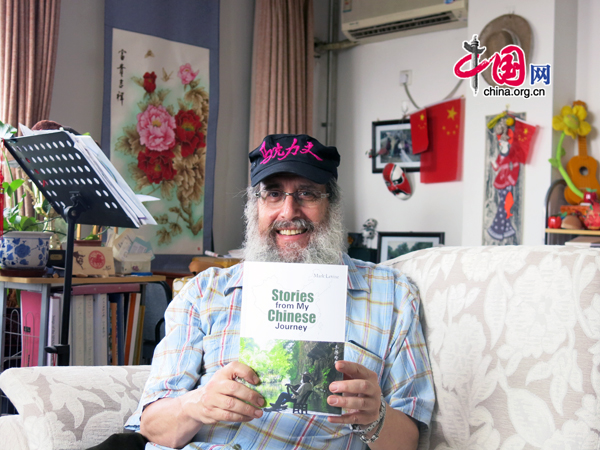
Mark Levine blends Western, Chinese culture
Adjust font size:
 
In 2005, American sociologist Mark Levine stepped onto China's soil for the first time to start a new English teaching job at Huaiyin Teachers College in Huai'an, Jiangsu Province. Having lived in large, metropolitan cities in the United States for most of his life and spent the last 30 years as a full-time labor and community organizer, he was looking for something different.
"I ended up taking a job at Huaiyin because the very first line of the letter asking me to come said, 'The city of Huai'an is the hometown of the first premier of the People's Republic of China, Zhou Enlai," says Mark, who is also a part of the Chinese musical duo, In Side Out. It seemed like a good opportunity to learn more about the country. When he first came to Huai'an, he only knew a handful of facts about modern Chinese history. Now a nationally recognized foreign expert on Chinese culture and policy, Mark has dedicated his life to building connections between the West and China, and even teaching Chinese people about each other.
Lessons Beyond the Classroom At the time, Mark's new teaching position at Huaiyin Teachers College was only a 12-month contract. He didn't know back then that he would end up staying in China for the next nine years, falling in love with the people and learning the way they think about school, life and the West. Mark realized many Chinese people had a distorted view of what life was really like in North America – that prosperity is abound and everyone is rich. After spending years working in poor communities across the United States, he wanted to change this idealized perception of his country. "Aside from theoretically understanding that everybody wasn't rich, firsthand I knew – 30 years put me in a position where every day I was challenging the poverty that existed," says Mark, who grew up in California. "I thought, 'Well, there's something else I have to teach here. English actually isn't the most important thing. Maybe I need to teach broader understanding of the United States and conditions of the U.S.'" Additionally, when he assigned his writing class to imagine themselves 50 years later and compose an essay about what they lived for, à la British philosopher Bertrand Russell, 72 students wrote, "I lived to have a good life for me and my family" and only two students wrote about addressing societal issues. While living for oneself and one's family isn't a bad goal, Mark says it's important to commit to a cause that's beneficial for the greater society. "I teach English to teach people English, but I also teach English as a vehicle to communicate some ideas that I think are very important – that many Chinese students forgot or maybe never learned. [These ideas] are not foreign to China. They still exist here, but are not really the priority for people to learn." |
 0
0 




| Copyright © China.org.cn. All Rights Reserved 京ICP证 040089号 京公网安备110108006329号 网络传播视听节目许可证号:0105123 京公网安备110108006329号 京网文[2011]0252-085号 |

Go to Forum >>0 Comment(s)