Is news photography already dead?
 0 Comments


The annual Lianzhou Photography Festival runs from December 5-10 in Guangdong Province. Roughly 100 photographers from about 10 countries competed for awards. About 80 exhibitions try to answer the tragic question: "Is news photography already dead?"
Among the participants are famous British war correspondent Don McCullin and Chinese news photographer He Yanguang. Festival attendees are able to learn the differences of choosing topics and dealing with news photos between various countries and news agencies.
Is news photography dying when everyone can be a photographer?
Last year, chief of Jiangning District Housing Bureau Zhou Jiugeng smoked luxury cigarettes at a meeting. Chinese Internet users posted a photo of this incident online, which had a huge influence on the government investigation that followed. It's a prime example of the disappearing boundary between professional and amateur news photography.
Chen Weixing, a professor at the Communication University of China and curator of the festival, said, "Everyone can take news photos and videos with their cell phones or digital cameras whenever an event happens. In some cases, correspondents can't even be there." In some western countries, which tend to have a large number of photographers, there is a popular yet tragic saying, "News photography has been dead." The Times stopped hiring professional news photographers as early as five or six years ago, when news photography plunged into a crisis. But Chen believes news photography can't be replaced because of its power to change the way people perceive the world.
 |
|
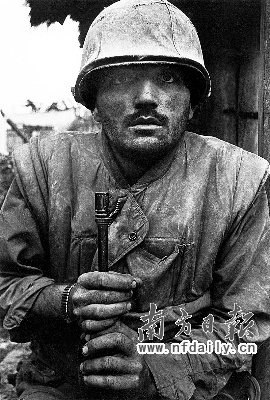
"An American Marine Suffering from Combat Fatigue," shot by Don McCullin in Vietnam, 1968 [sohu.com] |
"McCullin's picture of an American soldier in the Vietnam War has become a pictorial symbol. Compared with documentaries about the war, this image is easier for people to remember. And the news pictures from the Wenchuan Earthquake last May, such as the saluting boy and the hand of a dead pupil holding a pencil, will surely stay in people's hearts for quite a long time," said founder and director of the festival Duan Yuting. Duan believes the real challenge for today's news photographers is that they must offer better photos.
The differences between Chinese and western news photography masters
The theme this year is "Presence and Recurrence" and the focus is news photography. The festival held a series of solo exhibitions from domestic and international news photography masters. Famous Chinese photographer and senior reporter of PLA Pictorial Meng Zhaorui showed his news photographs of historical events, including the founding ceremony of the People's Republic of China in 1949, Chairman Mao's meeting with the Red Guards and the trial of Jiang Qing.
 |
|
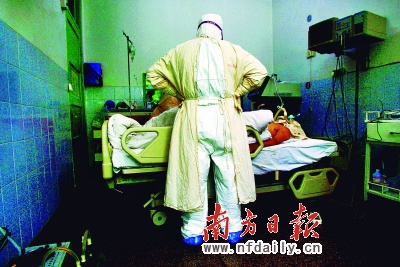
"Facing Life," shot by He Yanguang in a SARS ward at Beijing Ditan Hospital, April 30, 2003. [sohu.com] |
McCullin's works on display not only reflect the storm of shots and shells during the war, but also reveal human nature. His work of an American marine suffering from combat fatigue is printed on a poster of the festival.
He Yanguang recorded many important Chinese political events during the 1980s, including the banner saying, "Hello, Deng Xiaoping" that was raised by Peking University students during the National Day parade in 1984. He's coverage of SARS in 2003 and President Hu Jintao's meeting with Kuomintang Honorary President Lien Chan are also on display. He also spent a lot of time taking pictures of average people, such as coal miners, rural medical practitioners and migrant workers.
Chen believes Western correspondents tend to shoot photos outside of their countries to record breaking events such as wars, whereas in China's mainland, abundant news topics exist because society is transforming so quickly. But Chen believes many news photographers don't pay much attention to these events.


Comments