Official races to save heritage sites from bulldozer
 0
0 


 |
|
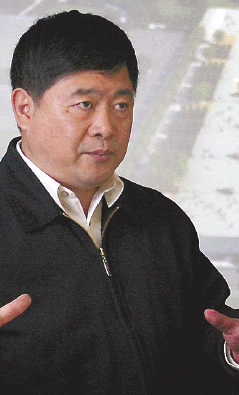
Shan Jixiang |
After a bulldozer driver accidentally uncovered a grove of golden, jade and bronze objects on Feb 8, 2001, Shan flew in from Beijing and convinced the municipal Party chief, Li Chuncheng, to give an order halting work on a realty development project on the Jinsha site. He believed archaeologists could find relics as important as those found at the Sanxingdui Ruins in 1929.
Excavation of Sanxingdui, which is 50 km from Jinsha, has yielded some of the most significant archaeological discoveries in China in the last century. They offer proof that Chinese civilization has diverse origins.
With the bulldozers gone, archaeologists found more than 5,000 precious relics at Jinsha. "The Chengdu government eventually asked archaeologists to turn the ruins into a museum, which is now an attraction for tourists," said Shan. His agency granted Jinsha national heritage status in 2006. The gold-leaf sunbird - a relic believed to be about 3,000 years old excavated from Jinsha - is now the emblem of China Cultural Heritage.
But not all cities appreciate the value of heritage in promoting their image and economic development, he said.
Pointing at a picture taken in a city in central China a few years ago, he said: "My camera caught only a small part of this artificial fountain pool." The city, like many others in China, he said, had demolished historic streets to make room for monstrous edifices, golf courses and a huge fountain square.
Another photo depicted a residential quarter in Beijing where skyscrapers dwarfed several sprawling traditional buildings. Those living in these tall structures in dilapidated streets seemed to have been penalized by developers' ambitions, he said, adding that many complained of having no access to green areas or parking, and that their homes kept losing value while neighboring traditional buildings surged in price.
Even in the ancient city of Xi'an, Shaanxi province, the capital of several dynasties, the local airport greeted sightseers with a giant billboard showing clusters of high-rises made of steel and cement, said Shan. "How can a province with abundant cultural heritage greet visitors with such emotionless modern construction? It has way much more impressive structures to celebrate."
In stark contrast, an advertisement posted by Bangkok Airways at Xi'an Xianyang International Airport proudly showcased the historic Grand Palace to attract tourists to Thailand.
To his chagrin, in Tianjin municipality and Nanjing, Jiangsu province, some historic structures have been dismantled in recent months. He said this is down to the fact cultural sites are not given the dignity they deserve.
He said siheyuan - traditional Chinese courtyard houses - had disappeared in their thousands in recent decades because they had been deemed "no longer fit" for modern life and replaced with new apartment blocks.
"A siheyuan is ideal for one or two families, but if you crowd seven families into it how can you expect it to be fit for life?" said Shan, who lived as a child in a siheyuan. "Even a four-bed apartment would be rendered unfit for modern life if it were inhabited by four families."


Go to Forum >>0 Comments