Nuclear reaction to tourist attraction
 0
0 


Filling the void
Walking through the vast excavation, even on a hot day, is a cold and dark experience. Only dim lamps light the pathway, and with all the nuclear equipment long since removed, the wide tunnels - two trucks could easily drive down them side by side, while the main hall is as big as a 20-story tower - seem disappointingly barren.
|
|
|
Just 10 percent of the 104,000 square meter base was opened to the public in April. |
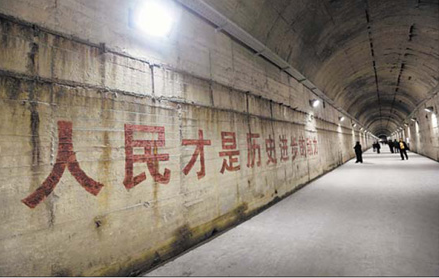
"Only 10 percent of the facility has been opened to the public," explained a tour guide as she led a party through the entrance. "The base was once equipped with the most advanced technologies, and if nuclear war broke out, the 2-meter-thick photoelectric lead doors would close and protect the production of plutonium-239, the primary fissile isotope used for the production of nuclear weapons."
In the dark maze of tunnels, there is little to see but rusted steel bars and discarded odds and ends, while the echoing voices contribute to a generally eerie atmosphere.
"It is so sad. The base was supposed to be the largest nuclear facility in China, not a tourist attraction," said Guo before vowing never to visit the cave again.
The animosity that some of the former scientists show towards the old base stands in sharp contrast to their enthusiasm in the early days of the project.
"Dedicating myself to my country was all I was thinking about, like all young people in that era," said 76-year-old nuclear reactor expert Chen Bingzhang when asked about his arrival in Baitao in 1969. "The harsher the place the government sent me to, the more honors I got."
After Sino-Soviet relations began to deteriorate in the late 1950s, China began to develop its hinterland with the belief that coastal regions, where its industrial and military powers were largely concentrated, and border provinces could be vulnerable to attack.
Records show that, between 1965 and 1980, the government invested 205 billion yuan in central and western regions, dubbed the "third front" (the "first front" included border and coastal areas; the "second" included areas close to east China such as Jiangxi and Anhui provinces ).
More than 1,000 factories and military plants were built in or relocated to mountainous central and western locations as part of the decade-long "third front construction" campaign, which included the Chongqing nuclear base, and millions of young workers followed.
"A family's only son would insist on leaving his parents, a husband would say goodbye to his wife on their honeymoon, a father would move his entire family to China's poorest region," explained Chen Donglin, a senior history researcher with the Institute of Contemporary China Studies.
"People left their hometowns to rounds of applause and were welcomed by the residents in third front areas as heroes," he said. "In that era, going to the third front was a great honor, one worth dying for."
Next to the railway line that runs between Chengdu, capital of Sichuan province, and Kunming in Yunnan province - one of the most famous third front construction projects - is a graveyard filled with more than 1,000 workers who died during construction. In Chongqing, the 71 soldiers killed while building the Baitao base are buried in a nearby cemetery. Judging by the place names carved on each tombstone, not one of them was born in the town.
"Only the offspring of workers, peasants and other members of the proletariat who could be true revolutionaries were allowed to join the third front construction. Participation was a sign of a good family background," said retired engineer Pan, who recalled that at the time he was "ambitious and eager to join in the national defense construction and China's nuclear industry".
"Suffering from years of war, you can't imagine how much people loved their country in that era," said the elderly man, who was hit in the leg by shrapnel during the War of Resistance Against Japanese Aggression (1937-1945). "We thought that if we had nuclear weapons, no one would invade our country."
The war many people were preparing for never happened, though. In the 1970s, relations between China and the United States thawed and the power of the Soviet Union grew weaker, diminishing fears of a nuclear attack.
The national strategy was refocused on economic development, and most of the defense technologies in the "third front construction" were transferred to civilian use. Although many projects floundered after the withdrawal of State funds, the "third front" campaign is credited with laying the foundations of the large-scale development strategy launched in the country's western regions in 2000.
"If it wasn't for the nuclear plant (being constructed here), Baitao would never have been developed and nobody would have come here," said Pan. "But I didn't just dedicate my life to this town, I also dedicated my children's lives."
Due to the poor standard of schools in the "third front" area, the large majority of the offspring of those who moved west in the 1960s and 1970s were unable to receive a good education - even though their parents were experts in their fields.
Pan, who now works for the fertilizer plant in the former military base, said neither of his sons went to college. He is now hoping his grandchildren will be able to escape the town, which has a population of about 31,000.
Beijing-born Shen Guoliang, 51, whose parents were both nuclear scientists at the base and witnessed the first atomic bomb test in the desert of Gansu province in 1964, has lived in Baitao since he was 9 years old and says he is ready to leave.
"Nobody wants to stay in a poor area but how can we go back (to the capital)?" he said. "Our hukou and apartment are here."
Others, like Chen Bingzhang, say they made even greater sacrifices for their country.
Before arriving in Baitao, the nuclear technician was assigned to Gansu, where he and 30 colleagues were exposed to dangerous levels of radiation after an accident in 1969. Seven people died, and although Chen Bingzhang survived, his son was born blind.
"My superior came to shake our hands and called us heroes of China's nuclear industry," he said proudly, wearing his traditional blue Mao-style suit. "He said the Party and the people would never forget us."
Chen Bingzhang and his family now live on his pension of just 1,000 yuan a month.
"I only hope the Party and the people will never forget us, like I was told," the retired technician added.


Go to Forum >>0 Comments