'Parenting with a stick' returns with a vengeance
- By Guo Xiaoyan
 0 Comment(s)
 Print
Print E-mail
China.org.cn, December 14, 2011
E-mail
China.org.cn, December 14, 2011


Zhou Weili first heard about the "wolf dad" - a father who used a stick to beat three of his children into China's top Peking University - from the Internet, and the news made this vice president of Guangdong Education Press a rather queasy.
|
|
|
Wolf dad [By Jiao Haiyang/China.org.cn] |
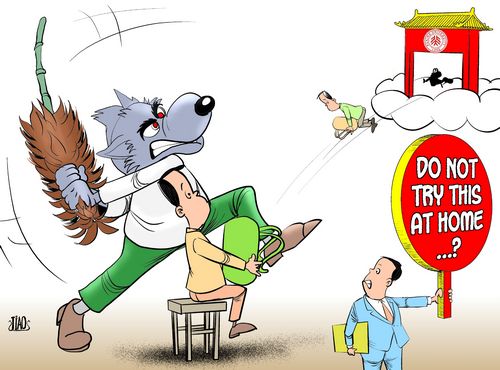
Zhou had introduced ideas of quality education to China's book publishing industry over a decade ago, and he could hardly sit still seeing "wolf dad" books flying off shelves. It is difficult for him to understand why the abandoned "parenting with a stick" is returning to the public's eye with a vengeance.
"I'm not saying that parents should never discipline their kids, but I just cannot accept entire sets of educational principles built around beating them with sticks," Zhou Weili said as he punctuated every word for emphasis.
Chen Hong, the director of the textbook division of Guangzhou Book Center, took the position in 1999. That year, she witnessed fevered scenes of parents rushing to buy reference books for their children before the start of the new semester and the end-of-semester exams.
But as entire floors of exam reference books emptied out, the five or six shelves reserved for quality education books were left untouched.
"There were only 100 books or so on quality education," Chen said. "Even that little stock could hardly be sold out."
In the early 1990s, however, some people had begun to realize shortcomings of examination-oriented education. Some Chinese experts and scholars began to promote quality in education. But they did not get much support from the public.
"As a publisher, my thoughts were not clear about a solution," Zhou recalled. "But I did feel that China's education needed a gust of fresh air from the other side of the Pacific."
Answering the call, in 1999, would be Huang Quanyu, a Chinese author who studied in the U.S. His book, where he compared differences between Chinese and American education, was published in December 1999, with the title: "Quality Education in the U.S." It did not attract much attention until in 2000, when a murder case shocked the country.
Xu Li, a high school student in Zhejiang Province, could not bear the mounting pressures of strict rules, physical discipline and high expectations. He brought a hammer to his mother, killing her at the scene.
Zhou Weili realized this incident may become the turning point of China's education. After much promotional efforts, Huang's book became a hit, reprinting 13 times and selling over 220,000 copies.
Bestseller "Good Mother Better than Good Teacher" author Yin Jianli said that the development of Chinese family education is related with both China's history and its one-child policy.
She believes that though China's one-child policy began thirty years ago, only in recent years people began to realize the importance of family education.
There are several bestsellers in recent years teaching various educational concepts. Parents began to realize that the traditional way to teach children to be modest was not always right, and that they should not beat their children on their whim. Instead, they should respect their children and allow them free thinking.
Yin believes that most opposing voices of good educational concepts are driven by commercial goals instead of educational expertise. She has a strong aversion to "stick parenting." "This is just the trick of authors and publishers sewing emperor's new clothes," she said.
In mid-November, the bestselling books "That's Why They Go to Peking University" by the "wolf dad" and "Good Mother Better than Good Teacher" by Yin Jianli were both displayed on the first floor of Guangzhou Book Center.
Chen Hong, a mother working at the store chose Yin's book. She said she agrees with the idea of "patience and reason" in her child's education. "But as a bookstore, we should be fair and provide a variety of options to parents."
Former Ministry of Education spokesman Wang Xuming said books from the "tiger moms" or "wolf dads" are not worth reading. He said these authors are only in pursuit of fame and fortune.
"Each family is different. There's no best education model, only the most suitable model," Wang said. "I have never seen the parents of the Nobel laureates write books. It is because the happiness and success are of many kinds."
Wang said Chinese parents are generally lacking in knowledge of educational methods. He said emphasis should be on fostering environments and mechanisms for the overwhelming majority of people to find their happiness, rather than fixating on the so-called happiness and success models.
(This article was first published in Chinese and translated by Li Huiru.)


Go to Forum >>0 Comment(s)