Experts urge protection for western Great Wall
 0 Comment(s)
 Print
Print E-mail Xinhua, July 17, 2012


Yang said that in recent years, authorities have limited damage from humans, but that such problems remained in some areas.
 |
|
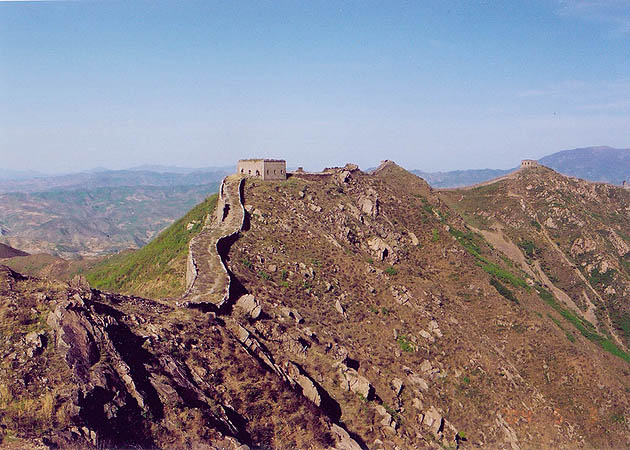
A section of the Great Wall. [File photo] |
The reseach group believe that, while western sections of the Wall are less attractive to tourists, the structure and the cultural relics that continue to be unearthed alongside it must be preserved as crucial materials for China's historical, geographical, political, martial and cultural research.
Besides the disadvantages of geography and weather, other problems the experts encountered with the preservation of the western Wall include a lack of research personnnel and protective technology, according to Duan Qingbo, a senior researcher with Northwest University in Shaanxi province.
Duan said that the dozen researchers from Dunhuang Academy tasked with taking care of the remaining sections scattered in the province are not enough.
Meanwhile, the experts suggested that awareness must be raised among local residents, as well as tourism operators, of the need to protect cultural relics.
"The protection of the ancient Great Wall sections in western China is a hard nut to crack," Duan said, adding that new systems and all-around efforts from society are needed if it is to be succesful.
Construction of the Great Wall, listed as a world cultural heritage by UNESCO in 1987, began during the reign of China's first emperor, Qin Shihuang (259-210 B.C.), to keep out foreign invaders. [ It passes through 10 provinces, municipalities and autonomous regions in northern China, including Liaoning, Hebei, Tianjin, Beijing, Shanxi, Inner Mongolia, Shaanxi, Ningxia, Gansu and Qinghai.


Go to Forum >>0 Comment(s)