Living, and coping, in the city
 0 Comment(s)
 Print
 E-mail China Daily, June 3, 2015


The rate of suicide is falling in China, and while experts attribute the decline to a number of causes, the large-scale urbanization that has taken place in recent decades is being hailed as a major factor.
|
|
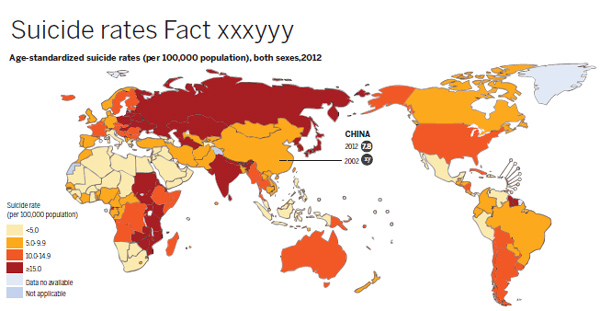
In the past three decades, many Chinese people have moved from rural areas to the cities in search of work, a process of urbanization that has helped transform China into the world's second-largest economy, providing jobs and raising the standard of living for millions of people.
Urbanization may also be responsible, at least partly, for a recent dramatic decline in the number of suicides in China, according to experts. In the past 10 years, the number of suicides has fallen so steeply that the country, which used to sit near the top of the global list, now has one of the lowest rates in the world. Many observers have attributed the decline to the sharp fall in the number of women committing suicide, especially in rural areas.
China's suicide rate fell from 19.4 per 100,000 people in 2000 to 7.8 per 100,000 in 2012, according to World Health Organization statistics. The 2000 figure was far higher than the 13 per 100,000 that WHO uses as a benchmark for countries whose suicide rate is officially classified as "high".
In 2002, Michael R. Phillips, a Canadian psychiatrist and executive director of the WHO's Suicide Prevention Center in Beijing, released a report that showed China's suicide rate had reached 0.023 percent, ranking the country among those with the world's highest suicide rates, and suicide was the leading cause of death for young adults ages 15 to 34.
Based on research conducted between 1990 and 1995, Phillips' report, which was published in the UK medical journal The Lancet, suggested that rural suicide rates were three times higher than those in urban areas, and women accounted for 25 percent more suicides than men - making China one of the few nations with that distinction.
Li Xianyun, director of the Suicide Prevention Center at the Beijing Huilongguan Hospital, believes that a steady and sizable decline in the number of suicides among women in rural areas has been a major reason for the reduction in the overall rate.
"The female suicide rate has declined remarkably since the early part of this century. In fact, it's now almost equal to that of Chinese men. The change is even more obvious in the rural areas," she said.
In 2003, the suicide rate among women in rural areas was 17.44 per 100,000 females, higher than the figure for men, which was 15.07 per 100,000 males, according to the China Year Book of Health, published by the National Health and Family Planning Commission.
In 2012 - the latest figures available from the commission - the rural rate stood at 9.09 per 100,000 for men and 8.05 per 100,000 for women.
Bucking the trend
Globally, attempted suicides among women outnumber those by men by three to one, but men have a higher rate of success, according to the WHO. However, China has been bucking that trend. "In China, women have a higher success rate because they use a very effective method - they drink pesticide," Li said.
China is the world's largest producer and consumer of pesticides. In 2013, chemical pesticide production hit 1.46 million metric tons and usage reached 967,166 tons, according to the National Bureau of Statistics.
"Before the 1990s, the sale, use and storage of toxic pesticides was not as strictly controlled as nowadays. Toxic pesticides usually cause death within just a few hours of ingestion," Li said.
In 1997, the Legislative Affairs Office of the State Council issued national regulations on production, quality control, marketing, and the use and management of pesticides.
In July 2011, the State Council announced a ban on the registration and sale of 10 types of highly toxic pesticides. A few days later, it released a draft of the revised regulations, which require local authorities to conduct reviews of all registered pesticide products and ban or limit their use in cases where there are potential risks to product safety, the environment and health.
"Many researchers believe that the ban on highly toxic pesticides has been a major contributor to the fall in the suicide rate, particularly in rural areas where they accounted for the majority of suicides," Li said.
She also attributed the decline to economic development, improved medical services and the country's rapid rate of urbanization during the past decade: "Emergency rescue services are available in many more villages nowadays, so people can be treated quickly if they take toxic pesticides. Also, people in rural areas are becoming more accustomed to urban refinements, and they have many other ways of consoling themselves if they feel depressed."
Jing Jun, a professor of sociology at Tsinghua University in Beijing who analyzes suicidal tendencies from the perspective of social influences, said the mass movement of people from villages to cities has resulted in a lower rate of suicide in rural areas.
Based on analysis of data collected between 2003 and 2012, Jing said the large number of women who moved from rural areas to cities during the period was a major factor in the decline in the number of suicides.
Mass movement
"Chinese women, especially those in rural areas, still have comparatively low social status, and are still considered inferior when it comes to certain kinds of interpersonal relations," he said.
The move to the cities has freed many women from the subordinate roles they played in village life, according to Jing. "It dispelled their feelings of desperation and prevented them from considering suicide," he said.
Li echoed Jing's view, saying that while many factors can trigger suicidal thoughts, the most common cause was "frustration with close relationships", a phrase often used as shorthand for problems in the family.
For many young women and teenagers, frustration is often the result of the breakdown of a close friendship or an unhappy love affair, she said.
In 2011, "Minnie Zhang", not her real name, a Chinese student in Australia, considered taking her own life after she had a falling out with a close friend.
"We said many harsh things to one another when we quarreled because we had a clash of personalities. I was too young to handle the depression caused by the pain of losing a friend I loved and cared for so deeply," the 24-year-old said.
The end of the friendship threw Zhang into a long-term depression and she began to lose her self-confidence. "I began to doubt everything I had done for her and I was unable to judge wrong from right about our time together. I couldn't see a way out of the mess and I wanted to die," she said.
At the time, Zhang was living in an apartment on the 19th floor of a school dormitory. At one point, she walked out on the balcony and prepared to jump. "Suddenly, I heard noises from the other room of the apartment and realized that it was my roommate, who was just 18 - two years younger than me. If I had jumped, my death would have been a nightmare for her. She was a good girl who didn't deserve that," she said.
A little later, Zhang called one of her closest friends, who persuaded her to abandon the idea. "It was a hard time for me, psychologically," she said.
Gradually, thanks to the support of friends who were enthusiastic and optimistic about the future, Zhang managed to overcome her dark thoughts and began to embrace life again.
Statistics show that 20-and 30-something adults in Beijing and Shanghai are the mostly likely to seek help if they are tempted to take their own lives.
Wang Cuiling, who works for the Beijing Suicide Prevention Hotline, said the center handles about 50 to 100 calls every day. "In most cases, the calls are from people in their 20s and 30s. Many of them are having difficulty dealing with problems between family members," she said.
The Shanghai Life Crisis Intervention Line - China's first 24-hour hotline for suicide intervention - opened in 2012, and by the end of last year, its volunteers had fielded more than 11,000 calls, most of which were made by people between 23 and 32 years old.
"In addition to white-collar workers, we are helping an increasing number of college students who are encountering problems getting along with friends or lovers. Some of the others were in the midst of strong identity crises," said Lin Kunhui, the hotline's founder. The hotline will soon expand its scope of coverage and will operate in 20 provincial capitals by the end of the year.
Art as therapy
However, intervention resources, such as hotlines and community-level mental health programs, are still rare in China's rural areas, Lin said.
The suicide prevention center in Beijing introduced an application on its website that helps people express their moods and feelings through the use of color patterns. "This daily dose of artistic pleasure may help people in the rural areas who are unable to receive direct help from medical professionals, and it may also help those who are willing to disperse the dark thoughts by their own efforts," Li said.
Developed by a research group at the Human Computer Interacting Institute at Carnegie Mellon University in the United States, the app, called MoodJam, helps users to keep a record of their mental state by rendering different moods via strips of color.
"You can learn about the trends and colors you associate with specific moods, and you can share your moods with friends, family and others who matter to you. It's an effective form of emotional release," Li said.
In an attempt to formulate effective intervention methods, the center has also initiated a number of research programs to study factors that can influence the suicide rate. However, it will be several years before the results are known.
Meanwhile, despite the decrease in the suicide rate, the great challenge is to ensure that the decline continues and that potential suicides are given help as quickly as possible, according to Li. "Early intervention is crucial."


Go to Forum >>0 Comment(s)