Ex-US Treasury chief in china to promote ties
- By He Shan
 0 Comment(s)
 Print
 E-mail China.org.cn, June 9, 2015


 |
|
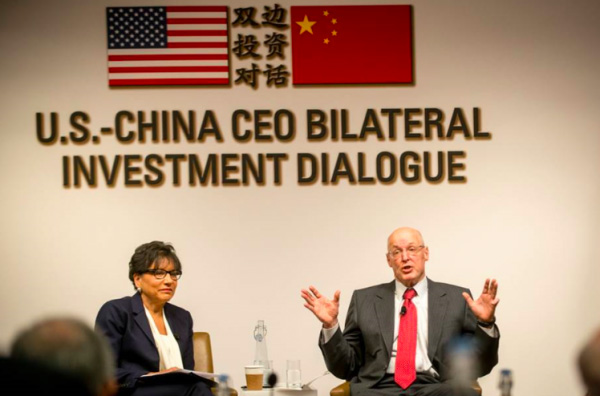
Henry Paulson, founder of the Paulson Institute, speaks at the U.S.-China CEO Bilateral Investment Dialogue. [File photo] |
Henry Paulson, founder of the Paulson Institute and former U.S. Treasury chief, witnessed the signing of an agreement on a national park system between China and the United States during his visit to China. His tight schedule in China from Monday to Thursday will also place a big focus on a number of topics concerning China-U.S. relations.
Learning from the U.S. national park system
The Paulson Institute and the National Development and Reform Commission (NDRC) on Monday inked an agreement to cooperate on a national park system for China over the next three years.
The pilot program, which will run until the end of 2017, will establish trial national park systems in nine regions in China.
China only has a handful of national parks in places such as Heilongjiang and Zhejiang provinces. Although some scenic areas claim to be national parks, they are actually conservation areas.
"China has rich ecological diversity and very beautiful wild places left," Paulson said. "The key really is for the government to come in to protect these areas.”
He said national parks can be a source of national pride, and can at the same time preserve great natural resources.
"Once people destroy them, they go forever," he said. "It is a matter of protecting them for Chinese people, because they are part of Chinese heritage.”
In China, the Paulson Institute has been working with leading conservation organizations and multinational enterprises on a number of conservation programs.
'Essential for our two countries to work together'
Paulson's visit comes amid tensions between the world's two largest economies stoked by a spate of unhappy confrontations over the issues such as the South China Sea and cyber attack allegations.
The former treasury secretary pointed that the U.S.-China relationship is the most important bilateral relationship in the world, because as people think about major global issues, they will be easier to solve when the two countries work together.
Paulson recently published his new book, "Dealing with China," in which he addresses the topic of China-U.S. relations.
He said two things came out as he promoted the book in the United States. The first is that American people are very interested in the topic, and the second is that there is not a good understanding on the part of American public.
"We clearly need more dialogues, and leadership at all levels," he said.
"When I last met President Xi, he made a very important point that it is very important to maintain the positive momentum of U.S.-China relations."
Chinese President Xi Jinping will pay an official visit to the United States in September, and is expected to discuss a wide range of topics including trade, cyber security and climate change.
Commenting on the forthcoming visit, Paulson assumed that it will be more challenging and even more important than previous visits, because the relationship has become more complicated.
He explained that the U.S. presidential election brings out tendency among leaders running for office to blame U.S. economic issues on other countries.
He added there are also some complicated issues that are very difficult to resolve, so it is very important that while Xi is in the United States, he helps the U.S. public understand China's aspiration and the aspirations of the Chinese people, as well as the shared vision of prosperity between the two countries.
He anticipated that some important agreements will be announced, so both countries will see the importance in the value of the relationship.
BIT to enter most difficult phase
The prolonged negotiation for the Sino-U.S. Bilateral Investment Treaty is set to complete its most difficult phase after China gave the U.S. its proposal on a negative list recently.
"The most difficult part is the negative list, and now the key will be making the list as small as possible," Paulson said, adding that it will not easy to get it down, and it will take a lot of political will.
He mentioned that China agreeing to publish the negative list was a positive change.
He believed the treaty will be a really important agreement, since there are huge advantages for each side in getting it down.
"I hope the leaders will use their meeting [in September] as an opportunity to make a lot of progress on the BIT and give us some good news," he said.


Go to Forum >>0 Comment(s)