Surrogate mothers 'illegal' in China
- By Zhang Rui
 0 Comment(s)
 Print
Print E-mail China.org.cn, December 8, 2015


At the first Sino-European Forum on Human Rights, held in Strasbourg, France on Friday, Chinese experts have explained that surrogate mothers are now "illegal" in China while European experts expressed that the concept is also very difficult to define in Europe.
|
|
| Xia Yinlan, professor of the China University of Political Science and Law and President of the China Marriage and Family Law Society, gives a presentation concerning how to protect children's best interests at the first Sino-European Forum on Human Rights held in Strasbourg, France on Dec. 4, 2015. [Photo by Zhang Rui/China.org.cn] |
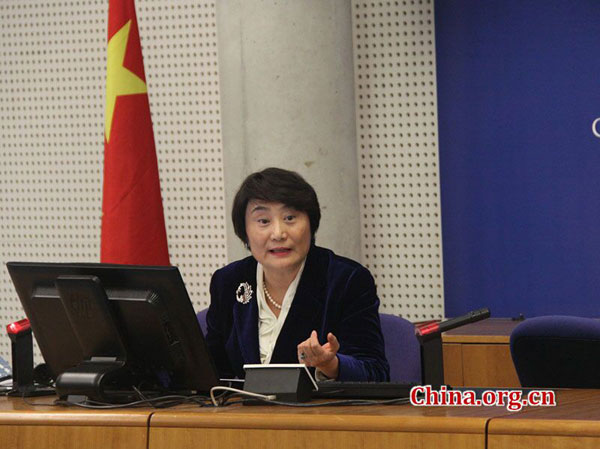
Xia Yinlan, a professor at the China University of Political Science and Law and president of the China Marriage and Family Law Society, said that China has been discussing the issue and there is no clear legal definition in China.
"According to current laws, it's illegal," Xia said, "and because it involves money and trade, it violates ethics and morals and also violates a mother's dignity."
The practice of surrogate mothers is also a means of human trafficking, said Professor Liu Huawen, vice director and general secretary of the Center for Human Rights Studies at China's Academy of Social Sciences.
However, for those couples who cannot give birth but have a desire to have children, "it is an area we are exploring and debating, and it may be resolved in the future," she said.
Isabelle Lenger, member of the Bar Council of Strasbourg, also said that the practice of surrogate mothers is involved with ethics and belongs to private areas, so it is very hard to define.
The topic of surrogate mothers came out when they discussed how to maintain and protect children's best interests no matter whether their parents are married or divorced.
"While dealing with the issues involving children's interests, we should give priority to children's interests rather than other interests, such as social interests and the family's interests," Xia said.
Chinese law explicitly stipulates that "parents or other guardians shall create a good and harmonious family environment and fulfill the duty of guardianship and support for children in accordance with the law." It is stipulated that parents have obligations to bring up, educate, live with young children and listen to their opinions.
"China will set up a single chapter about parent-child relationship when revising the existing Marriage Law to stipulate children's rights in their families and parental responsibilities," Xia said, going on to say that "China's Marriage Law, passed in 1950, explicitly takes the parent-child relationship as Chapter 4, highlighting the importance of the parent-child relationship. The Marriage Law's 1980 version combines the parent-child relationship with the conjugal relationship as family relations and places the grandparent-grandchild relationship and sibling relationship into family relations. The legislative goal was to enlarge family relations adjusted by the law, but the importance of the parent-child relationship was weakened. The Marriage Law of the 2001 version hasn't made any revision on the contents of this part."
Chinese and European scholars together with judges exchanged views and shared respective statistics from both sides on various issues ranging from the illegal use of child labor, child trafficking, child pornography, child prostitution, juvenile crimes and court systems to education for children. The forum was jointly held by the European Court of Human Rights, the University of Strasbourg, China's Society for Human Rights Studies and the International Institute of Human Rights.


Go to Forum >>0 Comment(s)