China's anti-graft campaign spreads to universities
- By Zhang Lulu
 0 Comment(s)
 Print
 E-mail China.org.cn, December 25, 2015


China's massive anti-corruption campaign, which has been mainly targeting Communist Party and government officials, has spilled over into other sectors, including finance and State-owned enterprises. Now, the drive is being extended to universities and academics, with several inspection teams from the Ministry of Education sent to a number of universities in the past two years.
 |
|
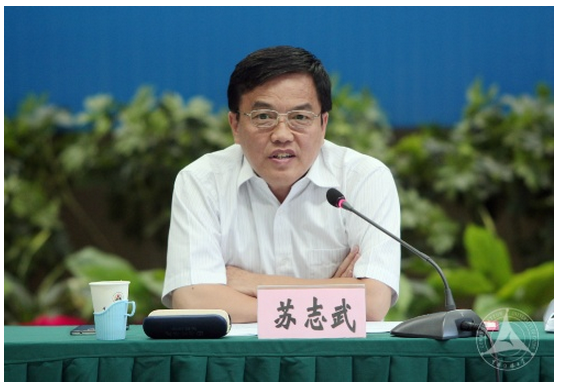
Su Zhiwu, president of the Communication University of China, was removed from his post for misusing public vehicles, using public funds on banquets and gifts, and failing to apply the Party's austerity rules in the university's management. |
According to China Economic Weekly, a total of 56 universities and 83 school officials have been investigated for wrongdoing since 2014; 17 of the institutions are national key universities. Meanwhile, according to data obtained by China News Week, a total of 108 university officials were investigated in the past two years.
Corruption in recruitment, infrastructure projects and research funds
In a meeting held in late 2014, Vice Education Minister Lu Xin revealed that corruption cases in infrastructure construction projects accounted for 24 percent of all crimes detected in the education sector in 2012.
"The infrastructure construction department enjoys most resources in universities and is most prone to corruption," said Bie Dunrong, a professor with Xiamen University.
This often means the construction of new school buildings or the renovation of existing ones, such dormitories or other facilities, which are often seen in Chinese universities undergoing expansion in student numbers.
An Xiaoyu, former vice president of Sichuan University, a key university in southwestern China, was found guilty of receiving illegal money totaling more than US$500,000 during the bidding and construction process of campus projects. He was in charge of the university's planning and new campus construction programs before being investigated. In May this year, he was punished with what China calls "double expulsion" meaning expulsion from the CPC and removal from his university posts.
Apart from construction projects, student recruitment is also a hotbed of corruption in universities. Under the current system, a few students can get into universities without taking the country's fiercely competitive national college entrance exams. Cai Rongsheng, the former officer responsible for student recruitment at Renmin University, one of the country's most prestigious universities, was accused of offering help to 44 students in their recruitment and received a total of 23.3 million yuan (US$3.6 million) for doing so.
Research funding is yet another source of corruption. Since 2013, the Ministry of Education has carried out investigations on the usage of research funds among various universities. In 2014, Chen Yingxu, a professor at eastern China's Zhejiang University, was accused of transferring research funds worth 9.45 million yuan (US$1.46 million) to his own company. He was sentenced to 10 years in prison.
Similar cases occurred in Beijing University of Posts and Telecommunications, Beijing University of Chinese Medicine, and Shandong University, all key universities in China.
In addition to corruption cases, behavior going against the CPC's frugality rules is also being punished. In November this year, eight top officials of the Communication University of China -- including the university's Party secretary and president -- were given disciplinary warnings or other punishments for owning expensive cars and sumptuous offices, and trying to cover up the university's "chaotic" financial management.
"The anti-graft campaign in the education sector is becoming more and more intense. It is not only aimed at investigating corruption cases, but also enhancing integrity among university officials," said Wang Yukai, a professor at the Chinese Academy of Governance.
The way out?
Experts believe the increasing number of corruption cases reveals problems in the management system in Chinese universities. Under the current system, top officials have a big say not only on administrative issues, but on academic matters as well.
"Supervision within universities must be enhanced: professors, staff and students should be allowed to play their role in the university power system," said Zhuang Deshui, a professor studying anti-corruption at Peking University.
Others believe that, instead of relying on the investigation by the fearsome inspection teams and supervision within campuses, the fundamental way out is to reform the current power structure of universities and establish a "modern university system." For instance, university officials should only be responsible for administrative matters and stay away from academic issues, or what China calls "de-administration."
Though the country has called for the establishment of a "modern university system" back in 2010, the system is unlikely to be built in short time among the 2,491 universities and 2.29 million teaching and administrative staff in China.


Go to Forum >>0 Comment(s)