Speculation about China squashed during Xi's term
 0 Comment(s)
 Print
 E-mail Chinadaily.com.cn, January 28, 2016


China is already the world's second largest economy and any move will be the focus for the entire international community.
 |
|
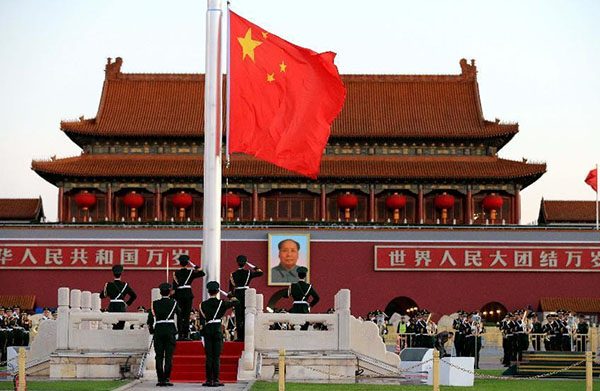
A national flag-raising ceremony is held at the Tiananmen Square to mark the 66th anniversary of the founding of the People's Republic of China on the National Day in Beijing, Oct 1, 2015. [Photo/Xinhua] |
Over the years, there have been rumors and speculation about China, such as China's economic breakdown or "China threat" theory. But many have proved wrong.
Here we take a look at some rumors that have been squashed during President Xi Jinping's governance in the past three years.
Rumor quashed – the collapse of China's Economy
Will 2016 Bring the Collapse of China's Economy? is an article by Gordon G. Chang published by National Interest magazine in December that sparked a lot of debate.
Chang had written a book in 2001, making a prophecy that China's economy would break down.
Over the past year, whenever China was undergoing a period of economic transformation, theories of China's financial collapse would gain ground. And it is still the same case this time.
China has been committing to reconstructing its economy since 2013 and shift more attention to the quality of economic growth, which dropped naturally in the process.
But it also offered space for the spread of collapse of China's economy again. The slump in China's stock market made such voices even more clamorous.
Despite such clamor, Xi repeatedly said: "China's economic growth is at a reasonable level and there will be no hard landing".
China's GDP growth slowed to a 25-year low of 6.9 percent in 2015. But China's economy is still developing well if we take a look at the whole picture.
First of all, GDP growth is still at a reasonable pace around 7 percent. Furthermore, more new jobs were created in the period and resident income also saw relatively rapid growth.
Second, China's industrial structure is further improved. The service sector contributed more than 50 percent of GDP growth, which explains why the country's electricity and coal consumption dropped. So it's totally baseless to assess China's economic development according to electricity and coal consumption.
Finally, China's economic transformation gained momentum. The central government's policy of encouraging development of new industries offered more impetus to the economy. Online retail sales increased more than 30 percent in last year.
China does not blindly seek rapid economic growth, but wants to improve its economic structure under reasonable conditions. This kind of medium- and high-speed growth is still considerable and will continue to be a major source of power for the world's economy.
Rumor quashed - China's threat theory
With the growth of China's economic and military power, an argument about China's so called threat to the world came up. Such a theory, after showing up in countries such as the US and Japan in the post-Cold War era, gradually expanded into cyberspace, food security and environment protection in recent years.
However, it has been China's consistent policy to never seek hegemony and expansion. China has actively worked on solutions to international affairs and issues.
During Xi's speech addressing the general debate at the 70th session of the UN General Assembly on Sept 28, he announced that China will establish a $1 billion China-UN Peace and Development Fund to support the UN's multilateral cooperation and boost world peace.
China also has been playing a positive role in issues of Iran, North Korea and climate change.
The country launched the "community of common destiny" initiative as a major idea to tackle international relations and establish a humanitarian community free of war and conflict to achieve development and common prosperity for all mankind.
The Asian Infrastructure Investment Bank (AIIB), a China-initiated multilateral bank, began operations this month, marking a milestone in the reform of global economic governance system.
Since its introduction by Xi in 2013, the Belt and Road Initiative (the Silk Road Economic Belt and the 21st Century Maritime Silk Road) - an ambitious plan to revitalize the ancient Silk Road overland and maritime trade routes linking East and West - has attracted considerable attention.
The project, which involves more than 60 countries and quite a few international organizations, implies unprecedented opportunities.
Over the past three years, China's actions tell the world that it's a responsible country that pursues a policy of bringing harmony, security and prosperity to other countries and of building good-neighborly relationship and partnership with the neighboring countries.
Rumor quashed - Failure of China's mode of development
China's mode of development has been doubted by some people since the founding of the People's Republic of China 60 years ago. Whenever there is some political or economic fluctuation in China, there will be people publicly peddling the "downfall of China's path."
In the past three years, such prophecies were crushed again as "the Chinese dream" unveiled by Xi won support from people across the country and has become a major guiding ideology and governing idea.
Faced with the doubt of some people towards its system, China sticks to its socialist core values and people's faith in the country's independent "path, theory and system" should be further boosted
In 2014, Xi launched the "Four Comprehensives" strategic blueprint. The theory refers to "comprehensively" building a moderately prosperous society, deepening reform, governing the country according to law and enforcing strict party discipline.
The "Four Comprehensives" is now a guide of action to realize "the Chinese dream".
Looking back at the three years of Xi's governance, China's status as a great power was completely established and people's faith in the country's path and system were further strengthened.
The theories of "China's threat, fail or collapse" were smashed by China's development and adherence to its path and system.


Go to Forum >>0 Comment(s)