The school that serves up butlers
 0 Comment(s)
 Print
 E-mail China Daily, February 1, 2016


The number of wealthy Chinese continues to rise, prompting greater demand for highly trained domestic servants.
 |
|
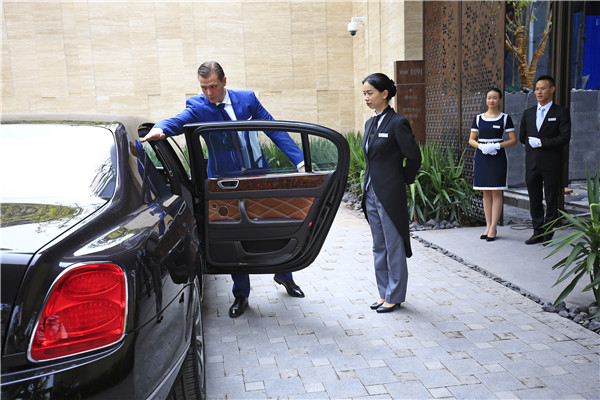
Sascha Seiler, an instructor from Germany, shows students how to greet a guest arriving by car. |
'Can a newspaper really be ironed, and what for?" asked Pei Yuchen, an office clerk at a State-owned enterprise, after reading about a school for butlers in Chengdu in the southwestern province of Sichuan. The 30-something's second question was: "Can a butler really make 1 million yuan ($152,000) a year?"
Pei, who grew up in a rural family in East China's Shandong province, is now considering quitting her job, which describes as "boring and predictable", because she believes working as a butler for a wealthy family will not only fatten her purse, but also be an eye-opening experience.
Tang Yang, public relations manager of the International Butler Academy in Chengdu, said she often received phone calls from people such as Pei, after the media reported the opening of the school, the first of its kind on the Chinese mainland, in July 2014.
The academy is affiliated to the academy headquartered in the Netherlands run by a veteran butler Robert Wennekes, who was born into a butlering family. Wennekes established the academy in 1999 in a 14th-century castle, after recognizing the great difficulty of finding high-quality, professional butlers for his clients.
As more billionaires appeared in China, Wennekes opened the Chengdu school in 2014, in cooperation with a local businesswoman in the real estate industry.
Forbes magazine's 2015 edition of the China Rich List, published on Oct 28, identified a record 335 billionaires from the Chinese mainland, second only to the United States, a rise of 93 individuals, or 38 percent year-on-year. In the past two years, China has seen about three to four new billionaires every week.
"After mansions, cars, yachts, jets and bodyguards, wealthy Chinese families need butlers. Higher-end property projects are also in a dire need of senior butlers to improve the quality of their services," said Pu Yan, the school's marketing director.
"The level of butler service directly indicates the taste of the masters. And China's new rich will pursue higher tastes of etiquette and higher-quality family life, which entails quality butler services," she added.
The Chengdu school has two teaching sites-one in a luxury villa in the city's suburbs, the other in a private club in a high-rise in an up-market residential community in the city, with a grand view of the Jinjiang River.
Owned by Wennekes' Chinese business partner, the two sites provide a real-life household environment in which to instruct students.
After paying 40,000 yuan ($6,000) in tuition fees-enough to pay for eight years of college tuition in Sichuan-the trainee butlers receive six weeks' "intensive and professional" training from instructors from the US, Italy, Switzerland, Canada, Germany and the Netherlands, in addition to three meals a day and a butler's suit.
The first few days of training are the most interesting, according to Vincenzo Matarrese, an Italian instructor and former bartender at a five-star hotel in Europe.
He said that in the first few days, the Chinese students learn to become familiar with a whole range of Western etiquette and protocols, from personal grooming to laying tables and pouring wine. He displays different kinds of grapes on the table and explains the differences between various types of wines.
"In Europe, people have an understanding of wine. But in China, that knowledge is new," he said.
Liu Kecheng, former manager of a five-star hotel and now a travel consultant for wealthy Chengdu residents, attended the training sessions through his company's cooperation with the school.
"It was the first time I learned that it takes about two hours to clean a pair of shoes through 12 procedures. I realized how considerate, meticulous and good at handling multiple tasks a successful butler should be," Liu said. "It's life-changing experience, because the training not only gives me new status, but also a new angle to see hospitality work."
Cultural differences
Christopher Noble, an Ohioan who is director of training at the Chengdu school, graduated from the academy in the Netherlands in 2012. He said China was one of the first civilizations in history to have butlers, called guanjia, or "housekeeper".
"What we are reintroducing here already existed for hundreds of years," he said.
But the cultural differences between the West and China constitute a major obstacle for the instructors.
Noble, who worked as a consultant and a trainer for salespeople in the expensive residential community where the club is located before he joined the academy, has noticed that there are many differences between serving a Western employer and a Chinese one.
"Chinese businessmen and businesswomen tend to hold their household staff at arm's length. In the West, they give the butlers trust and the butlers are in the inner circle. Butlers sometimes even know more about their masters than the other family members do," he said. "I should know everything about you, and your personal life, not because I am nosy, because the knowledge can help me better serve you."
Although the Chengdu academy instructs trainees in Western standards, most of the students have to adapt to the practical circumstances in their future Chinese principals' homes.
Noble said it is unfortunate that servants are looked down upon in traditional Chinese culture: "It's a career, and there should be mutual respect between the butler and the employer."
Tang, the public relations manager, is optimistic that the relationship between butlers and employers is likely to improve gradually, as China becomes more open to other cultures.
"That the TV series Downton Abbey is popular on the Internet with Chinese audiences, especially the young who are fluent in English, proves that there is a lot of space for British-style butler services among Chinese employers, and their attitudes to servants will change gradually," said Tang.
Although the tuition fees are expensive, the school attracts many Chinese lured by the potential of a high salary.
He Lianping, a 51-year-old babysitter from Henan province, paid the fees for the expensive training sessions herself. "I felt I would have been left behind by the times if I continued to work as a babysitter like before," she said, as an explanation of why she traveled from Henan province to Chengdu.
So far, about 40 four-term Chinese students have graduated from the academy. A new term for 10 students will start in early March, and places have been booked until early winter, according to the school's website.
Tang hopes the school will be able to open more branches in the next five years, in Beijing, Shanghai or Guangzhou in Guangdong province. "Most of the potential employers of our trainees are concentrated in big cities in East China," she said.
So far, the academy has not undertaken any advertising campaigns in China, she said, adding that apart from some trainees from its partner hotels and real estate sales centers, most candidates contact the school directly.
She said many of the candidates are quite young: "Some are college graduates, accompanied by their parents, who look forward to having a well-paid job as a butler."
However, the students' youth may be a disadvantage at times. "Chinese employers tend to look for more experienced butlers, older than 30, but our trainees are all in their mid-20s," Tang said.
She recently received a call from a wealthy businessman in Fujian province. "He had heard of our school and was looking for an experienced, veteran butler in his mid-30s or older to look after his two villas and large family. But our trainees are all in their mid 20s and did not meet his requirements," she said.
In addition, the media have exaggerated butlers' income and downplayed their sacrifices, she added" "A high salary comes from good service, and good service originates from a heart that values loyalty, passion and patience."


Go to Forum >>0 Comment(s)