By Lisa Carducci
Wu Mingzhu is a small woman who doesn't show her 77 years. She moves with short, quick steps and speaks with a modulated voice of contained passion. She has an accent from the south. Who would have said that the melons that I have enjoyed since my arrival in Xinjiang were because of her!
Wu normally did not like to be interviewed, and she will speak about herself only if she is obliged to. That time, she willingly accepted my interview with the hope it could attract the interest of other countries to take up her cause – that of the Turpan melon. She asked that I go to her work place before 8:00, because the temperature was unbearable between 11:00 and 17:00. It was 45ºC in Turfan on my arrival the day before; the morning of the interview, the sky was heavy, but as precipitations reach only 18 mm per year, I knew it would probably not rain.
|
|
|
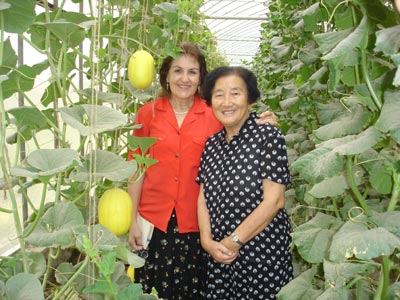
Lisa(L) and Wu Mingzhu(R) [Foreign Languages Press]
|
I thus found Wu Mingzhu already busy, under an immense metal structure with a pergola as a roof, choosing the melons that would be served at the end of the interview. When I started to ask her questions, she dismissed her staff so that we could speak in quieter surroundings.
Wu Mingzhu was born in 1930 in Wuhan, Hubei Province, to a father, a professor of English, and a mother, a nurse. Her only brother also became a teacher within the army. Her family lived in Nanjing, Jiangsu Province.
Agriculture as a subject of study was her own choice because, she said, her health was poor. Her father would have preferred for her to go into engineering as she did very well in mathematics. At the age of 23, she earned her diploma from the Southwest Institute of Agriculture. In the 1930s, the Japanese invaded China and a large part of the population moved to flee from them. This is also what Wu Mingzhu's family did; they moved to Sichuan. When the danger was over, they went back to Nanjing, but Wu returned to Chongqing for her higher education.
Her four years of university left indelible marks. First, she learned from a Japanese professor that she herself should do one more step every day. All the students received 20 sq m of land that they should plough, sow, fatten, weed, and sprinkle themselves. "I do not have any merit," she said, "all my comrades cultivated this same spirit." Second, she was always imbued with the leitmotiv "to serve the people" (wei renmin fuwu). Twice she took part in a revolutionary campaign of agriculture. "We had to go to each family and help the household to achieve a task within a fixed time."
Punctuality was an essential quality to become a member of the Party. Her teachers inculcated the idea of serving the people in the students, and Wu was so convinced of the importance of this point that she wrote in her diary, at the age of 21, that "this is the most beautiful thing in the world." Ever since childhood she wished to work in the countryside. At the end of her studies, the Institute proposed that the students choose areas of difficulty such as Yunnan, Guizhou, Sichuan, and 90 percent of them did it voluntarily. "Nobody was obliged to choose misery," she specified, "but it was to Xinjiang that I wanted to go, and my choice was accepted."
Not immediately, however. Wu first worked 10 months in Sichuan, then in Beijing for the Department of Rural Work of the CPC Central Committee for one and a half years. But it was very removed from her specialty and she did not intend to keep on doing clerical work. She wanted to exercise her skills on the ground in her specialty. In 1955, Xinjiang needed experts, mostly in agriculture, and this was the chance for Wu. The black-braided girl spent 15 days in a truck to reach Urumqi. There, she had to wait for her turn to be sent to Turpan and work the soil with her own hands.
The adaptation period did not prove to be easy but it was possible, since, 50 years later, Wu Mingzhu is still in the Turpan countryside, 183 km southeast of Urumqi.
The first difficulty lay in daily life. Wu had never eaten mutton meat and could not stand its smell. In Turpan, largely populated with Uyghurs and where she ate with the peasants, she had no choice. The first time, her stomach could not help rejecting what was imposed on it, and Wu cried. But she finally adapted and today she prefers mutton to pork. For sleeping, people lay down side-by-side on a large kang – a bed made of bricks heated by pipes passing underneath. She was given the best place, as an honoured guest, where the heat was most intense. "But it was also, by that fact, the place where fleas were more numerous," Wu remembered in a burst of laughter, adding that today, these people have much more comfortable houses than hers.
As for work, if the peasants cultivated corn, Wu had to help them and had no time left for her own research on melons. One day, after the harvest of the sorghum, her whole body ached so much that she could not move.
Heat was another major problem. Wu once harvested cotton at 48.1ºC. In Turpan, the mercury passes 40ºC 40 days a year. In 1958, while carrying her first child, Wu worked in the vineyards under such a heat wave, she remembered. There was no resting for the mother-to-be. In the evening, by the gleam of a candle, she could finally open her books and devote herself to her studies, at the cost of necessary sleep. In 1960, she walked for two days to find the ideal sweet melon, a hongxincui, which would become the ancestor of the favourite Turpan melon – a deep orange with firm and tender flesh. The temperature of the ground was then 81 degrees. Very happy with her discovery, Wu consumed the melon on the spot; it was enough to keep the seeds.
Fourth difficulty: language. Living among Uyghurs, Wu had to gradually learn their language. In the beginning, because of her bad pronunciation, when one asked her the time and she answered, for example, "Nine o'clock," they all made fun of her. What she had said was something like "nine men." However, the Uyghurs quickly adopted her and gave her a name with a touch of tenderness: Ayimuhan (Moon Girl).
